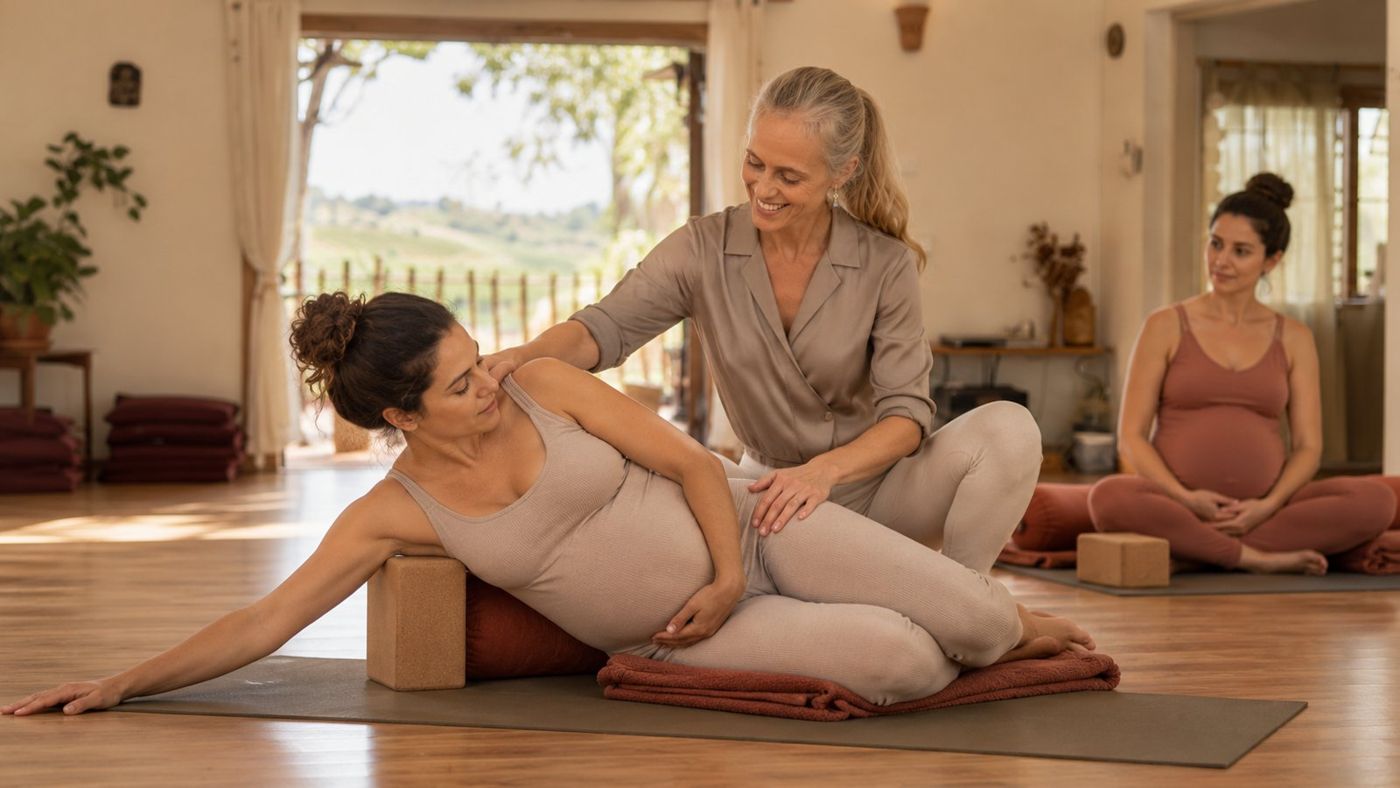
- Relaxation, yoga and music may ease labor pain and help some women feel more satisfied with their pain relief. The evidence is low to very low quality.
- Walking and upright positions in the first stage of labor were linked to a shorter first stage and fewer caesareans and epidurals, with no sign of harm.
- Continuous support from one person throughout labor has some of the most consistent findings of all: more spontaneous births, less pain medication, and fewer negative feelings about the birth.
Relaxation, yoga and music during labor Evidence: low to very low
A 2018 Cochrane review looked at mind-body approaches used during labor itself: relaxation, yoga, music and mindfulness. It included 19 trials with 2,519 women, though only 15 of them (1,731 women) gave data that could be analysed.1 Breathing was not studied as a separate group; it sat inside the broader relaxation techniques.
- Relaxation lowered pain in early (latent) labor in one small trial of 40 women. In active labor, four trials found no clear difference.
- Yoga lowered pain scores and raised satisfaction with pain relief, but this came from a single trial of 66 women.
- Music lowered pain in early labor in two trials, with no clear difference in active labor.
- Mindfulness increased women's sense of control in one trial of 26 women.
None of these approaches clearly changed the chance of an assisted birth or a caesarean. Most trials had a high risk of bias, and most did not report on safety. The authors' careful conclusion: relaxation, yoga and music may have a role in reducing pain, and better trials are needed.1
Does yoga in pregnancy change the birth? Evidence: low to very low
A different question is whether practicing yoga during the months of pregnancy affects labor. A 2022 systematic review pooled 29 studies with 2,217 pregnant women.2
- In six randomized trials (472 women), labor was on average about two hours shorter in the yoga groups. The authors rated this evidence as low quality.
- Women in the yoga groups had higher odds of a normal vaginal birth, but this evidence was rated very low quality.
- Findings on pain were mixed across four small trials and could not be combined.
Every included study had a high risk of bias in at least one area. Most did not say what style of yoga was taught, and many came from a single country, which the authors noted could tilt the results toward positive findings. No adverse events were reported in any trial.2 So the signal is encouraging, but it is not yet a promise.
Moving and staying upright Evidence: mixed quality
A 2013 Cochrane review compared upright and mobile positions (walking, sitting, standing, kneeling) with lying down or reclining in the first stage of labor. It included 25 trials with 5,218 women.3
The review found no differences in the length of the second stage or in other measures of mother and baby wellbeing. The trials varied a lot in quality, their results differed widely, and most women were at low risk, so the findings apply mainly to straightforward labors.3 Even so, the authors concluded that women at low risk should be told about the benefits of upright positions and supported to use whatever positions they choose.
Someone beside you Evidence: low, but consistent
A 2017 Cochrane review looked at continuous, one-to-one support during labor, from a midwife or nurse, a doula, or a companion the woman chose herself. It drew on 26 trials with 15,858 women in 17 countries.4 Compared with usual care, women with continuous support were:
- more likely to have a spontaneous vaginal birth,
- less likely to use pain medication or to have a caesarean or instrumental birth,
- less likely to report negative feelings about the birth,
- and had slightly shorter labors, by about 40 minutes on average.
The review found no evidence of harm. Most results were rated low quality, mainly because women and staff could not be blinded to who had support. Support from a chosen family member or friend increased women's satisfaction compared with having no companion.4 In practice, this is a quiet argument for preparing your birth partner, not only yourself.
A practice to rehearse before birth
Not a method that guarantees anything. A way to make breath, sound and movement familiar, so they are easier to reach for when labor is intense. Practice a few times a week in late pregnancy, if your midwife or doctor is happy for you to stay active, and invite your birth partner to learn it with you.
- The long exhale. Sit on a ball or chair, feet wide. Breathe in through the nose for a slow count, then out through the mouth for a longer count. Let the shoulders and jaw soften on each exhale.
- Add sound. Let the out-breath become a low "ahh" or "mmm". Keep the sound deep and steady rather than high and tight. Notice how the belly and pelvic floor soften with it.
- Move with the breath. On the ball, circle or rock the hips slowly. Then try standing and swaying, or leaning forward onto a table or your partner, breathing the same way.
- Practice a "wave". Ask your partner to time about a minute. Breathe and sound through it as if it were a contraction, then rest completely. Try it in a few positions: kneeling, on all fours, side-lying.
- Rehearse the partner's role. Your partner can breathe the long exhale out loud with you, offer a hand to lean on, and remind you to drop the shoulders. Agree on a few simple words that help.
When to call the midwife or hospital
The NHS advises calling your midwife or maternity unit urgently if your waters break, if you have vaginal bleeding, if your baby is moving less than usual, if you are less than 37 weeks pregnant and think you may be in labor, if any contraction lasts longer than 2 minutes, or if you have 6 or more contractions in 10 minutes. Tell them straight away if the waters are smelly or coloured. Call for guidance when contractions come every 5 minutes or more often. If you think the baby is coming now and you have a strong urge to push, call emergency services.5 Your own maternity unit's instructions come first.
Rehearsing labor stage by stage
One pregnancy yoga course in our archive took the rehearsal a step further: a single, unhurried session that walks through labor in order, so that the body has met each stage once before the day comes. Every birth is different, and this is a menu to choose from, not a script. Practice it only if your midwife or doctor is happy for you to stay active, and stop if anything hurts.
- Early labor: stay upright and moving. Stand with the feet a little wider than the hips, sway the pelvis in slow figure-eights and hum on the exhale. Then walk slowly around the room, letting the arms swing loose. This matches the evidence above in favour of upright, mobile positions.3
- Stronger waves: lean and circle. Face a wall with one foot forward and the forearms resting on it. During a timed "wave", circle the hips and breathe out on a low sound. Between waves, stop moving and rest your forehead on your hands. The course stressed this rest as much as the effort.
- Effort without gripping. Hold a working position, such as a supported lunge or kneeling upright, for several breaths. Let the legs keep working, and look for what is tight that does not need to be: the jaw, the shoulders, the hands, the belly. Soften those on each exhale. This was the theme of a second practice in the archive, and it is the same skill a contraction asks for.
- Tiredness: come lower. Kneel on all fours or lean over a ball, chair or bed, and let the hips circle with an open "ahh". If the back aches, all fours may help.7
- The "candles" breath. As the baby's head is being born, the midwife may ask you to stop pushing and take short breaths, blowing out through the mouth.7 The course rehearsed this by imagining blowing out birthday candles one by one.
- Side-lying. Lie on your left side and hug the top knee, drawing it in a little on each exhale. Lying on your side is one of the positions offered for giving birth, and it suits a birth with an epidural too.7 In a large UK trial of first-time mothers with a low-dose epidural, lying on the side in the second stage led to more spontaneous births than staying upright, with no sign of harm.6
- Gather, then let go. In pregnancy yoga you practice lifting the pelvic floor. In birth it needs to soften fully. Practice both: a gentle lift on one exhale, then a long, low "mmm" or "ma" on the next while the pelvic floor and lips go soft. As the course put it, if you know how to gather, you know how to release.
The bottom line
The research does not offer a technique that removes labor pain, and the evidence for breathing, relaxation and yoga is still weak. But these approaches showed no sign of harm, being upright and mobile has reasonably consistent support, and having someone with you throughout labor is one of the best-studied aids we have. Practicing breath, sound and positions beforehand, together with the person who will be beside you, is a gentle and reasonable way to prepare.
Sources
- Smith CA, Levett KM, Collins CT, Armour M, Dahlen HG, Suganuma M. Relaxation techniques for pain management in labour. Cochrane Database of Systematic Reviews. 2018;3:CD009514. doi:10.1002/14651858.CD009514.pub2. Link
- Corrigan L, Moran P, McGrath N, Eustace-Cook J, Daly D. The characteristics and effectiveness of pregnancy yoga interventions: a systematic review and meta-analysis. BMC Pregnancy and Childbirth. 2022;22:250. Link
- Lawrence A, Lewis L, Hofmeyr GJ, Styles C. Maternal positions and mobility during first stage labour. Cochrane Database of Systematic Reviews. 2013;10:CD003934. doi:10.1002/14651858.CD003934.pub4. Link
- Bohren MA, Hofmeyr GJ, Sakala C, Fukuzawa RK, Cuthbert A. Continuous support for women during childbirth. Cochrane Database of Systematic Reviews. 2017;7:CD003766. doi:10.1002/14651858.CD003766.pub6. Link
- NHS. Signs that labour has begun. nhs.uk. Link
- Epidural and Position Trial Collaborative Group. Upright versus lying down position in second stage of labour in nulliparous women with low dose epidural: BUMPES randomised controlled trial. BMJ. 2017;359:j4471. doi:10.1136/bmj.j4471. Link
- NHS. The stages of labour and birth. nhs.uk. Link
This article is general information, not medical advice. Medical review: pending.