- Women's yoga is ordinary yoga reshaped around three ideas: a stable center built from the breath and the pelvic floor, a practice that changes with the cycle and with life stages, and time to notice and record what is happening.
- Some of it has solid support: the pelvic floor moves with the breath, and training it helps with leaking. Other parts, such as "balancing hormones", are tradition and hope rather than proven effect.
- Adjusting your practice to how you feel on a given day is sensible. Rigid rules for each phase of the cycle are not backed by research.
Where the idea comes from
The works in the course archive begin from the same observation. Most of what we call yoga was written down, developed and taught for centuries mainly by men, and much of the modern physical practice grew up without paying special attention to the female body. Women's yoga, as the course presents it, is not a new style of poses. It is a way of choosing and adapting familiar tools (postures, breathing, relaxation, meditation) for a body that goes through menstruation, pregnancy, birth and menopause.
The works also share a second starting point: the pressure of modern life. Work, children, aging parents, a home to run. Many describe women's yoga less as exercise and more as a regular space to stop, listen and come back to oneself in the middle of it all.
A stable center
If one idea runs through every work, it is the center. In the course's language this is mula bandha, the "root lock", described in practical terms as a gentle gathering of the pelvic floor muscles, coordinated with the breath. The course treats it as the anchor of the whole practice: gather first, then move.
The physical side of this is reasonable. Imaging studies show that the diaphragm and the pelvic floor move together as you breathe: both descend on the inhale and rise on the exhale.1 That is why the course pairs pelvic floor work with the out-breath. Training these muscles also has real evidence behind it: a Cochrane review of 31 trials found that women with stress incontinence who did pelvic floor training were far more likely to report a cure than those who did not.2
Several works add a point that is easy to miss: you also need to learn to let go. A pelvic floor that never relaxes is not a strong one. The release on the inhale matters as much as the lift on the exhale.
The course also speaks of the center in emotional terms: an inner anchor, something steady to rely on. Some works describe the pelvis as a place where memories and feelings are held. This is part of the yogic and therapeutic tradition the course draws on, and many women find it meaningful, but it is an image rather than a physiological fact.
A practice that follows the cycle
The second shared idea is that practice should change with the month. The course suggests a calmer, more grounded practice before and during the period, and a more dynamic one around ovulation, with balancing work in between. It also invites a new attitude to menstruation: a pause and a beginning rather than a nuisance to hide.
Hormones do rise and fall across the cycle, and many women notice shifts in energy, mood and sleep. But the pattern differs a great deal from woman to woman. A large review of 78 studies found that the cycle's effect on exercise performance was, on average, trivial, and the authors recommended a personal approach based on each woman's own response.3 So the useful lesson is "notice and adjust", not "follow a schedule".
The course tradition also advises not lifting the pelvis above the head during a period. There is no evidence that inversions are harmful at that time; treat this as a traditional suggestion and follow your own comfort.
Life stages
The same logic extends across a lifetime: first periods, trying to conceive, pregnancy, the months after birth, menopause and later life. Each calls for a different practice. For menopause there is some research support: a review of 13 trials found that yoga eased menopausal symptoms compared with no treatment, though against other exercise the benefit was smaller and limited to hot flushes and night sweats.4
Paying attention, and writing it down
A third tool appears in almost every work: a personal journal. Women are invited to note the day of the cycle, energy, mood, pain and what came up in practice. Over months, patterns become visible, and with them a sense of being less at the mercy of change. The course also uses images and inner listening during practice, and short pauses between poses "to let the body absorb" what happened.
A simple session in the spirit of the course
A practice idea from the course archive. Go gently, stay within comfort, and skip anything that hurts.
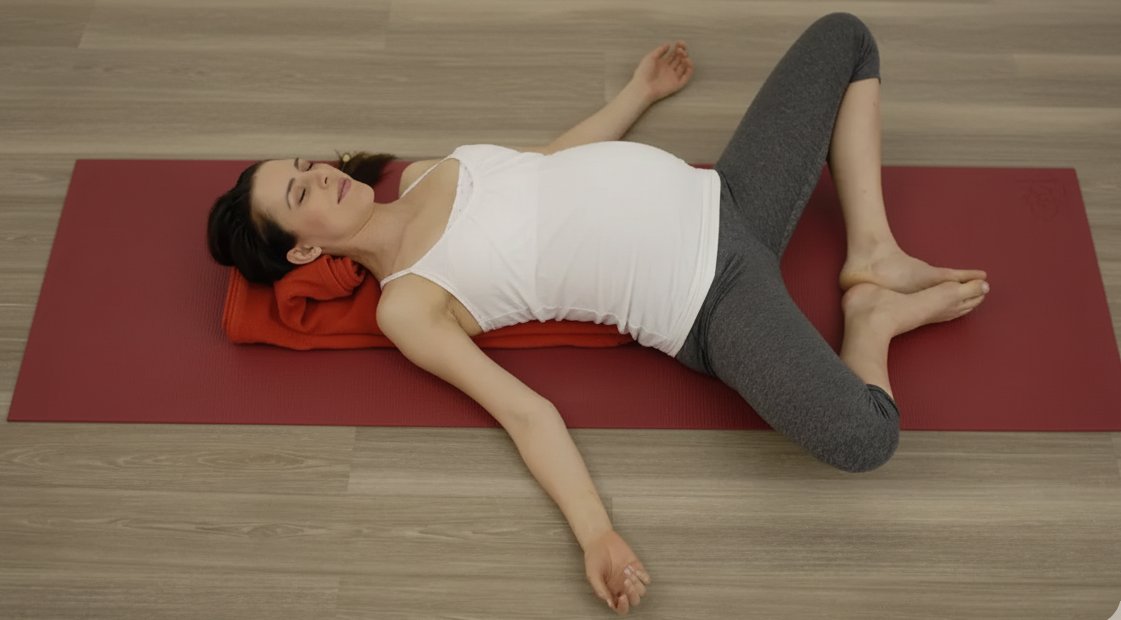
- Arrive. Lie on your back, knees bent. Let the breath settle and notice how today feels, without judging it.
- Breath and pelvic floor. As you breathe out, gently gather the pelvic floor, as if lifting it slightly. As you breathe in, let it fully release. Six to eight slow rounds. Gentle, not a squeeze.
- Warm the pelvis. Still on your back, rock the pelvis, circle the knees and let them sway side to side, waking up the lower back, hips and sacrum.
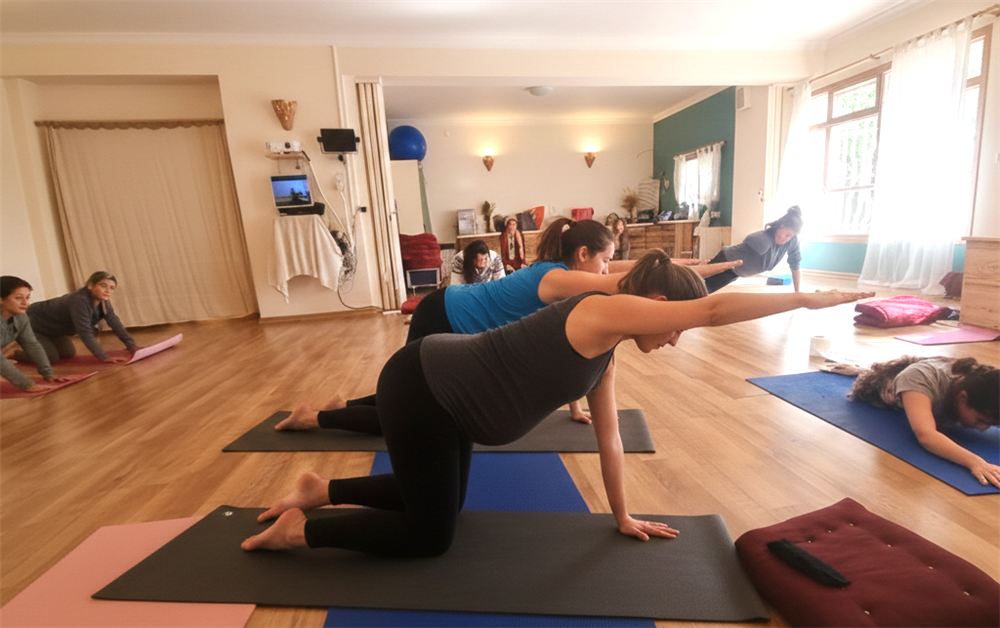
- Gather, then move. In each pose that follows, breathe out and gather lightly first, then enter the movement. Hip openers, gentle twists and a few balancing poses suit most days.
- Choose the pace for today. On low-energy days keep it slow and grounded. On days with more energy, add standing poses and a more flowing rhythm.
- Pause. Rest at the end of the exhale for a moment before the next breath, and rest between poses.
- Write a few lines. Afterwards, note the day of your cycle, your energy and anything you noticed.
Take care
Pelvic floor work should never cause pain. Do not practice it while passing urine. If you have pelvic pain, pain with sex, leaking, a feeling of heaviness, or you are pregnant or recently gave birth, a pelvic health physiotherapist can check that you are doing it right. Women's yoga can support health, but it does not treat fertility problems, autoimmune disease or other conditions; keep working with your doctor.
Where the works differ
The emphasis varies. Some works are mostly practical, centered on anatomy, the pelvic floor and safe daily movement. Others are personal or social, framing women's yoga as a way to bring together a self split between roles, and a path to confidence, creativity and sexuality. A few make broad health promises, while others say plainly that it is not a cure and does not make difficulties disappear; it offers a place to stand within them. That last, modest view is the one we share.
The bottom line
Women's yoga asks a practice to take the female body seriously: its breath and pelvic floor, its changes across the month and across life, and the inner life that comes with them. The center and the breath have good physical grounding. The cycle is real, but the right response to it is personal. Listening, adjusting and writing it down are tools anyone can start with today.
Sources and further reading
- Talasz H, Kremser C, Kofler M, Kalchschmid E, Lechleitner M, Rudisch A. Phase-locked parallel movement of diaphragm and pelvic floor during breathing and coughing: a dynamic MRI investigation in healthy females. International Urogynecology Journal. 2011;22(1):61–68. Link
- Dumoulin C, Cacciari LP, Hay-Smith EJC. Pelvic floor muscle training versus no treatment, or inactive control treatments, for urinary incontinence in women. Cochrane Database of Systematic Reviews. 2018;(10):CD005654. Link
- McNulty KL, Elliott-Sale KJ, Dolan E, et al. The effects of menstrual cycle phase on exercise performance in eumenorrheic women: a systematic review and meta-analysis. Sports Medicine. 2020;50:1813–1827. Link
- Cramer H, Peng W, Lauche R. Yoga for menopausal symptoms: a systematic review and meta-analysis. Maturitas. 2018;109:13–25. Link
Based on works from the 2011 women's yoga teacher course, reviewed and updated. General information, not medical advice. Medical review: pending.