- On average, exercise performance may be very slightly lower in the first days of a period. The effect is trivial and the evidence is low quality.
- For strength training, current reviews find no clear effect of cycle phase on strength or muscle gains.
- Fixed "phase plans" are not backed by research. Noticing your own pattern, and adjusting on the day, is a more reasonable approach.
The cycle in plain words
A menstrual cycle is counted from the first day of one period to the first day of the next. The average is 28 days, and anything from 21 to about 35 days is considered normal.1 It is usually described in four overlapping phases:1
- Menstruation. The lining of the uterus sheds. Most people bleed for three to five days, and anything from three to seven days is usually not a concern.
- The follicular phase. Starts on the first day of bleeding and lasts until ovulation. Estrogen rises and the uterine lining thickens again.
- Ovulation. An egg is released, around day 14 in a 28-day cycle.
- The luteal phase. Roughly the second half of the cycle. Progesterone rises; if there is no pregnancy, hormone levels fall and the next period begins.
"Around day 14" is an average, not a rule. Real cycles vary from person to person and from month to month, which turns out to matter a great deal for the research.
What the research says about performance Evidence: low
The most thorough look so far is a 2020 systematic review and meta-analysis in Sports Medicine. It included 78 studies of women with regular, natural cycles.2
- Pooling the data, exercise performance might be trivially reduced in the early follicular phase, roughly the days of the period, compared with the rest of the cycle.
- The difference was small, and it varied a lot between studies.
- The authors rated the quality of the evidence as low, and said general guidelines for training by phase cannot be drawn.
Their recommendation is worth quoting in spirit: take a personalised approach, based on how each woman actually responds across her own cycle.2
Strength training by phase
Many programs suggest lifting heavy in the first half of the cycle and easing off in the second. A 2023 umbrella review looked at five existing systematic reviews and meta-analyses on exactly this question.3 Its title says it plainly: current evidence shows no influence of cycle phase on acute strength or on strength and muscle gains over time.
The authors also explained why the findings so far are so mixed. Many studies assumed a textbook 28-day cycle with ovulation in the middle, rather than confirming each woman's phase with testing. Some mixed women using the pill with women who were not.3 Their conclusion: it is premature to say that monthly hormone changes meaningfully affect strength training, and programming by phase is not currently evidence-based.
"No proven effect" is not the same as "proven no effect." Better studies may still find something. But today, the confident phase calendars online go well beyond what the science shows.
What this means for a yoga practice
No study has tested yoga practice planned by cycle phase, so what follows is a reasonable interpretation of the research above, not a proven method.
If the average effect of the cycle is tiny, and the differences between women are large, then a fixed four-week plan is unlikely to fit you better than your own attention does. Some women feel heavy and tired in the first days of a period; others feel nothing at all; some feel low before the period starts. A practice that meets you where you are on the day, rather than where an app says you should be, is the simpler and more honest choice.
For a more personal take on this, see our essay A dialog with the pelvis.
Tracking as a tool, not a rule
The authors of the strength review suggest that women whose symptoms affect their training keep a record of those symptoms, so that training can be adjusted to the person.3 A simple log is enough:
- Note the first day of each period, so you can count your cycle day.
- Once a day, rate energy, mood and sleep from 1 to 5, and jot any pain, bloating or headache.
- After practice, write one line: what felt good, what did not.
- After two or three cycles, look back. If a pattern repeats, plan around it. If none appears, that is useful to know too.
A practice menu for different days
Choose by how you feel, not by the calendar. Either list can show up at any point in the cycle.
On low-energy days
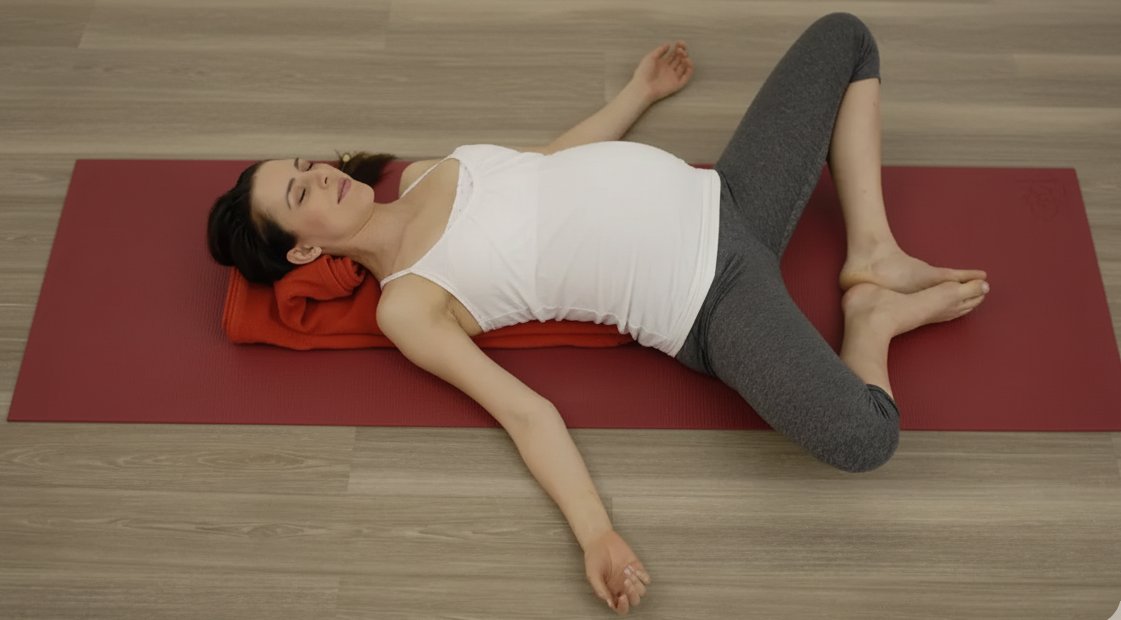
- Arrive lying down. A few minutes on your back, knees bent or supported, with slow breathing into the belly and ribs.
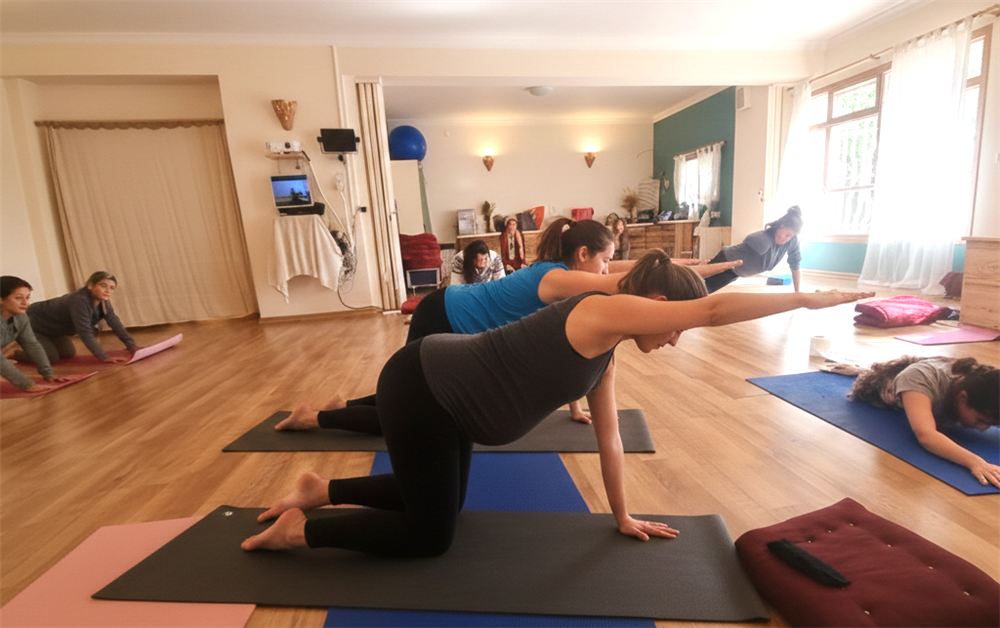
- Gentle movement. Cat and cow on hands and knees, or small pelvic tilts on your back, in time with the breath.
- Supported rest. Child's pose over a cushion, or legs resting up on a chair or a wall.
- A longer ending. Give the final relaxation more time than usual. A short practice still counts.
On high-energy days
- Warm up fully. Several rounds of sun salutations at a pace that lets you keep breathing through the nose.
- Standing strength. Warrior poses, chair pose and lunges, held a little longer than feels easy.
- Balance and core. Tree pose, plank or side plank, kept steady rather than strained.
- Come back down. Forward folds, a gentle twist, and rest. A strong practice still needs a soft landing.
When to see a doctor
Cycle symptoms are common, but some are worth checking. The NHS suggests seeing a GP if heavy periods are affecting your life, or you have had them for some time; if you have severe period pain; or if you bleed between periods or after sex.4 Signs of a heavy period include needing to change a pad or tampon every 1 to 2 hours, periods lasting more than 7 days, or passing clots larger than about 2.5cm.4 See a GP too if you have missed your period 3 times in a row, if your periods have become irregular, or if a missed period comes with other changes such as weight gain or loss, or tiredness.5
The bottom line
The cycle is real, and some women feel it strongly. But the research does not support a one-size-fits-all monthly training plan: the average effect on performance is trivial, and no clear effect has been shown for strength. The most reasonable path is the plainest one: pay attention, keep a little record, practice according to the day you are actually having, and get symptoms that worry you checked.
Sources
- Cleveland Clinic. Menstrual cycle: phases, length and what's normal. Health Library. Link
- McNulty KL, Elliott-Sale KJ, Dolan E, Swinton PA, Ansdell P, Goodall S, Thomas K, Hicks KM. The effects of menstrual cycle phase on exercise performance in eumenorrheic women: a systematic review and meta-analysis. Sports Medicine. 2020;50(10):1813–1827. Link
- Colenso-Semple LM, D'Souza AC, Elliott-Sale KJ, Phillips SM. Current evidence shows no influence of women's menstrual cycle phase on acute strength performance or adaptations to resistance exercise training. Frontiers in Sports and Active Living. 2023;5:1054542. Link
- NHS. Heavy periods. nhs.uk. Link
- NHS. Stopped or missed periods. nhs.uk. Link
This article is general information, not medical advice. Medical review: pending.