- Period pain is very common. Studies report it in anywhere from 16% to 91% of women of reproductive age, depending on how it is measured.
- Reviews of randomized trials find that regular exercise, including yoga, reduces period pain compared with doing nothing. The effect looks meaningful, but the studies are small and the evidence is rated low quality.
- In the trials, the practice was regular and spread across the month, usually for several weeks, not only on painful days. Pain that is severe, getting worse or stopping your daily life deserves a doctor's attention.
What period pain is
Period pain happens when the womb tightens during your period.5 It is usually felt as cramping in the lower belly, sometimes spreading to the back and thighs. When there is no other condition behind it, doctors call it primary dysmenorrhea. When it is caused by something else, such as endometriosis, it is called secondary dysmenorrhea. This article is about the first kind.
For many women it is a normal part of the cycle. That does not mean it is trivial. A review of 15 studies found that between 2% and 29% of women experience severe pain.1
How common is it?
Very. The same review found that the share of women of reproductive age with period pain ranged from 16% to 91% across studies. The range is wide because the studies defined and measured pain differently. Older age, having given birth and using the contraceptive pill were linked with less pain. High stress and a family history of painful periods were linked with more.1
What the trials show Evidence: low
The most careful summary is a 2019 Cochrane review of exercise for period pain.2 It gathered 12 randomized trials with 854 women. The types of exercise included gentle forms, such as stretching, core work and yoga, and more intense forms, such as aerobics and Zumba.
Compared with no exercise, women who exercised reported clearly less pain, roughly 25 millimetres less on a 100-millimetre pain scale. The authors judged this large enough to matter in daily life. They also rated the evidence as low quality: the trials were small, their results varied a lot, and women could not be blinded to whether they were exercising.2 Side effects were poorly reported, so the review could not draw conclusions about them. There was not enough evidence to say whether exercise works better or worse than anti-inflammatory painkillers.
Yoga specifically
A 2019 meta-analysis looked only at yoga. It pooled 4 randomized trials with 230 women and found that those who practiced yoga had less menstrual pain than those who did not.3 Four trials is a small base, and the range of possible effects in that analysis was wide.
A larger 2024 review compared six types of exercise across 29 trials and 1,808 participants.4 After eight weeks, every type of exercise reduced pain compared with no exercise, yoga included: about 2.75 points less on a 10-point scale. After four weeks, yoga's effect was only borderline. In that review, relaxation exercises came out ahead of the others, and yoga ranked lowest of the six at eight weeks. Those rankings rest on few trials per type, so they are better read as "all of these seem to help" than as a league table.
Put simply: moving regularly appears to ease period pain, yoga is one reasonable way to do it, and no single type of exercise has been shown to be clearly best.
How much, and how often?
This may be the most useful finding for daily life. In the Cochrane review, most trials asked women to exercise at least three times a week, for about 45 to 60 minutes each time, and the exercise was spread across the month. Some trials even asked women not to exercise during their period.2 It is not known whether shorter or less frequent sessions would work as well.
The yoga programs varied widely, from a few minutes a day to an hour three times a week.4 Most trials measured results after four to eight weeks. In other words, the benefit seen in the research came from a steady habit over weeks, not from a single session on a painful day.
A gentle practice for painful days
Not a treatment, and not tested as a sequence in any trial. A way to stay comfortable and keep moving when cramps are present. Stop anything that makes the pain sharper.
- Warmth first. Place a warm (not hot) heat pad or wrapped hot water bottle on the lower belly while you lie down. Heat and gentle exercise are both among the NHS self-help suggestions.5
- Slow breath. Lie on your back with knees bent, or on your side with a pillow between the knees. Let the exhale be longer than the inhale, letting the belly soften rather than holding it in.
- Knees to chest, one at a time. Draw one knee gently toward the chest, hold for a few breaths, then switch. Rock slowly side to side if that feels soothing.
- Child's pose, supported. Kneel and fold forward over a cushion or folded blanket, knees apart, forehead resting. Stay for a minute or two, breathing into the lower back.
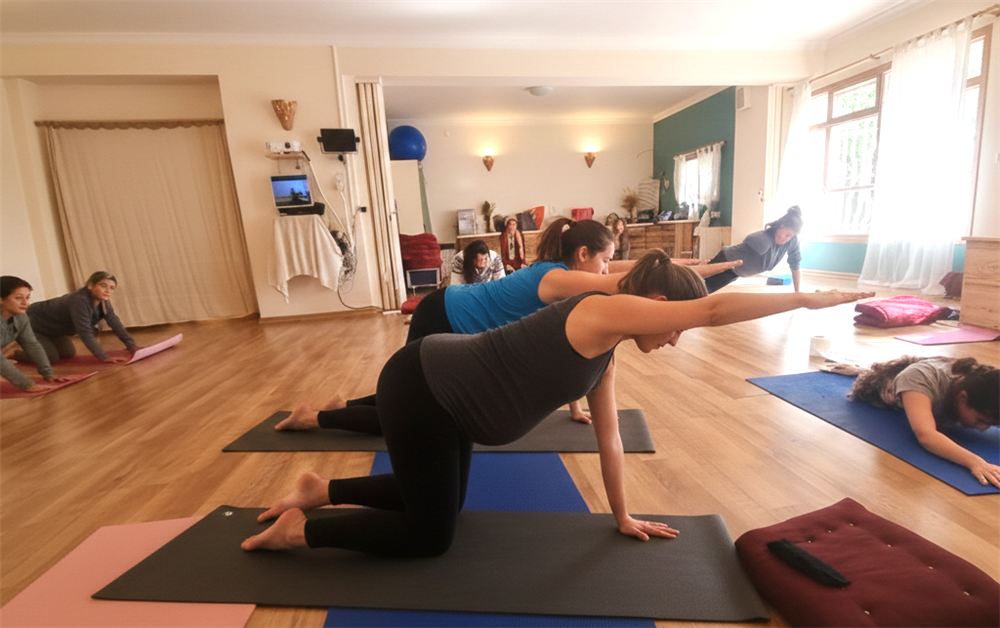
- Easy cat and cow. On hands and knees, round and arch the spine slowly with the breath. Keep the range small.
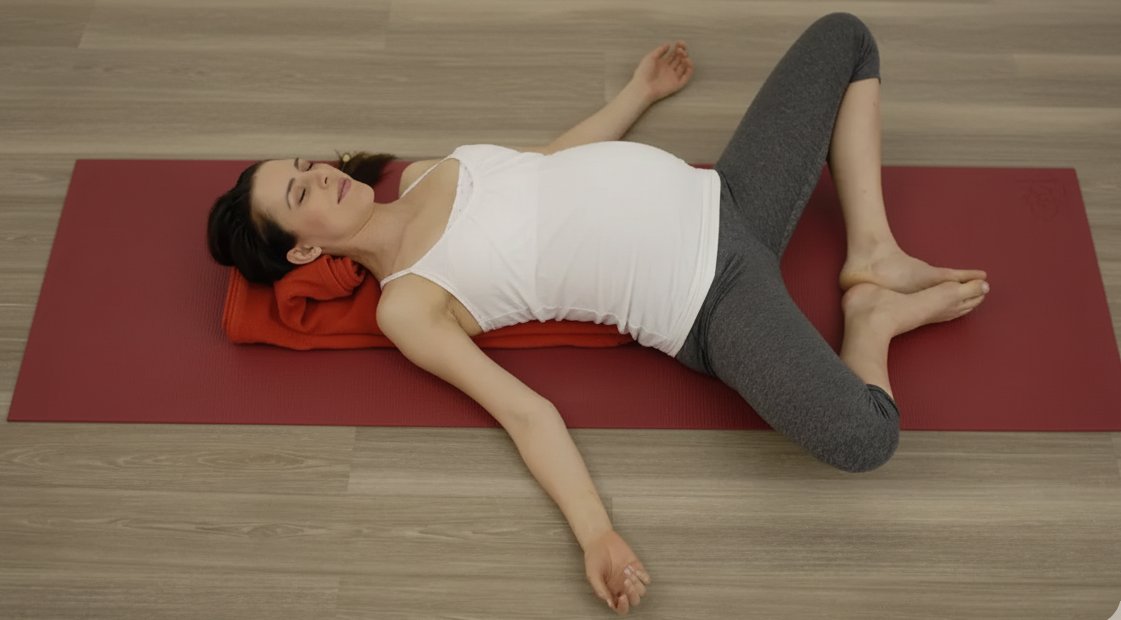
- Rest. Finish lying down, legs supported, for a few minutes. On days you feel up to more, a walk counts too.
What about "no inversions during your period"?
Many yoga traditions advise against upside-down poses, such as headstands or shoulder stands, during a period. We could not find any trial or guideline that tested this, either for harm or for benefit. The evidence is simply lacking. In practice, comfort is a sensible guide: if turning upside down feels unpleasant during your period, there is no reason to do it, and nothing in the research above depended on inversions.
When to see a doctor
The NHS advises seeing a GP if your periods become more painful, heavier or irregular, if period pain stops you doing your usual daily activities, or if you have pain during sex, bleeding between periods, or unexplained changes in bladder or bowel habits. If the pain is severe or worse than usual and painkillers have not helped, seek urgent advice.5
Painful periods can sometimes be caused by a condition such as endometriosis, adenomyosis, fibroids or pelvic inflammatory disease.5 Signs that may point to endometriosis include severe period pain that stops you from doing normal activities, very heavy periods, pain in the lower tummy or back at other times, pain when you poo or pee, pain during or after sex, and extreme tiredness.6 These are worth raising with a doctor, even if you have been told before that painful periods are normal.
The bottom line
Period pain is common, and for most women it is not a sign that something is wrong. Regular movement, including yoga, has a reasonable track record in small trials, with a benefit that looks real but rests on low-quality evidence. The trials point to a steady practice through the month over several weeks, rather than relying on painful days alone. On those days, warmth, slow breathing and gentle positions are a kind place to start. And pain that is severe, changing or getting in the way of life is a reason to see a doctor, not to push through.
Sources
- Ju H, Jones M, Mishra G. The prevalence and risk factors of dysmenorrhea. Epidemiologic Reviews. 2014;36:104–113. Link
- Armour M, Ee CC, Naidoo D, Ayati Z, Chalmers KJ, Steel KA, de Manincor MJ, Delshad E. Exercise for dysmenorrhoea. Cochrane Database of Systematic Reviews. 2019;(9):CD004142. Link
- Kim SD. Yoga for menstrual pain in primary dysmenorrhea: a meta-analysis of randomized controlled trials. Complementary Therapies in Clinical Practice. 2019;36:94–99. Link
- Tsai IC, Hsu CW, Chang CH, Lei WT, Tseng PT, Chang KV. Comparative effectiveness of different exercises for reducing pain intensity in primary dysmenorrhea: a systematic review and network meta-analysis of randomized controlled trials. Sports Medicine – Open. 2024;10:63. Link
- NHS. Period pain. Last reviewed 18 March 2026. Link
- NHS. Endometriosis: symptoms. Last reviewed 27 August 2024. Link
This article is general information, not medical advice. Medical review: pending.