- Bone loss speeds up in the years around the final period, mostly at the spine and hip. Exercise slows it, but does not stop it on its own.
- The exercise with the best evidence for bone is muscle strengthening plus some impact. The best evidence for preventing falls is balance and functional exercise.
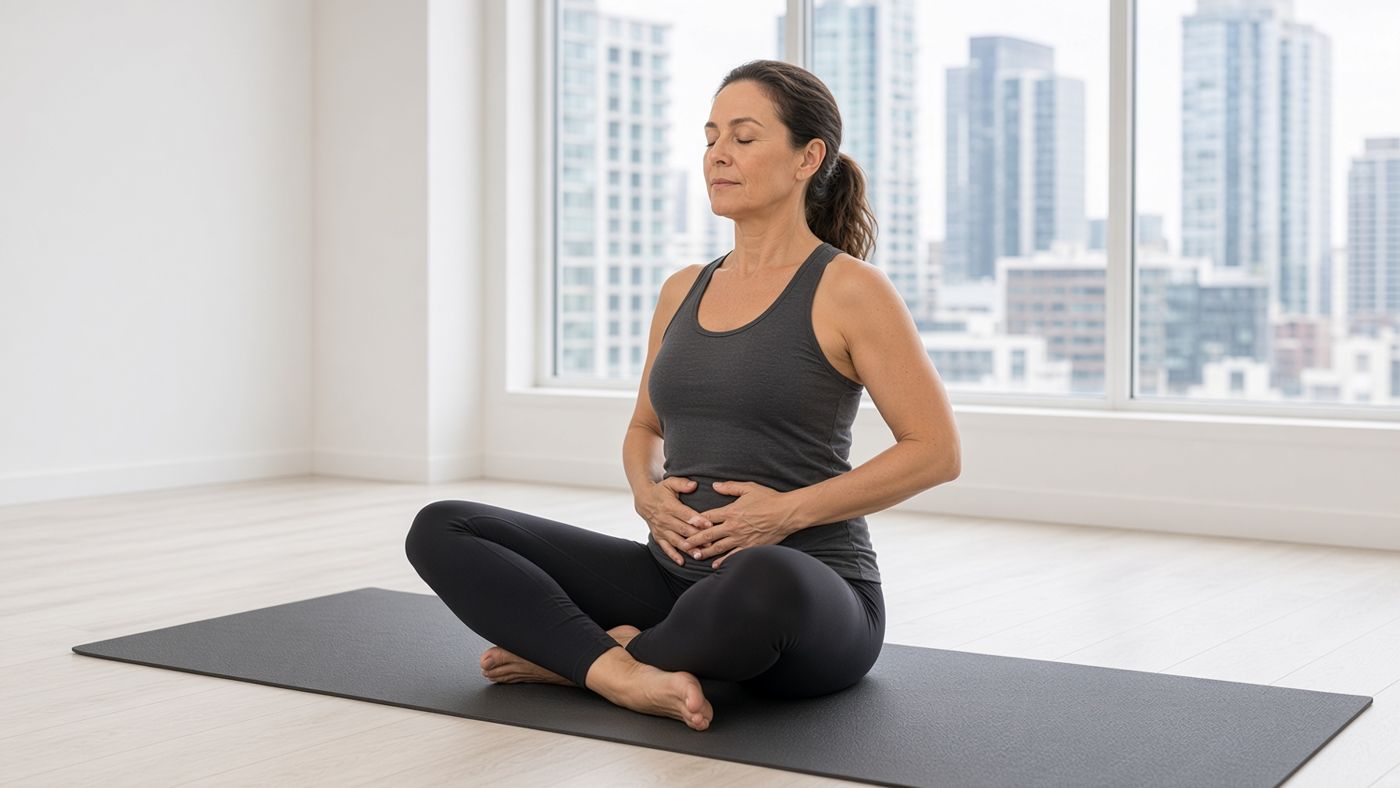
- Yoga is a good way to train balance and strength. There is no good-quality evidence yet that yoga alone builds bone, so it works best alongside heavier strength and impact work.
What happens to bone around menopause
Bone is living tissue, constantly broken down and rebuilt. Oestrogen helps keep that balance. When oestrogen falls, breakdown gets ahead of rebuilding. If you want the bigger picture of what changes and when, see Menopause, explained.
The Study of Women's Health Across the Nation (SWAN), which followed women in the US through the transition, found that little bone is lost before menopause gets close. Loss then speeds up from about a year before the final menstrual period to two years after it, before slowing again.1
These figures are averages for the White women in the study, who were the reference group. Women of other ethnic backgrounds lost bone at somewhat different rates.1
Why it matters: fractures
When bones thin enough, the condition is called osteoporosis, and the risk is broken bones. The Royal Osteoporosis Society estimates that one in two women over 50 in the UK will break a bone because of osteoporosis.2 Osteoporosis does not cause symptoms until a bone breaks, which is why many women only find out after a fall.7
A fracture usually needs two things: a bone that is fragile enough, and a fall or force that is big enough. That gives exercise two jobs. Build bone and muscle strength, and keep you steady on your feet.
What exercise helps bone? Evidence: moderate
In 2022, a UK expert group supported by the Royal Osteoporosis Society published a consensus statement called Strong, steady and straight.3 Its main advice for people with osteoporosis, or at risk of it:
- Strong: muscle strengthening exercises on 2 to 3 days a week, and brief bursts of moderate impact, such as jogging or aerobics, on most days.
- Steady: activities that improve strength and balance to reduce the risk of falls. The statement names tai chi, Pilates and yoga as examples.
- Straight: exercises that strengthen the back extensors, to help posture. It also advises avoiding postures with a high degree of forward bending of the spine.
The statement also says that physical activity has not been linked to significant harm, and that in general the benefits outweigh the risks. Where research was thin, the group used expert opinion.3
How much load is enough? The Australian LIFTMOR trial took 101 postmenopausal women with low bone mass and gave half of them 8 months of supervised, twice-weekly, high-intensity lifting and jumping. The rest did a gentle home program. The lifting group gained 2.9% in spine bone density while the gentle group lost 1.2%, and the hip showed a smaller but similar pattern. Only one minor injury was reported, a back spasm.4 This was one small study under close supervision, so it does not mean heavy lifting is safe for everyone to start alone. It does show that bone responds to real load, and that low bone mass on its own does not have to mean avoiding it.
Balance and falls Evidence: high
This is where the evidence is strongest. A 2019 Cochrane review pooled 108 trials with more than 23,000 older people living at home.5
The certainty differs. For balance and functional exercise it is high. For combined programs it is moderate, and for tai chi it is low.5 The pattern is clear, though: practise standing, stepping and shifting your weight, and you are less likely to fall.
What yoga can and cannot do Evidence: very low (bone)
You may have seen headlines saying that 12 minutes of yoga a day reverses bone loss. They come from a 2016 study by Lu, Fishman and colleagues.6 Of 741 volunteers who signed up online, 227 kept up the routine, and only 43 sent in complete bone scans from the start and the end. There was no control group: each person's bone change before the program was compared with their change during it. Spine density improved; the hip change was not statistically significant. No yoga-related serious injuries were reported.
That is an encouraging signal, not proof. People who choose to join and stick with a program are often different from those who don't, and with so few complete scans, the results could easily be off.
What yoga clearly does offer is practice in balance, strength through the legs and back, and body awareness, the "steady" part of the advice.3 What it usually lacks is the heavy load and impact that bone responds to most. And some poses ask for a lot of forward bending: deep forward folds, rolling up through the spine, full twists. If you have osteoporosis, these are the moves to change, not the whole practice.3
A practice for strength and balance
Not a treatment. A way to cover strength, balance and posture in one session, two or three times a week. Add brisk walking or other impact on other days if it suits you. If standing balance feels uncertain, chair yoga is a safe way to begin and build confidence.
- Mountain with weight shifts. Stand tall, feet hip-width. Shift your weight slowly to the front of the feet, the heels, and side to side. One minute.
- Chair pose to standing. Sit back as if onto a chair, hips hinging, back long, then stand. Hold a weight at your chest when this gets easy. Eight to ten times.
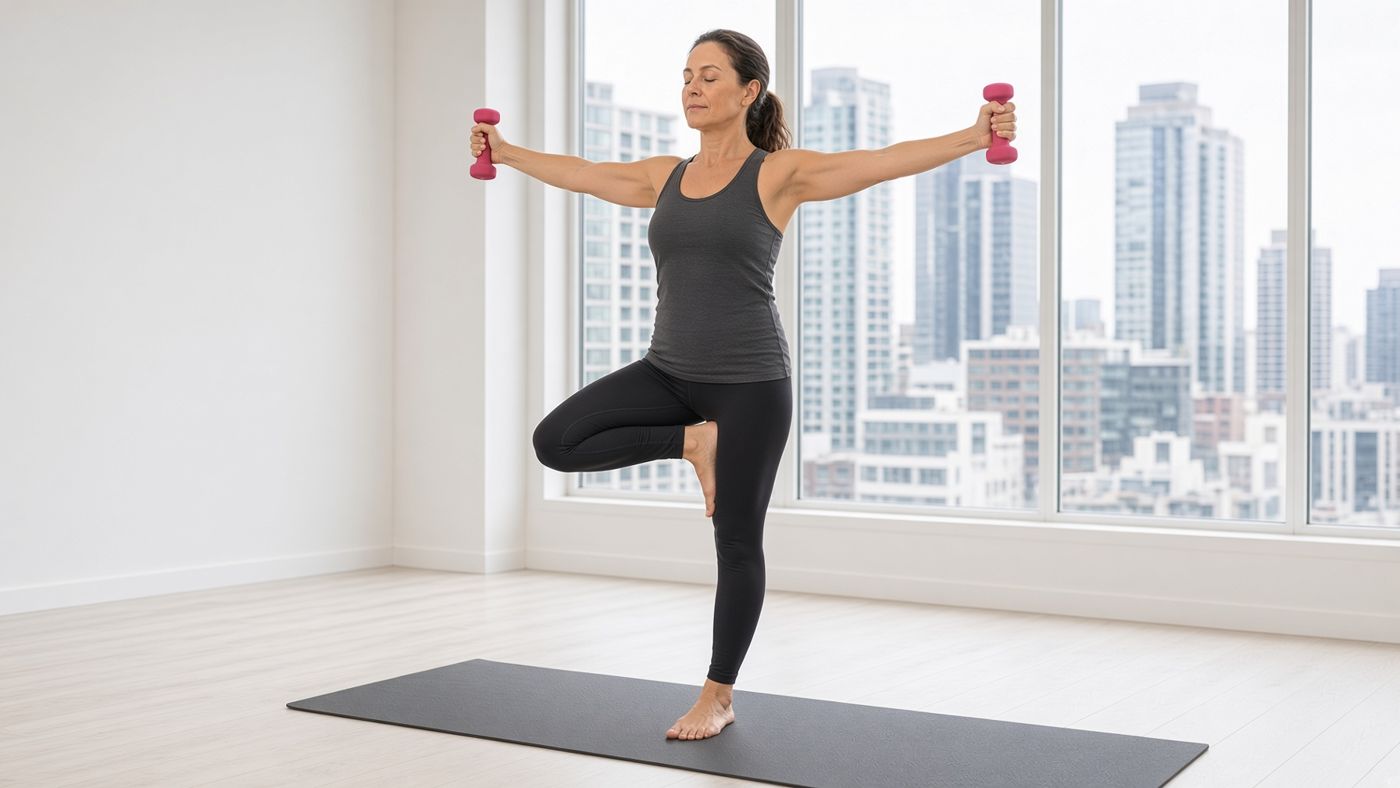
- Tree, near a wall. Lift one foot to the ankle or calf. Hold for five breaths, fingertips on the wall if needed. Both sides.
- Warrior II and step-throughs. Hold Warrior II for five breaths, then step the back foot forward to stand on one leg. Five each side.
- Locust, lying on the front. Lift the chest and arms a little off the mat, gaze down. This strengthens the back extensors, the "straight" part. Five to eight times.
- Bridge. Lift the hips, squeezing the buttocks. Eight to ten times.
- Swap the folds. In place of deep forward bends, hinge at the hips with a long back, hands on your thighs or a chair.
When to ask about a bone density scan
A bone density scan, also called a DEXA scan, is quick and painless and uses much less radiation than a standard X-ray. In the UK it may be offered to adults over 50 with a risk of osteoporosis, and to younger adults with other risk factors, such as smoking or a previous broken bone. Results are usually read alongside a fracture risk assessment.7 Ask your doctor if you have broken a bone, have a parent with osteoporosis, have taken steroid tablets, are underweight, or notice back pain or a more hunched posture. If you have already had a spinal fracture, ask for a physiotherapist's advice before starting a new exercise plan.
The bottom line
Bone loss around menopause is real and fastest in a few short years, so this is a good time to start. Lift things, add some impact if your body allows it, and train balance. Yoga is a good home for the balance and posture work, and for many women it is the practice they actually enjoy and keep doing. Just don't count on it alone to protect your bones.
Sources
- Greendale GA, Sowers M, Han W, Huang MH, Finkelstein JS, Crandall CJ, Lee JS, Karlamangla AS. Bone mineral density loss in relation to the final menstrual period in a multiethnic cohort: results from the Study of Women's Health Across the Nation (SWAN). Journal of Bone and Mineral Research. 2012;27(1):111–118. Link
- Royal Osteoporosis Society. Women's Health Strategy needs to go big on osteoporosis emergency affecting one in two women over 50. 20 July 2022. Link
- Brooke-Wavell K, Skelton DA, et al. Strong, steady and straight: UK consensus statement on physical activity and exercise for osteoporosis. British Journal of Sports Medicine. 2022;56(15):837. doi:10.1136/bjsports-2021-104634. Link
- Watson SL, Weeks BK, Weis LJ, Harding AT, Horan SA, Beck BR. High-intensity resistance and impact training improves bone mineral density and physical function in postmenopausal women with osteopenia and osteoporosis: the LIFTMOR randomized controlled trial. Journal of Bone and Mineral Research. 2018;33(2):211–220. Link
- Sherrington C, Fairhall NJ, Wallbank GK, Tiedemann A, Michaleff ZA, Howard K, Clemson L, Hopewell S, Lamb SE. Exercise for preventing falls in older people living in the community. Cochrane Database of Systematic Reviews. 2019;(1):CD012424. Link
- Lu YH, Rosner B, Chang G, Fishman LM. Twelve-minute daily yoga regimen reverses osteoporotic bone loss. Topics in Geriatric Rehabilitation. 2016;32(2):81–87. Link
- NHS. Bone density scan (DEXA scan). Link
This article is general information, not medical advice. Medical review: pending.