- Menopause is when you have not had a period for 12 months. Perimenopause is the time leading up to it, when hormone levels change and symptoms often begin.
- It usually happens between 45 and 55. Symptoms usually last for years, not months, and frequent hot flushes lasted a median of 7.4 years in one large study.
- There are effective treatments, hormonal and non-hormonal. Movement and yoga are good for you in this stage, but they are not a replacement for treatment when symptoms are hard.
The words, in order
Perimenopause is the time leading up to your last period. Periods start to change, and many symptoms begin here. It lasts about four years on average, but can last up to ten.2 It ends when you reach menopause.1
Menopause is when you have not had a period for 12 months.1 Because of that definition, you only know you have reached it looking back.
Postmenopause is simply the years after that point. You no longer have periods and cannot get pregnant.2
When does it happen?
The NHS says menopause usually happens between 45 and 55, and can happen earlier.1 The US Office on Women's Health puts the average age at 52.2
What changes in the body
Put simply, the ovaries gradually make less of two hormones, oestrogen and progesterone. Their levels fall during perimenopause, and after menopause the ovaries make very little of either.2 These hormones act on many parts of the body, not only the womb, which is why the symptoms can show up in such different places: temperature, sleep, mood, skin, joints and the vagina and bladder.
The fall is not always smooth. In perimenopause, periods can become irregular, heavier or lighter, closer together or further apart, before they stop.
Common symptoms
The NHS lists these as the main ones:1
- Changes to your periods
- Hot flushes and night sweats
- Sleep problems
- Mood changes, poor memory and brain fog
- Weight gain
- Vaginal problems, such as dryness, and urinary tract infections
- Also: headaches or migraines that are worse than usual, hair thinning, and lower sex drive
Not everyone has all of them, and they can change over time. The NHS says symptoms usually last 7 to 9 years, sometimes longer.1
The best-known study of how long hot flushes last is SWAN, which followed more than 3,300 women in the US. Among the 1,449 women who had frequent hot flushes or night sweats, the median total duration was 7.4 years. After the final period, they continued for a median of 4.5 years.4 Women whose symptoms started early, in or before early perimenopause, tended to have them the longest. If yours have gone on for years, that is common, not a sign that something is wrong with you.
Early menopause and POI
Menopause before 45 is called early menopause. Before 40, it is called premature menopause, also known as premature ovarian insufficiency (POI).3 It can run in families, and it can also follow surgery to remove the ovaries, chemotherapy or radiotherapy.3
It matters because the body loses the protection of its own hormones earlier. The NHS says it is important to replace missing hormones if menopause starts before 45, to lower the risk of bone and heart problems. The main treatments are the combined contraceptive pill or HRT.3
Treatment options, briefly
This is an overview, not advice. What suits you depends on your symptoms, your health history and your preferences, and that is a conversation to have with your doctor.
Hormone therapy (HRT, also called MHT). The Menopause Society (formerly NAMS) calls it the most effective treatment for hot flushes and night sweats, and for vaginal and urinary symptoms, and says it prevents bone loss and fracture. Its 2022 position statement concludes that for women under 60, or within 10 years of menopause, without reasons not to take it, the benefits outweigh the risks for bothersome hot flushes and for preventing bone loss. Risks depend on the type, dose, route, timing and how long it is used, so the choice should be individual.5
Non-hormonal options. For women who cannot or do not want to take hormones, The Menopause Society's 2023 statement recommends, with good evidence, cognitive behavioural therapy (CBT), clinical hypnosis, and several prescription medicines.6 It does not recommend over-the-counter supplements or herbal remedies for hot flushes.6
CBT deserves a special mention: it is a talking therapy, it needs no medication, and it is one of the options the statement rates with the strongest evidence.6
Where movement and yoga fit Evidence: mixed
Here we want to be honest. In its 2023 review, The Menopause Society did not recommend exercise, yoga or mindfulness as treatments for hot flushes specifically, because the evidence was not consistent enough.6 That is about hot flushes only. It does not mean movement is useless in this stage of life.
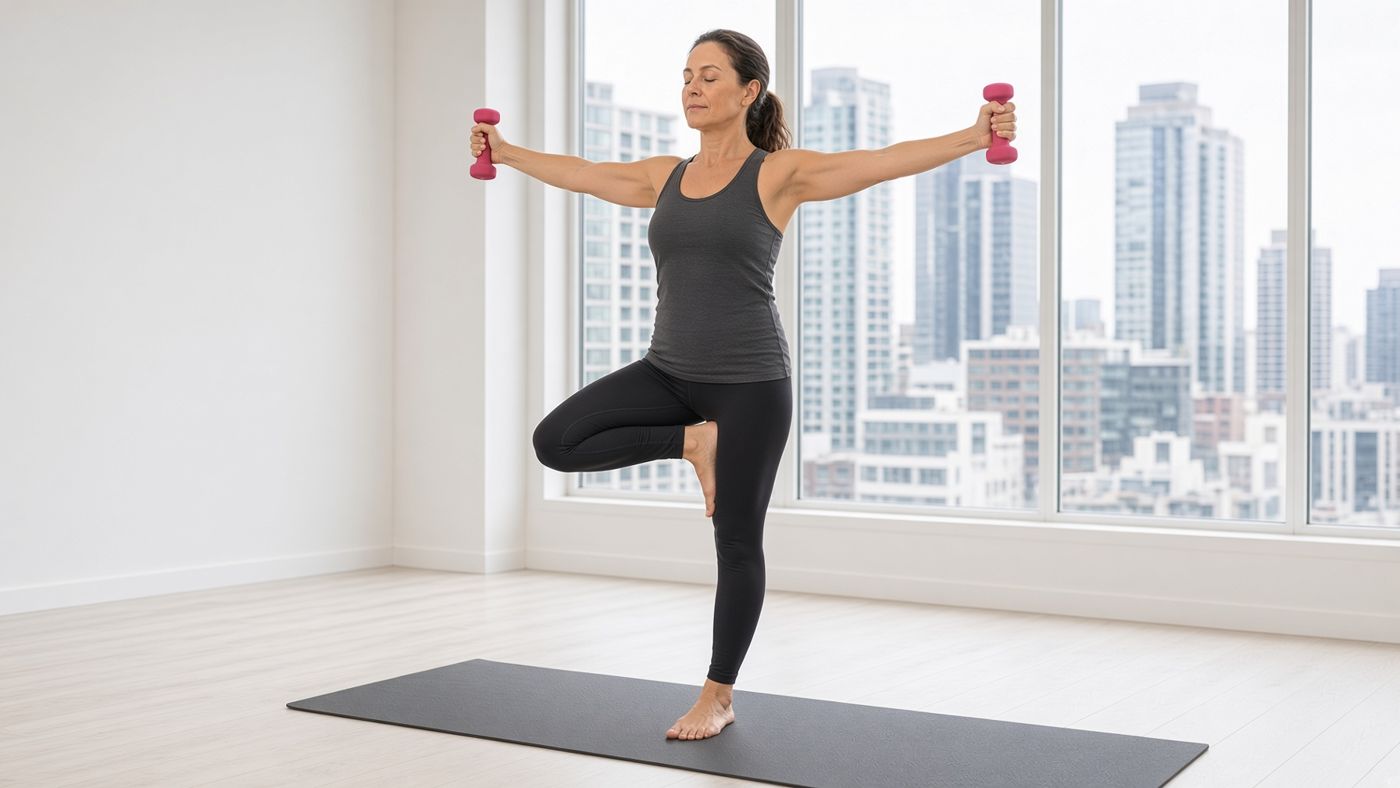
Regular movement is one of the few things in your control during a time that can feel out of your control. It also gives you a time in the day that belongs to you. Yoga is one gentle way in. What it can and cannot do for specific symptoms is a separate question, and we look at the research on each topic in its own article:
A gentle practice
Not a treatment. Ten quiet minutes to check in with your body, on a hard day or an ordinary one.
- Arrive. Sit or lie down somewhere cool, with a window open if you can. Notice where you feel warm, tense or tired, without trying to change it.
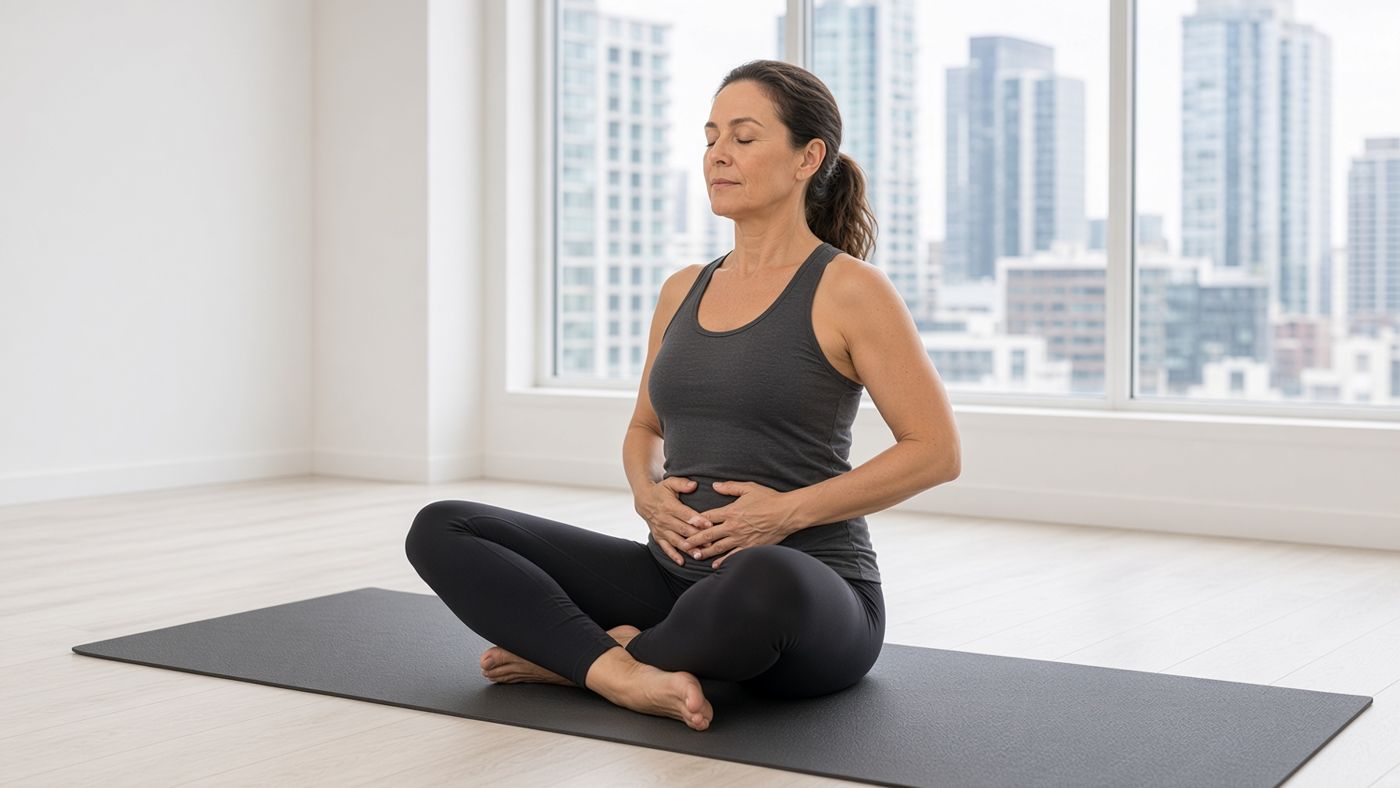
- Slow breathing. Breathe in through the nose, and let the out-breath be a little longer than the in-breath. Ten rounds, at your own pace.
- Cat and cow. On hands and knees, round the back on the exhale and lengthen it on the inhale. Eight slow rounds. Move only as far as feels easy.
- Supported child's pose. Knees wide, a cushion under the chest. Rest for a minute.
- Legs up the wall. Lie on your back with your legs resting up a wall or on a chair. Stay for three to five minutes. If you start to feel hot, open the legs or simply come down.
When to see a doctor
See a GP if you have any vaginal bleeding after 12 months or more without a period, even if it only happened once. It is not usually serious, but it can be a sign of cancer and needs checking.1 Talk to a doctor too if you think you have menopause symptoms, especially if you are under 45, as you may need tests and treatment.3 And make an appointment whenever symptoms are affecting your sleep, mood, work or relationships. You do not need to wait until it is unbearable.
The bottom line
Perimenopause and menopause are a normal stage of life, but normal does not mean you have to put up with everything. Symptoms often last for years, and there are treatments with good evidence behind them, hormonal and not. Movement and yoga have a real place alongside them, as a way to look after your body and your mind, and a doctor is the right partner for deciding what else you need.
Sources
- NHS. Symptoms of menopause and perimenopause. nhs.uk. Accessed November 2026. Link
- Office on Women's Health, US Department of Health and Human Services. Menopause basics. womenshealth.gov. Accessed November 2026. Link
- NHS. Early or premature menopause. nhs.uk. Accessed November 2026. Link
- Avis NE, Crawford SL, Greendale G, et al.; Study of Women's Health Across the Nation (SWAN). Duration of menopausal vasomotor symptoms over the menopause transition. JAMA Internal Medicine. 2015;175(4):531–539. Link
- The North American Menopause Society. The 2022 hormone therapy position statement of The North American Menopause Society. Menopause. 2022;29(7):767–794. Link
- The North American Menopause Society. The 2023 nonhormone therapy position statement of The North American Menopause Society. Menopause. 2023;30(6):573–590. Link
This article is general information, not medical advice. Medical review: pending.