- The pelvic floor is a hammock of muscle and connective tissue at the base of the pelvis. It supports the bladder, uterus and bowel, helps control the three openings, and plays a part in sex and birth.
- It does not work alone. It works with the breath, the deep belly muscles and the back, and it responds to pressure from inside the abdomen.
- A healthy pelvic floor can both tighten and let go. Regular, well-taught training helps many women with leaking, and noticing the area comes before strengthening it.
A floor that is not a floor
The word "floor" suggests something hard and fixed. The works in the course archive kept reaching for softer images instead: a hammock, a trampoline, a basket, a sling. Those images are closer to the truth. The pelvic floor is living tissue. It is made of muscle, connective tissue, nerves and blood vessels, strung between the pubic bone at the front, the tailbone at the back and the two sitting bones at the sides.1
Above it rest the bladder, the uterus and the rectum, and above those the rest of the abdominal organs. Three openings pass through it: the urethra, the vagina and the anus.
Three layers, from the outside in
The course described the pelvic floor in three layers. Anatomy books divide it in slightly different ways, but this map is a useful one for practice.
- The surface layer. Small muscles in the perineum, the area between the pubic bone and the tailbone. Together they form a rough figure eight: the front loop surrounds the vaginal opening, the urethra and the clitoris, and the back loop surrounds the anus (the external anal sphincter). They take part mainly in sexual function and in closing the openings.
- The middle layer. The sphincters of the urethra, with a sheet of muscle and connective tissue across the front of the pelvis, often called the perineal membrane. This layer helps us hold urine and choose when to let go.
- The deep layer. The levator ani, a broad muscle made of three parts (puborectalis, pubococcygeus and iliococcygeus), together with the smaller coccygeus muscle at the back. Together they are sometimes called the pelvic diaphragm, and they carry most of the weight of the organs above.1
The puborectalis forms a U-shaped sling around the back of the rectum. When it tightens, it pulls the rectum forward and helps hold stool in. When it relaxes, the angle opens so that the bowel can empty.
What it does
The works agree on a short list. The pelvic floor:
- supports the pelvic organs, at rest and during effort;
- helps keep the openings closed, and relaxes to let us empty the bladder and bowel;
- tightens quickly when pressure rises suddenly, as in a cough, a sneeze, a laugh or a lift;
- takes part in sexual sensation and response;
- stretches and yields to let a baby through during a vaginal birth.
Several works also describe the pelvic floor as part of a team, and research supports this. It works with the breathing diaphragm above, the deep abdominal muscles in front and the deep back muscles behind. In studies, the pelvic floor switches on just before the arms move, as part of the body's automatic steadying, and its activity also changes with the breath.3
The perineal body
At the center of the figure eight, between the vagina and the anus, lies the perineal body. It is a small, dense knot of muscle fibers and connective tissue where many pelvic floor muscles meet and attach. It is considered central to the integrity of the pelvic floor, especially in women.2
The perineal body can be stretched or torn during vaginal birth. Damage to the perineum and the deeper muscles can contribute to prolapse, incontinence or pain during sex later on, which is why the area deserves care after birth.2 Most tears heal well, especially with good follow-up.
Closing and lifting: the course's working model
Many of the works use a model taught in the course: some pelvic floor muscles mainly close (holding on), while others mainly lift (raising the organs and steadying the pelvis). In this model, a healthy pelvic floor is one that can do both and can also fully let go. The course linked closing with the long front belly muscles and lifting with the deep belly muscles. This is a teaching model, not a textbook division, but it captures something useful: control is about timing and balance, not about squeezing as hard as possible.
The yogic view: prana, apana and mula bandha
Alongside the anatomy, every work in the archive turns to yoga tradition. In the traditional texts, prana is the life force, linked with the in-breath and with the chest. Apana is the downward-moving energy, at home in the lower belly and pelvis, linked with the out-breath and with everything the body releases: urine, stool, menstrual blood, a baby.
The course taught that apana tends to drift downward over the years, and that mula bandha, the "root lock", gathers the pelvic floor inward and upward toward the perineal body and helps keep prana from leaking away. Some works also describe the pelvis as a place where emotion and memory are held. These are ideas from tradition and from the course's approach. They can be meaningful images for practice, but they are not physiological facts.
A practice for finding the pelvic floor
Practice ideas from the course. Go gently, and never hold your breath.
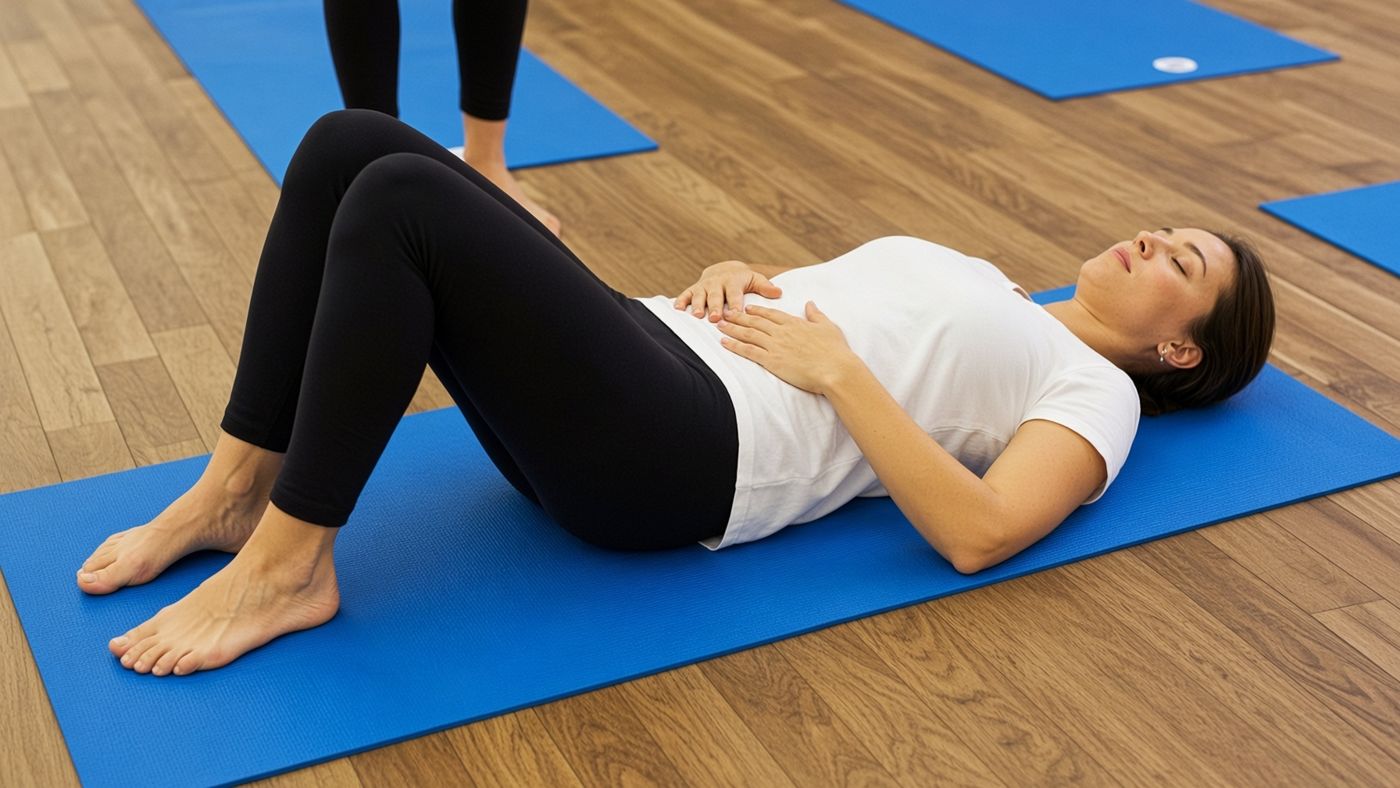
- Arrive. Sit tall on a firm chair or cushion, feeling both sitting bones, or lie on your back with knees bent. Let the breath settle.
- Find the back. Gently tighten around the anus, as if holding in wind. Then let it go completely.
- Find the front. Gently draw in around the urethra and vagina, as if you were about to hold in urine. Let it go. Use the idea only; do not stop your urine flow as an exercise.
- Lift with the out-breath. Inhale and let the pelvic floor soften. As you exhale, gather front and back toward the center and lift slightly upward. Inhale and release fully. Repeat a few times.
- Hold and quick. When this feels clear, try holding the lift for a few calm breaths, and then a few short, quick lifts. Always rest fully between them.
- Before effort. Practise lifting the pelvic floor just before you cough, sneeze or lift something, so that it becomes a habit.
- Mula bandha in asana. In standing poses or seated breathing, use a light version of the same lift, around a quarter of your effort, as a gathering point rather than a clench.
Training like this is well supported. In women with stress incontinence, regular pelvic floor training clearly improves symptoms.4 Training during pregnancy helps prevent leaking in late pregnancy and in the months after birth.5
Where the works differ
The works share the same picture but not the same details. Muscle names and layers are sometimes mixed up, and some assign muscles of the hip or pelvic wall to the floor itself. The traditional descriptions also vary: some place prana in the heart, some in the chest; some talk of channels and chakras; some keep it simple. The personal reflections differ most of all. For some writers, the pelvic floor was a source of strength and focus. For others, it was a place of weakness, fear or old pain, and their practice was a way of making peace with it. Both are part of the story.
When to see a professional
A pelvic health physiotherapist can check that you are tightening and releasing correctly, which is hard to judge alone. See one if you leak urine, wind or stool, feel heaviness or a bulge in the vagina, have pain during sex or when using a tampon, find it hard to empty, or still feel weak months after birth. Pelvic pain can also come from a floor that is too tight. In that case, learning to let go matters more than strengthening.
Sources and further reading
- Anatomy, Abdomen and Pelvis, Pelvic Floor. StatPearls [Internet]. Treasure Island (FL): StatPearls Publishing. Link
- Bordoni B, Launico MV. Anatomy, Abdomen and Pelvis, Perineal Body. StatPearls [Internet]. Treasure Island (FL): StatPearls Publishing. Link
- Hodges PW, Sapsford R, Pengel LH. Postural and respiratory functions of the pelvic floor muscles. Neurourology and Urodynamics. 2007;26(3):362–371. Link
- Dumoulin C, Cacciari LP, Hay-Smith EJC. Pelvic floor muscle training versus no treatment, or inactive control treatments, for urinary incontinence in women. Cochrane Database of Systematic Reviews. 2018;(10):CD005654. Link
- Woodley SJ, Lawrenson P, Boyle R, et al. Pelvic floor muscle training for preventing and treating urinary and faecal incontinence in antenatal and postnatal women. Cochrane Database of Systematic Reviews. 2020;(5):CD007471. Link
Based on works from the 2011 women's yoga teacher course, reviewed and updated. General information, not medical advice. Medical review: pending.