- A gap between the abdominal muscles is close to universal in late pregnancy. For most women it narrows on its own in the first months after birth.
- About one in three women still has a gap a year later. On its own, the gap has not been clearly linked to back pain or leaking.
- No exercise program has strong evidence behind it, and no single exercise has been proven harmful. Gradual, comfortable, regular movement is the reasonable path.
What it is
The two long muscles at the front of the belly, the rectus abdominis, are joined in the middle by a band of connective tissue called the linea alba. As the uterus grows, that band stretches and the muscles move apart. The widening is called diastasis recti abdominis, often shortened to DRA.
It is not a tear and it is not an injury. It is the body making room.
How common is it?
Very. In a Portuguese study that measured the gap with ultrasound, every one of the 84 first-time mothers had a diastasis at week 35 of pregnancy. By six months after birth, the figure had dropped to 39%.1
A Norwegian study followed 300 first-time mothers from pregnancy to a year after birth, and found this pattern:2
The numbers differ between studies because they use different methods and cut-offs. The direction is the same: common in pregnancy, gradually closing afterwards, still present in a meaningful minority a year on. In the Norwegian study, the only factor clearly linked to a gap was heavy lifting, 20 or more times a week.2
Does it cause pain?
This is where the internet and the research part ways. A systematic review of 12 studies and more than 2,200 women found no significant link between diastasis and lower back or pelvic pain, and none with incontinence. It found a small link with pelvic organ prolapse, and some signs that a wider gap may go with weaker abdominal strength and lower quality of life.3 The authors rated the quality of the studies as weak.
In the Norwegian study, women with and without a gap reported the same amount of lower back and pelvic pain a year after birth.2
In other words, the gap is not a diagnosis on its own. How the belly works matters more than how wide it is.
Does exercise close it? Evidence: very low
A 2021 systematic review pooled seven randomized trials with 381 women.4 Its conclusions are modest:
- Training the deep abdominal muscle (the transversus abdominis) may reduce the gap a little, but the evidence is very low quality.
- Pelvic floor training alone did not narrow the gap more than doing little or nothing.
- The trials mostly included women with mild diastasis, and the programs were very different from each other.
The authors' bottom line: there is not yet enough evidence to recommend any specific exercise program.
What about crunches?
Many women are told to avoid them completely. The research is less clear. An ultrasound study found that a regular curl-up actually narrows the gap while you do it, while switching on the deep abdominal muscle first narrows it less but may keep the midline tissue more taut.5 The study was small, and the way it measured "taut" has not been validated.
So we do not know yet whether a narrower gap or a firmer midline matters more in the long run. What we can say is that no study has shown that a curl-up damages the belly. Avoiding it out of fear is not supported, and neither is rushing back to heavy loads.
How to check yourself
This is a rough guide, not a measurement. Finger checks are less precise than ultrasound.
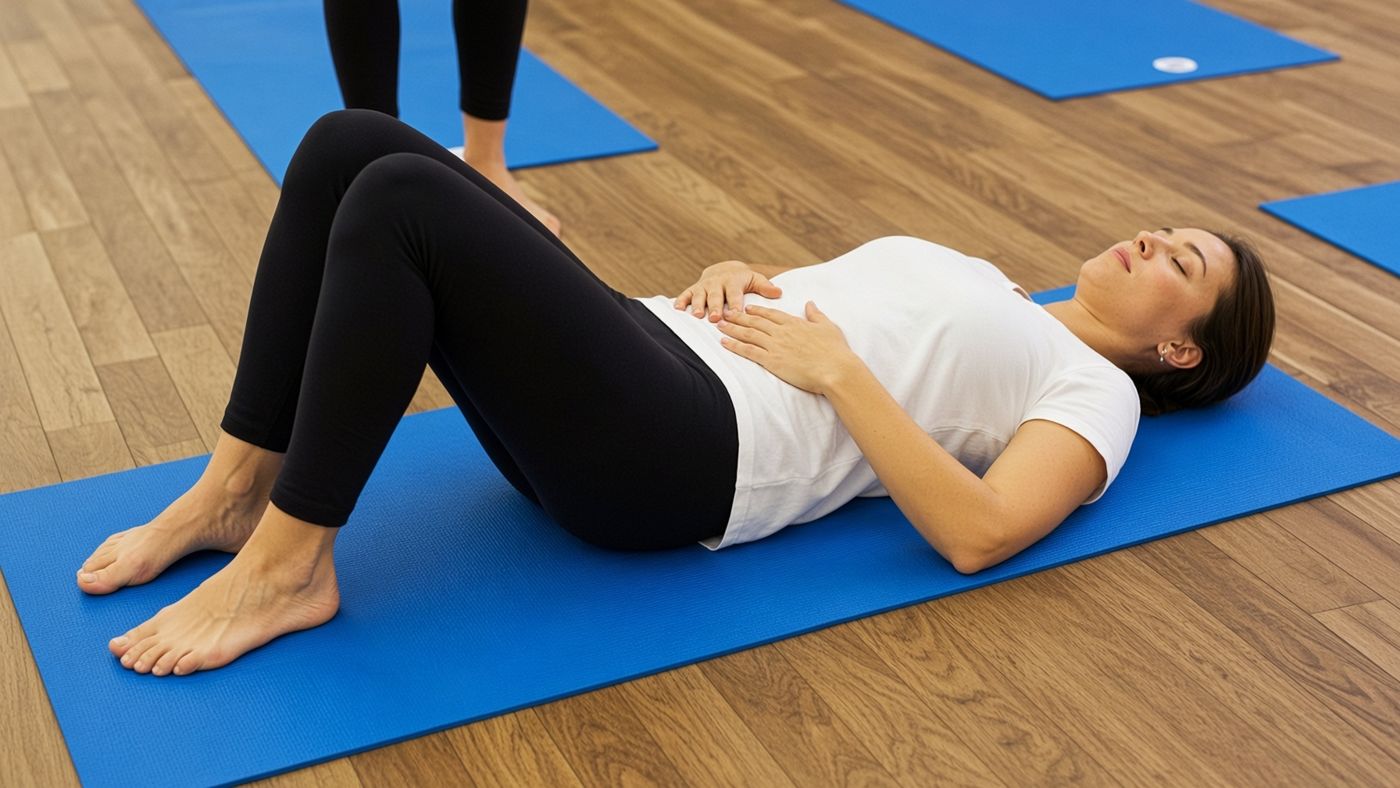
- Lie on your back, knees bent, feet on the floor.
- Place your fingertips across the midline, just above the belly button, palm facing you.
- Lift your head slightly, as if to look at your knees. Feel how many fingers fit between the two muscle edges.
- Repeat just below the belly button. Notice also whether the midline feels firm or soft, and whether it bulges or "domes".
Studies often use two fingers or more as the threshold for diastasis.2 A soft, deep midline or a dome that appears when you lift your head is worth showing to a professional, whatever the width.
A gentle practice for the first weeks
Not a treatment. A way to reconnect with the belly, comfortably, from the early weeks after birth if your caregiver agrees.
- Breath into the ribs. Lie on your side or back. Inhale wide into the sides of the ribs. On a long exhale, let the lower belly draw gently in, as if zipping up loose trousers.
- Heel slides. On the exhale, slide one heel away along the floor, keeping the belly flat and quiet. Inhale to bring it back. Five times each side.
- Rolling to get up. To get out of bed, roll onto your side first and push up with your arms, instead of sitting straight up.
- Notice the dome. In any movement, if the midline bulges into a ridge, make it smaller or easier. That is your signal, not a failure.
When to see a professional
A pelvic health physiotherapist is the right person if the gap feels wide or deep, if a dome appears with everyday movement, if you have back pain, leaking, or a feeling of heaviness in the pelvis, or if you notice a lump at the belly button. Your doctor should check any pain or bulge that does not go away when you lie down.
The bottom line
A gap is a normal part of pregnancy, and for most women it closes over months, not weeks. The research does not support fear of specific movements, and it does not promise that any program will close the gap. Moving regularly, building up slowly and paying attention to how the belly responds is a reasonable way forward, with professional help when something does not feel right.
Sources
- da Mota PGF, Pascoal AGBA, Carita AIAD, Bø K. Prevalence and risk factors of diastasis recti abdominis from late pregnancy to 6 months postpartum, and relationship with lumbo-pelvic pain. Manual Therapy. 2015;20(1):200–205. Link
- Sperstad JB, Tennfjord MK, Hilde G, Ellström-Engh M, Bø K. Diastasis recti abdominis during pregnancy and 12 months after childbirth: prevalence, risk factors and report of lumbopelvic pain. British Journal of Sports Medicine. 2016;50(17):1092–1096. Link
- Benjamin DR, Frawley HC, Shields N, van de Water ATM, Taylor NF. Relationship between diastasis of the rectus abdominis muscle (DRAM) and musculoskeletal dysfunctions, pain and quality of life: a systematic review. Physiotherapy. 2019;105(1):24–34. Link
- Gluppe S, Engh ME, Bø K. What is the evidence for abdominal and pelvic floor muscle training to treat diastasis recti abdominis postpartum? A systematic review with meta-analysis. Brazilian Journal of Physical Therapy. 2021. Link
- Lee D, Hodges PW. Behavior of the linea alba during a curl-up task in diastasis rectus abdominis: an observational study. Journal of Orthopaedic & Sports Physical Therapy. 2016;46(7):580–589. Link
This article is general information, not medical advice. Medical review: pending.