- Back pain after birth is common but not the rule. In one Canadian study, about one in five women had low back pain in the first six months, and most were pain free.
- Thumb-side wrist pain, sometimes called "mommy thumb", is a recognised problem after birth, linked to the repeated hand positions of baby care.
- Exercise, especially strengthening of the trunk, has moderate-quality evidence for easing back and pelvic pain after birth. Comfortable setups for feeding, lifting and carrying help too.
How common are these aches?
Many women expect to hurt after birth, and some do. A study from Ontario, Canada phoned women at 1, 3 and 6 months after delivery. At each point, between 15% and 21% had low back pain, and 76% to 80% were pain free.1 The only risk factor the researchers found for back pain at 3 and 6 months was having had back pain during pregnancy. The study was small, with fewer than 70 women answering at each point, so treat the numbers as a rough guide.
The wrist is the other common complaint. De Quervain's tenosynovitis is an irritation of the tendons on the thumb side of the wrist. Researchers describe it as a common diagnosis after birth, and suggest it comes from the strain of bending the wrist toward the little finger, over and over, while caring for a baby.2 In a study comparing 63 postpartum women who had it with 630 who did not, it was more likely after a first birth, a pregnancy longer than 40 weeks, and a BMI over 25.2
We did not find reliable figures for neck and upper back pain after birth, so we will not quote one.
Feeding: bring the baby to you
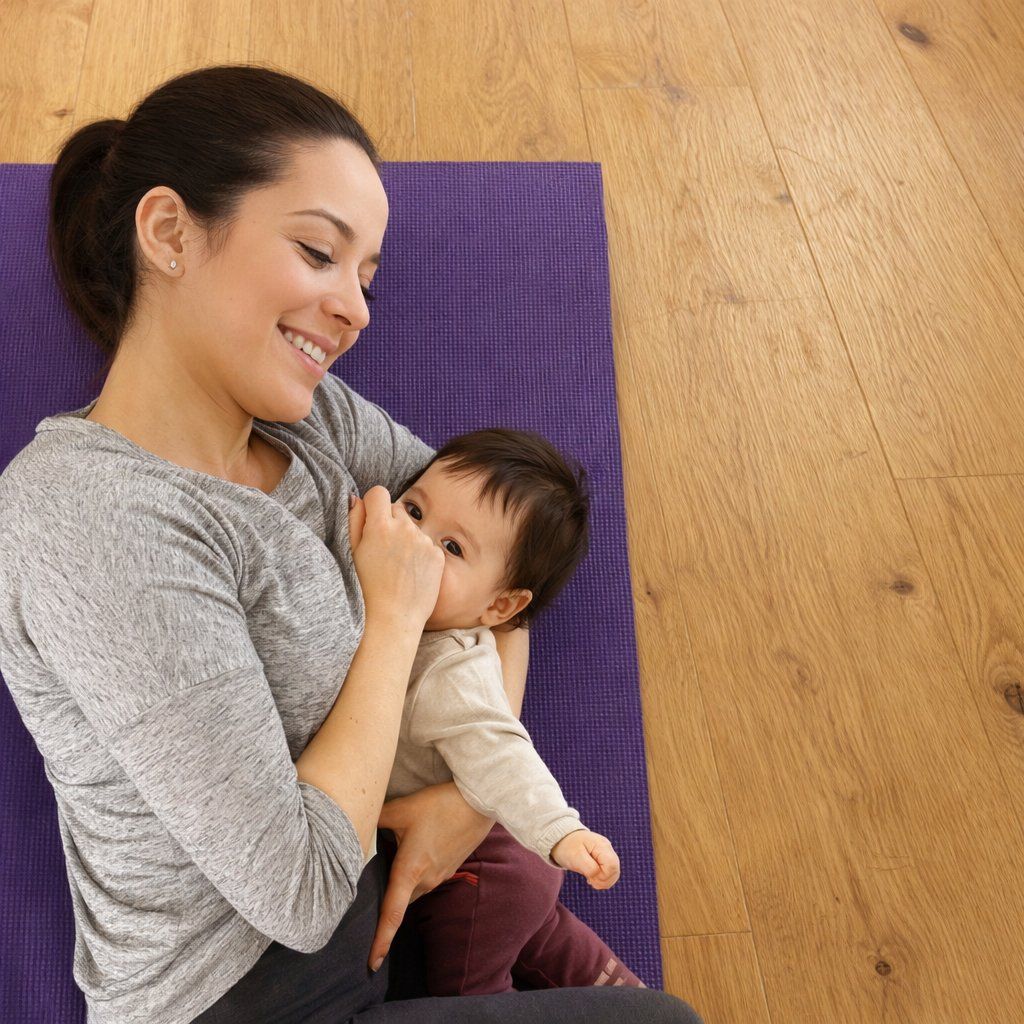
Feeds are long and frequent, and it is easy to curl forward over the baby without noticing. The NHS advice on breastfeeding is simple: get comfortable before a feed, use pillows or cushions if you need them, and keep your shoulders and arms relaxed. Bring your baby to the breast, rather than leaning the breast toward the baby.3
A postnatal physiotherapy leaflet from a London NHS trust adds: when sitting to feed, support your back and your feet, try a pillow behind your lower back, use pillows to raise the baby rather than leaning forward, and avoid feeding in the same position every time.4 The same ideas work for bottle feeding.
Lifting: the baby, the cot, the car seat
The same leaflet suggests keeping changing and bathing surfaces at waist height, or kneeling on a pillow if you use a bed or sofa. It also suggests letting someone else carry a portable car seat when possible, or moving the baby into a buggy.4
After a caesarean, the leaflet advises not lifting anything heavier than your baby for six weeks, and avoiding very heavy lifting for three months. It suggests inviting older children to climb up to you when you are sitting, rather than lifting them.4
Carrying in a sling: safety first
In a sling, safety comes first. The Lullaby Trust points parents to the TICKS guidance from the Consortium of UK Sling Manufacturers and Retailers:5
- Tight
- In view at all times
- Close enough to kiss
- Keep chin off the chest
- Supported back
Babies under four months are especially at risk if the head falls forward and the chin presses onto the chest, which can block the airway. The advice is to keep the face visible, the nose and mouth clear, the baby upright, and to reposition the baby after feeding.5 The NHS is clear that it is not safe to breastfeed a baby while they are in a sling or carrier.3 Always follow the manufacturer's instructions.
Getting up and down
Much of baby care happens low down, on a bed, a sofa or the floor. For getting out of bed, especially after a caesarean, physiotherapists suggest bending your knees, rolling onto your side, letting your legs drop over the edge and pushing up to sitting with your arms.4 The same idea, rolling to the side and using your arms, can make getting up from the floor easier: come to your hands and knees, step one foot forward, and rise slowly.
Does exercise help back pain after birth? Evidence: moderate
A 2025 systematic review gathered the research on exercise and musculoskeletal pain in the first year after birth.6
With moderate certainty, exercise alone, including strengthening exercises for the trunk muscles, reduced the severity of low back and pelvic pain and the disability that comes with it, compared with no exercise.6 That sounds strong, but the main pain result came from only four trials with 210 women, and the disability result from six trials with 296 women. Whether exercise reduces fear of movement was unclear. The review looked at back and pelvic pain. It does not tell us much about necks or wrists.
If you want to build up to fuller exercise, our article on returning to exercise after birth covers the timing. If you are worried about the gap between your abdominal muscles, see what the research says about diastasis recti.
A short practice for neck, upper back and wrists
Not a treatment. A few minutes to undo the forward curl of feeding and holding. Move slowly and stay within comfort.
- Settle. Sit with your back supported and both feet on the floor. Take a few slow breaths, letting the shoulders drop on each exhale.
- Chin glide. Gently draw the chin straight back, as if making a small double chin, then release. Five times.
- Open the chest. Interlace your hands behind your head, elbows wide. Inhale and lift the breastbone a little toward the ceiling, then exhale to return. Five breaths.
- Shoulder rolls. Roll the shoulders up, back and down, slowly. Five times, then reverse.
- Wrist circles. With relaxed hands, circle the wrists slowly, five times each way. Then open the fingers wide and soften them, five times.
- Rest. Let the hands rest on your thighs, palms up, for a few breaths.
If the wrist is already painful on the thumb side, skip anything that hurts and have it checked rather than stretching through it.
When to see a doctor or physiotherapist
See your doctor if back pain does not improve after a few weeks of home care, if it stops you doing everyday things, if it is worse at night or does not ease with rest, or if it sits between your shoulders rather than low down.3 Thumb-side wrist pain that keeps coming back is worth having checked too. A pelvic health physiotherapist can help if you have pain, leaking, a feeling of heaviness or dragging in the pelvis, or bulging of the tummy muscles during activity.4 Get help straight away for pain, tingling, weakness or numbness in both legs, loss of feeling around the genitals or anus, or changes in your bladder or bowels, and get an urgent appointment if back pain comes with feeling hot, shivery or unwell.3
The bottom line
Aches after birth are common. Supporting your back while feeding, bringing the baby to you, sharing the car seat, following TICKS in a sling and building strength gradually are all reasonable steps. If something does not settle, ask for help.
Sources
- Tavares P, Barrett J, Hogg-Johnson S, Ho S, Corso M, Batley S, Wishloff K, Weis CA. Prevalence of low back pain, pelvic girdle pain, and combination pain in a postpartum Ontario population. Journal of Obstetrics and Gynaecology Canada. 2020;42(4):473–480. Link
- Daglan E, Morgan S, Yechezkel M, Frenkel Rutenberg T, Shemesh S, Iordache SD, Kadar A. Risk factors associated with de Quervain tenosynovitis in postpartum women. Hand. 2024;19(4):643–647. Link
- NHS. Breastfeeding: positioning and attachment (page last reviewed 23 June 2026), Link; and Back pain, Link. NHS website.
- St George's University Hospitals NHS Foundation Trust (gesh). Postnatal physiotherapy advice. Patient leaflet MAT_PPA_01, published August 2025. Link
- The Lullaby Trust. Slings and carriers: the research. 2026. Link
- Ruchat S-M, Beamish N, Pellerin S, Usman M, Dufour S, Meyer S, Sivak A, Davenport MH. Impact of exercise on musculoskeletal pain and disability in the postpartum period: a systematic review and meta-analysis. British Journal of Sports Medicine. 2025;59(8):594–604. Link
This article is general information, not medical advice. Medical review: pending.