- Recovery usually takes around six to eight weeks, and longer for some women. Moving gently and often from the first days helps.
- Roll to your side to get up, support the wound when you cough, walk a little every day, and lift nothing heavier than your baby for now.
- Your pelvic floor still needs attention after a caesarean. Scar massage is widely recommended, but the research behind it is weak.
How a caesarean heals
A caesarean is major surgery: the cut goes through the layers of the tummy and the womb. A physiotherapy leaflet from an NHS hospital puts recovery at up to six to eight weeks, and longer for some women. It is common to feel pain or discomfort for the first few weeks when moving, getting in and out of bed, or doing anything that strains the tummy.2
Most women leave hospital one or two days after the operation. The scar is usually horizontal, about 10 to 20 cm long, just below the bikini line. Stitches or staples that do not dissolve are usually taken out after five to seven days. The scar is often red at first and fades with time.1 Under the skin, scar tissue usually forms within three to four weeks.3
Some numbness or tightness around the scar is normal at first. If it does not ease, mention it to your doctor, midwife or a pelvic health physiotherapist.2
The first days: getting up, coughing, moving
It helps to start moving as soon as you can, because movement supports circulation and breathing and stops joints and muscles getting stiff. Pain relief is there to make this possible.2
- Getting out of bed. Avoid sitting straight up, so the tummy muscles can recover. Bend your knees with feet flat, gently draw in the lower tummy, then roll onto your side, knees and arm moving together. Push up to sitting with your upper hand on the mattress as your legs go over the edge. Reverse it to lie down.2
- Coughing, sneezing, laughing. Support the wound with your hands, a rolled-up towel or a small pillow, and lean forward a little.2 A pillow over the tummy can also help when you open your bowels.3
- Standing up. Hands on the bed either side of you, draw in the lower tummy, lean forward and push up. Then stand tall as you walk.2
Walking and gentle movement
The NHS advises staying mobile with gentle activity, such as a daily walk, to lower the risk of blood clots, without overdoing it.1 Build up speed and distance gradually, as it feels comfortable.3 Rest is part of recovery too. Strain-heavy chores such as vacuuming, standing for long periods or carrying toddlers are best avoided for the first few weeks.2
Driving, lifting and returning to activity
The guidance is gentle rather than fixed, and it is based on how you feel:
- Lifting: nothing heavier than your baby for the first six weeks.3
- Driving: the NHS says not for a few weeks;1 the pelvic health physiotherapists' association suggests four to six weeks, once you could do an emergency stop and have checked your insurance.3
- Exercise and sex: when you feel ready and they are not uncomfortable, which may be around six weeks.1 From about six to eight weeks, if your postnatal check went well, brisk walking and swimming are reasonable next steps.3
For the longer road back to running, classes and strength work, see When can I go back to exercise after birth?
Scar care and scar massage Evidence: weak
Day to day, the NHS advises gently cleaning and drying the wound every day and wearing loose clothes and cotton underwear.1
Many physiotherapists suggest massaging the scar once it has fully healed over, usually from around three to four weeks, to ease sensitivity or tightness.3 It is a reasonable, low-risk thing to try. But the evidence is thin. A review of 10 studies of scar massage, with 144 patients in total, called the evidence weak: the routines varied and the outcomes were not measured in a consistent way. Benefit seemed greater for surgical scars than for injury or burn scars.4 We did not find a systematic review focused on caesarean scars specifically.
So if massage feels good, it is fine to do. If it hurts, or the scar is still painful after six weeks, a pelvic health physiotherapist can help.2
Breathing and the pelvic floor
Deep breathing in the early days helps keep the lungs clear while you are less active.2
The pelvic floor still matters. As one NHS leaflet puts it, even without a vaginal birth these muscles carried the weight of your baby through pregnancy.2 A caesarean lowers the risk of leaking but does not remove it. A systematic review of postpartum studies found:5
You can start pelvic floor exercises once the catheter is out and you have passed urine.2
The emotional side
Recovering from surgery while caring for a newborn is a lot. Feeling low, anxious or teary for a few days is very common and usually passes within two weeks of the birth. If it lasts longer, starts later, or you are struggling, talk to your doctor, midwife or health visitor, even if you only have some of the signs.6 This is especially worth saying if the birth was unplanned or did not go as you hoped.
A gentle practice for the first weeks
Not a workout. Small movements, taken from NHS physiotherapy advice, that you can do in bed or in a chair from the first days if your care team agrees.2
- Three slow breaths. Knees bent. Breathe in through the nose, hold for two seconds, breathe out gently through the mouth. Three or four times.
- Ankle pumps. Bend the feet up and down from the ankle 15 times, then circle them. Good for circulation while you are less active.
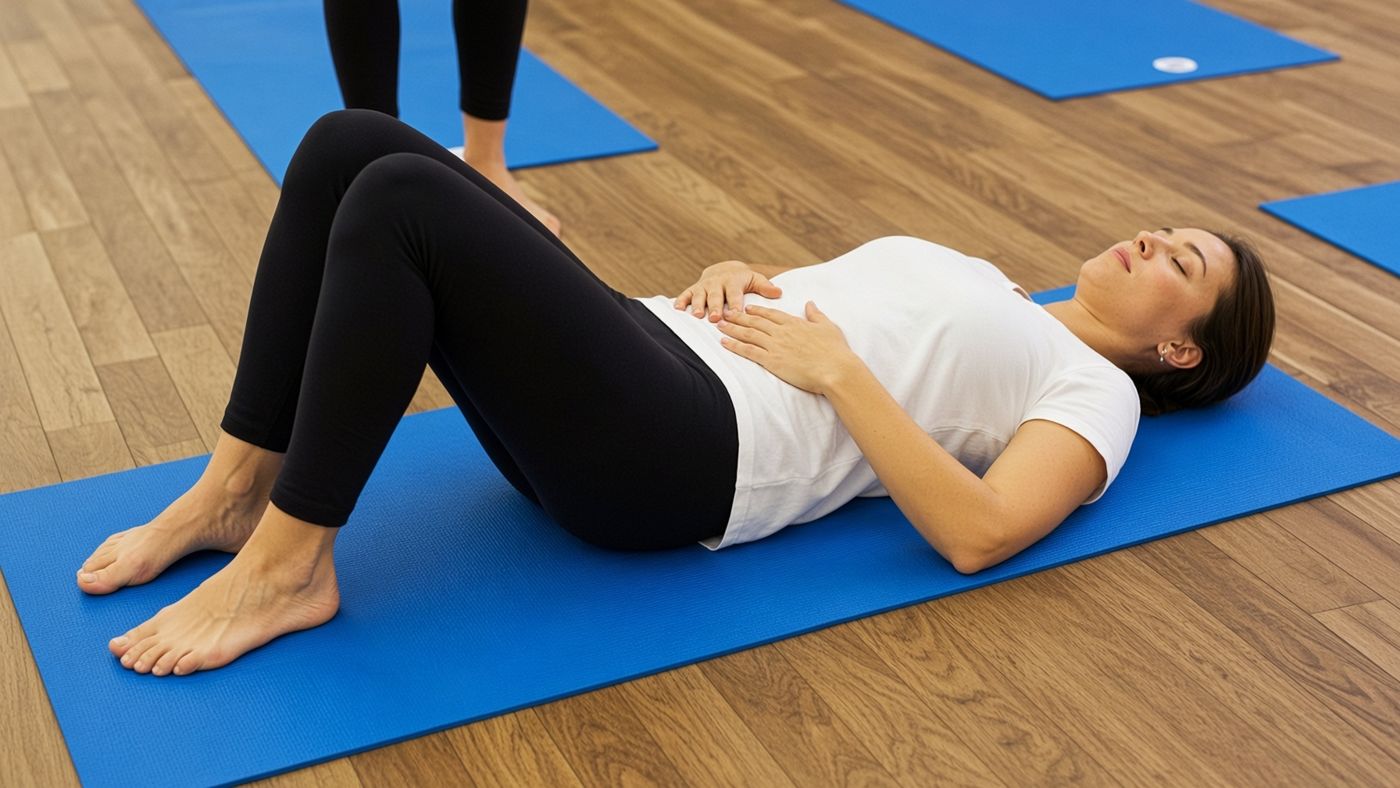
- Gentle tummy draw-in. Hands resting on the lower tummy, draw the muscles towards the spine a small amount. Hold for three seconds and relax. Five times, holding a little longer as you feel able.
- Pelvic floor squeezes. As if stopping wind, squeeze and lift, without holding your breath. Begin with five holds of five seconds and five quick squeezes, relaxing fully between each.
- Roll, don't crunch. Every time you get out of bed, use the side roll above. Each careful roll is practice too.
When to get help
Contact your midwife or doctor straight away if you have severe pain, heavy vaginal bleeding, pain when peeing or leaking urine, a wound that becomes redder, more painful or more swollen, pus or foul-smelling fluid from the wound, a cough or shortness of breath, or swelling or pain in your lower leg. These can be signs of infection or a blood clot.1 If you feel very unwell or it feels urgent, call your local emergency number.
The bottom line
A caesarean asks for patience. Move gently from the first days, protect the wound when you get up and cough, walk a little more each day, and let comfort guide when you drive, lift and exercise. Look after your pelvic floor and your mood as well as your scar, and ask for help early when something does not feel right.
Sources
- NHS. Caesarean section: recovery. NHS website. Page last reviewed 4 January 2023. Link
- Milton Keynes University Hospital NHS Foundation Trust, Physiotherapy. Advice and exercises following Caesarean Section (patient information, version 4). Published June 2023. Link
- Pelvic, Obstetric and Gynaecological Physiotherapy (POGP). Recovery after having a caesarean section. Patient information. Link
- Shin TM, Bordeaux JS. The role of massage in scar management: a literature review. Dermatologic Surgery. 2012;38(3):414–423. Link
- Thom DH, Rortveit G. Prevalence of postpartum urinary incontinence: a systematic review. Acta Obstetricia et Gynecologica Scandinavica. 2010;89(12):1511–1522. Link
- NHS. Postnatal depression: overview. NHS website. Page last reviewed 18 March 2026. Link
This article is general information, not medical advice. Medical review: pending.