- A small number of studies suggest postnatal yoga may help the mother's mood and well-being. Research on yoga done with the baby is very thin.
- Start gentle exercise when you feel ready after a straightforward birth, and ask your midwife or doctor first if the birth was complicated or a caesarean.
- Your baby stays in sight and within reach the whole time. Anything that lifts or balances the baby waits until they hold their head steady.
What the research says Evidence: low
Most of what we know is about yoga for mothers, not yoga with babies. A 2024 systematic review gathered every quantitative study of postnatal yoga it could find:2
Together, the studies linked postnatal yoga with fewer depressive symptoms and better well-being and quality of life. The authors were careful, though: the studies were few, small and designed very differently, and their conclusions "need to be taken with caution".2
The best-rated of them is a randomized trial from the United States. Fifty-seven women with postpartum depression were assigned either to 16 yoga classes over 8 weeks or to a waiting list. The yoga group improved more in depression, anxiety and quality of life, and 78% of them showed clinically meaningful change.1 The authors called yoga promising and asked for larger studies to confirm it.
The one study where babies came along offered mothers four weeks of baby yoga and four weeks of baby massage. It found no significant effect on the mother–baby measures compared with a control group.2 The review's authors note that no study yet looks properly at mother-and-baby yoga itself.
So the honest answer: practising together is a lovely way to move, rest and play, and it solves the childcare problem. Any benefit for the baby has not been shown. The ideas below are practice suggestions, not proven treatments.
Before you start
The NHS says that after a straightforward birth you can start gentle exercise, such as walking, gentle stretches and pelvic floor exercises, as soon as you feel up to it. After a more complicated birth or a caesarean, recovery takes longer, and you should ask at your 6-week postnatal check before any high-impact exercise.3 If you are unsure, ask your midwife or doctor when it is right for you. For more on this, see returning to exercise after birth.
A few safety basics for the baby:
- Stay close. Tummy time is for babies who are awake and closely supervised.4 The same goes for every idea here: never step away, even for a moment.
- Mind the head. Babies hold their head up on their tummy at around 2 months, and hold it steady without support when held at around 4 months.5 Until then, keep a hand behind the head and neck whenever you lift or hold them.
- Practise on the floor. A mat or blanket on the floor, with nothing nearby that could fall, means nobody can roll off anything.
- Awake, not asleep. If your baby dozes off on you, move them to their own safe sleep space on their back.4
Practising with your baby also counts as play. If tummy time is part of your day, our guide to tummy time has more.
Ideas to practise together
Pick one or two. A good session might be ten minutes, and it is fine to stop halfway for a feed.
1. Baby beside you
The simplest start, from the early weeks.
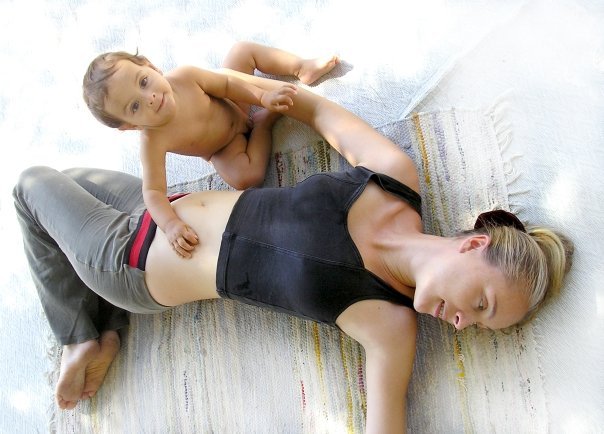
- Lay your baby on their back on a blanket next to your mat, where you can see their face.
- Move through gentle stretches: side bends, shoulder rolls, cat-cow on hands and knees.
- Talk or sing as you move. Your voice keeps them company.
2. Breathing with baby on your chest
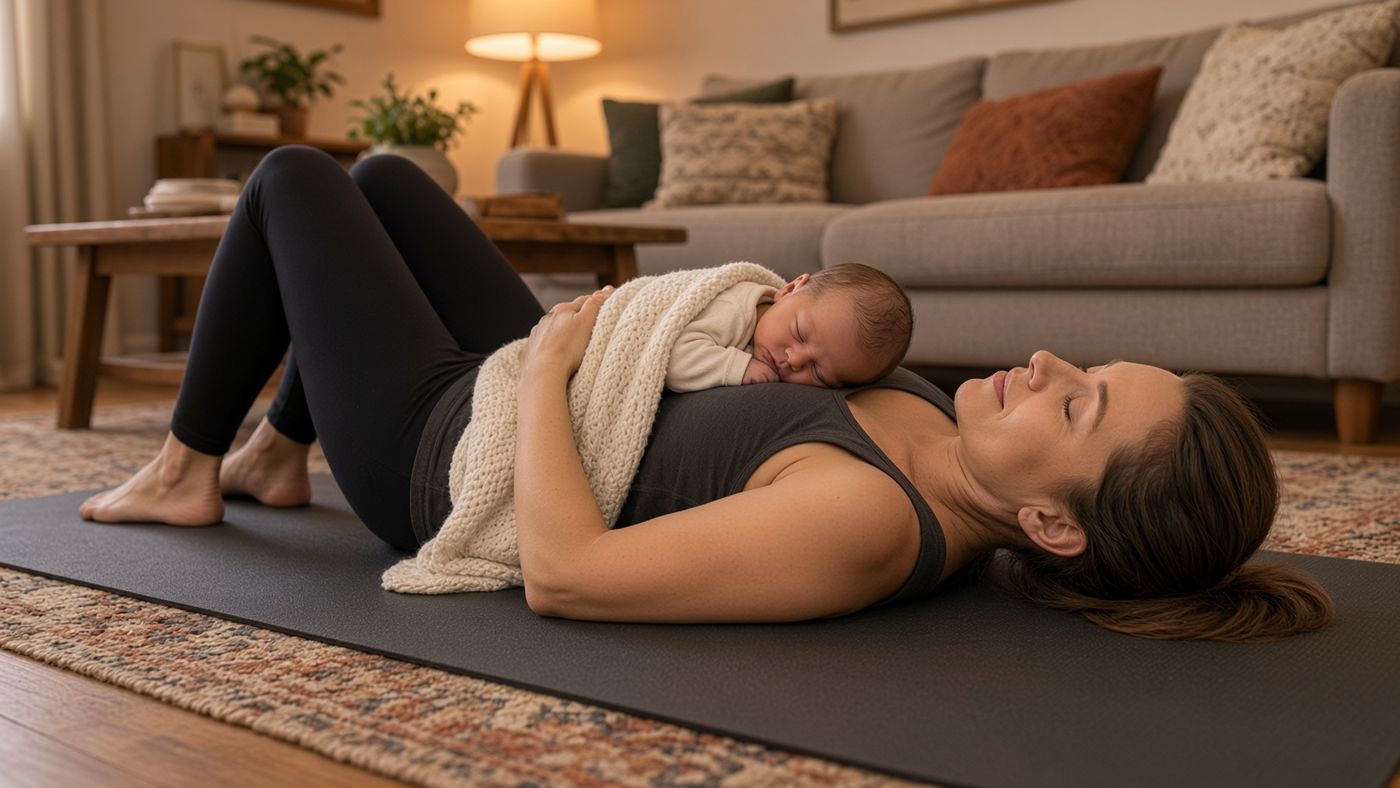
The NHS suggests tummy time can start from birth with your baby lying on your chest, as long as you are fully awake and unlikely to doze off.6
- Recline on cushions or lie on your back, knees bent. Place your baby tummy-down on your chest, a hand on their back.
- Breathe slowly into your sides and back. Notice your baby rising and falling with you.
- Stay for a few breaths or a few minutes, as long as you are both content.
3. Bridges with baby on your lower belly
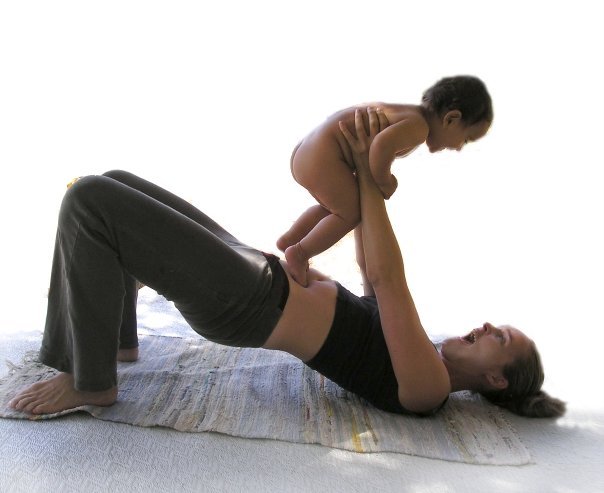
- Lie on your back, knees bent, feet hip-width. Sit your baby on your lower belly and thighs, facing you, both hands holding them.
- Exhale and slowly lift your hips a little. Inhale and lower.
- Keep the lift small and smooth. Five to eight times is plenty.
4. "Airplane" on your shins
Only once your baby holds their head steady on their own.
- Lie on your back and bring your knees towards your chest, shins parallel to the floor.
- Lay your baby tummy-down along your shins, holding them firmly under the arms and chest.
- Gently rock forward and back, keeping the movement small and your grip secure.
5. Plank or cat-cow over baby
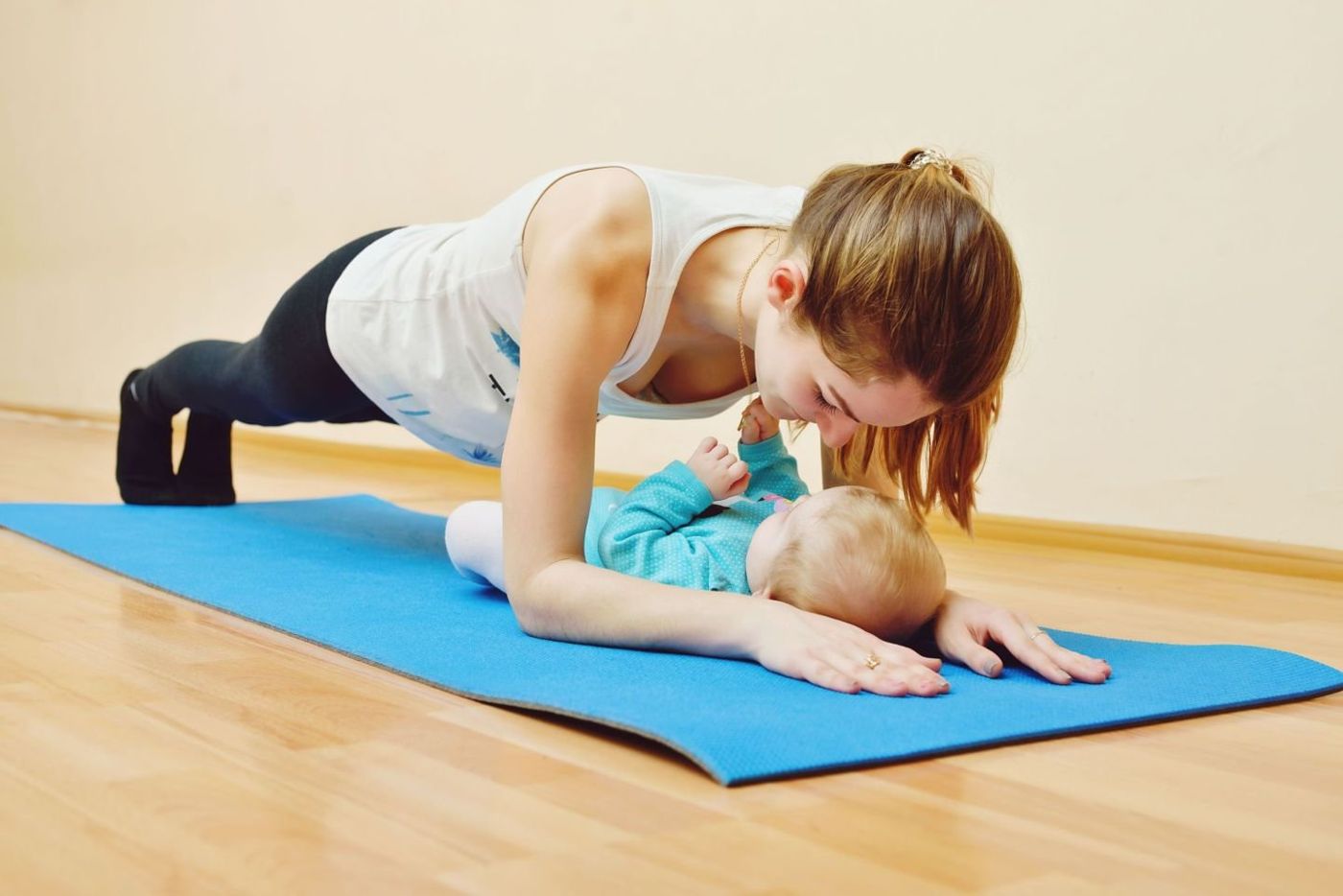
- Lay your baby on their back on the mat. Come to hands and knees over them, face to face.
- Move through cat-cow, or lower towards them for a "kiss" and push back up.
- If your core feels ready, hold a short plank from your knees. Keep your knees down if you see your belly dome.
6. Squats and lunges holding baby close
- Hold your baby securely against your chest, supporting the head if needed.
- Bend your knees into a shallow squat, or step back into a small lunge, and rise slowly.
- Go only as deep as feels steady. Balance matters more than depth.
7. Seated rocking and swaying
- Sit cross-legged or on a cushion, baby held against you or across your lap.
- Rock gently side to side and forward and back, in time with a song you both know.
- Let your exhale lengthen. This one is as calming for you as it is for them.
8. Baby "bicycles"
A playful moment for your baby, not an exercise with proven benefits.
- With your baby on their back, hold their lower legs gently.
- Move their legs slowly, one knee towards the tummy, then the other.
- Try soft arm movements too: open wide, then cross over the chest. Never force a limb; follow where it goes easily.
If your baby enjoys being touched, our guide to baby massage is a lovely next step.
9. Resting together
- Lie on your back with your baby beside you or on your chest, a hand on them.
- Close your eyes if you can stay fully awake, or soften your gaze if not.
- Take five slow breaths. You have both done enough today.
Stop if…
Your baby cries, turns away, arches, goes floppy or seems tired: pause, cuddle, feed or try another day. You feel pain, leak urine, notice a heavy or dragging feeling in the pelvis, see your belly dome along the midline, or your bleeding gets heavier: stop and talk to your midwife, doctor or a pelvic health physiotherapist.
The bottom line
There is early evidence that postnatal yoga may lift a mother's mood, and almost none yet on yoga done with the baby. That does not make it less worthwhile. Practising together gives you a few minutes to move and breathe without needing childcare, and gives your baby your face, your voice and your touch. Keep it short, keep your baby close, and let the session follow whoever needs it more that day.
Sources
- Buttner MM, Brock RL, O'Hara MW, Stuart S. Efficacy of yoga for depressed postpartum women: a randomized controlled trial. Complementary Therapies in Clinical Practice. 2015;21(2):94–100. Link
- Munns L, Spark N, Crossland A, Preston C. The effects of yoga-based interventions on postnatal mental health and well-being: a systematic review. Heliyon. 2024;10(3):e25455. Link
- NHS. Keeping fit and healthy with a baby. nhs.uk. Link
- American Academy of Pediatrics. Back to sleep, tummy to play: give your baby a safe, strong start. HealthyChildren.org. Link
- American Academy of Pediatrics. Developmental milestones: 1–4 months old. HealthyChildren.org. Link
- NHS Start for Life. Baby moves. nhs.uk. Link
This article is general information, not medical advice. Medical review: pending.