- In trials with healthy newborns, early skin-to-skin contact was linked to more breastfeeding in the following months. The evidence for this is moderate.
- For small and preterm babies, the World Health Organization now advises skin-to-skin care straight after birth, without first separating baby into an incubator.
- Safety is simple but important: you can see the baby's face, the nose and mouth are clear, and the adult is awake and alert. Partners can do it too.
What it is
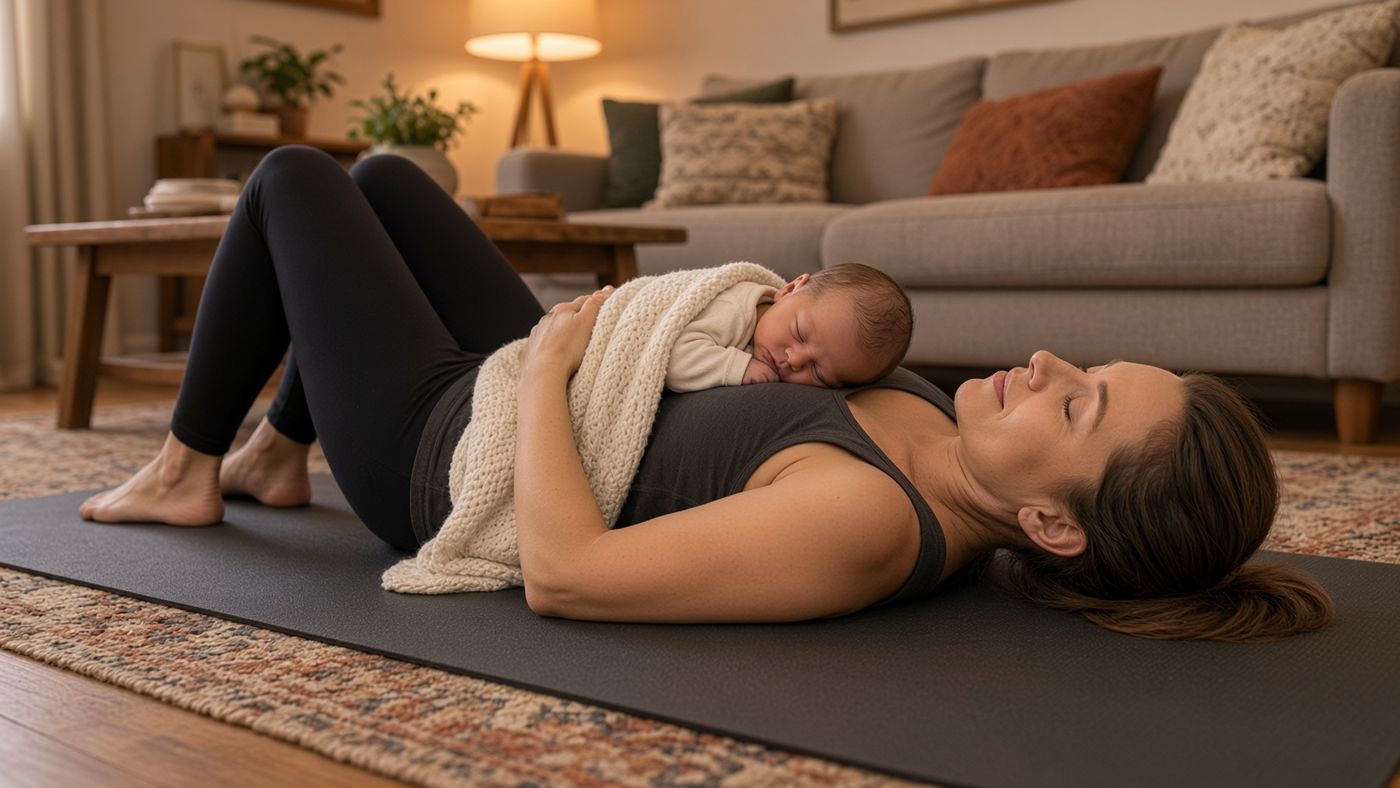
Skin-to-skin contact means holding your baby, naked or in just a nappy, against your bare chest, usually under a loose top or a blanket.5 After birth it often means the baby is dried and laid directly on the mother's chest, with both covered by a warm blanket, for at least an hour or until after the first feed.3
It is not a technique to get right. It is a way of being together: your warmth, your heartbeat, your smell and your voice, close at hand.
What the research shows for healthy newborns Evidence: moderate
The main summary of the evidence is a Cochrane review by Moore and colleagues, published in 2016. It included 46 randomized trials with 3,850 mothers and babies, of which 38 trials contributed data.1 Compared with usual care, mothers who had early skin-to-skin contact were more likely to be breastfeeding one to four months after birth, and more likely to be breastfeeding exclusively both in the first month and from six weeks to six months. The authors rated all three findings as moderate quality.1
Mothers in the skin-to-skin groups also breastfed for longer, by about 64 days on average, but this came from only a few small studies and was rated low quality.1
Babies held skin-to-skin had steadier breathing and heart rate scores and higher blood sugar, and their temperature was similar to babies in usual care. All of these findings were rated low quality.1 The authors' overall conclusion was that the evidence supports skin-to-skin contact to promote breastfeeding, that larger studies are needed to confirm the physical benefits for babies, and that the quality of many trials remains a problem. The review has since been updated, in 2025, and still supports immediate skin-to-skin contact for healthy newborns.1
Small and preterm babies
For babies born early or small, holding them skin-to-skin is called kangaroo mother care. In November 2022 the World Health Organization advised that this contact should begin immediately after birth, without any initial period in an incubator, a change from earlier practice.2 WHO also stressed caring for families and preterm babies together as a unit. In hospital, this is always done with the care team, who decide what is safe for each baby.
Partners can do it too
Skin-to-skin is not only for mothers. Ireland's health service says a birth partner can also do skin-to-skin, and that partners are encouraged to spend uninterrupted time in skin-to-skin contact with their baby.4 UNICEF UK's Baby Friendly guidance describes the same routine checks for babies in skin-to-skin with mother or father.3 If the mother needs rest after birth, a partner's chest is a warm second home.
Doing it safely
Most of the time, skin-to-skin is calm and easy. A few checks keep it that way:3,4
- Sit semi-reclined, not lying flat, so the baby cannot slip or become trapped in bedding or against your body.
- Baby's head is turned to one side, shoulders flat against your chest, head and arms above the breasts.
- You can always see your baby's face, and the nose and mouth are not covered.
- Keep the baby warm, and watch their colour and tone. A baby should never seem limp or unresponsive.
- You are awake and alert. If you feel sleepy, very tired or unwell, ask your partner or a member of staff for help.
At home, the same rule matters most. If you might doze off, move the baby to their own safe sleep space. The American Academy of Pediatrics advises that babies sleep on their back, in their own space, and that if you do fall asleep with your baby you move them back as soon as you wake. It warns that the risk of sleep-related death is up to 67 times higher when babies sleep with someone on a couch, soft armchair or cushion.6
Closeness in the months after
The first hour is not the only window. The NHS suggests continuing skin-to-skin at home, especially in the first days and weeks, and for months if you are happy to, to help calm a baby who is hungry or upset.5 Ireland's health service suggests continuing it as much as possible through the early weeks, months and years.4
Closeness also comes in many everyday forms: holding, rocking, feeding, carrying. Many parents carry their baby in a sling. If you do, read our guide to your body after birth, which covers sling safety in detail. When you are ready to move together, see mom and baby yoga, and for a quieter kind of touch, baby massage.
A calm practice to share
Not a treatment, and not something to perfect. A few quiet minutes for you and your baby, when you are both awake and settled.
- Settle in. Sit semi-reclined with good back support. Lay your baby on your bare chest, head turned to one side, face visible. Cover both of you with a blanket.
- Slow your breath. Breathe in through the nose, and let the exhale be a little longer than the inhale. Feel your baby rise and fall with your chest.
- Hum or sing. On the out-breath, hum softly or sing something simple. Your chest vibrates gently under your baby's cheek.
- Sway. If it feels good, rock slowly from side to side. Keep the movement small and smooth.
- Notice. Watch your baby's face and colour. When you or your baby have had enough, or you feel sleepy, stop and lay the baby down on their back in their own space.
When to stop and get help
Stop skin-to-skin and get help straight away if your baby seems limp, floppy or unresponsive, changes colour, or has unusual breathing sounds. Ask for support, or move the baby to their own sleep space, if you feel very sleepy or unwell. In hospital, the staff should keep checking your baby during skin-to-skin, just as they would in a cot.
The bottom line
Early skin-to-skin contact is a low-cost, gentle start that the research links with more breastfeeding, with moderate confidence. For small and preterm babies, WHO now recommends it from the very first moments. Keep the baby's face visible, stay awake and alert, share it with your partner, and let closeness continue in whatever form feels right in the months that follow.
Sources
- Moore ER, Bergman N, Anderson GC, Medley N. Early skin-to-skin contact for mothers and their healthy newborn infants. Cochrane Database of Systematic Reviews. 2016;11:CD003519. Link. Percentages from the NIHR Evidence summary of the review, Link. 2025 update: Moore ER, Brimdyr K, et al. Immediate or early skin-to-skin contact for mothers and their healthy newborn infants. CD003519.pub5. Link
- World Health Organization. New recommendations for the care of preterm and low-birth-weight infants, 15 November 2022, as reported by UN News: "WHO urges immediate skin to skin contact for babies born prematurely". Link
- UNICEF UK Baby Friendly Initiative. Skin-to-skin contact. Link
- HSE (Health Service Executive, Ireland). Skin-to-skin contact with newborns. Link
- NHS Start for Life. Skin-to-skin contact with your newborn. Link
- American Academy of Pediatrics, HealthyChildren.org. A parent's guide to safe sleep (last updated September 2026). Link
This article is general information, not medical advice. Medical review: pending.