- The pelvis is a strong ring of bone that carries the weight of the upper body to the legs, protects the pelvic organs and anchors the body's largest muscles.
- Its joints move only a little, but in pregnancy hormones soften them, which makes room for the baby and can also cause pain.
- Yoga traditions link the pelvis with grounding, safety, creativity and relationships. These are ways of paying attention, not medical facts.
A ring of bone
The word pelvis comes from the Latin for basin, and the shape fits. Each side is a single hip bone formed from three bones, the ilium, the ischium and the pubis, which fuse together during growth. You can feel the top of the ilium as the curved crest at your waist. The ischium gives you the sitting bones. The two pubic bones meet at the front, low in the belly.1
At the back, the two hip bones meet the sacrum, a triangular bone made of five fused vertebrae, with the small coccyx, the tailbone, below it. Together they close a ring that links the spine to the legs. All three hip bones meet in a deep socket, the acetabulum, where the head of the thigh bone sits to form the hip joint.1
The pelvis has three main jobs: it carries the weight of the upper body down to the legs when we stand and walk, it protects the bladder, uterus and lower bowel, and it gives attachment to the large muscles of the belly, back and thighs. Because it sits close to the body's centre of gravity, the way we hold it affects the spine above and the knees below.1
The female pelvis is generally wider and lighter than the male pelvis, with a roomier opening and a wider arch under the pubic bones, differences that relate to carrying and giving birth.1
Small joints, real movement
The ring has several joints: the two sacroiliac joints at the back, the pubic symphysis at the front, the joint between the sacrum and the tailbone, and the joint between the lowest lumbar vertebra and the sacrum.1 Because they form a closed ring, none of them moves on its own. A change on one side is felt across the whole pelvis, and in the lower back and hips.
The sacroiliac joints are held by very strong ligaments and move only a little, mainly to absorb shock in walking and landing. The pubic symphysis is joined by a disc of cartilage and normally moves very little too. The hip joint is different: a true ball-and-socket joint that moves in every direction.
In pregnancy, hormones including relaxin soften the tissues of the pubic symphysis, and the joint becomes slightly wider and more mobile.3 This is part of how the body makes room. The same change is one reason many pregnant women feel pain at the front or back of the pelvis. Pelvic girdle pain is common, and the recommended care is information, reassurance and individually adapted exercise.4
Position matters in birth as well. In an MRI study, a kneeling squat measurably increased the space in the middle and lower part of the pelvis compared with lying on the back.5 Several works in the course archive describe the same idea from experience: on all fours or leaning forward, the sacrum and tailbone are free to move back, and the outlet has more room.
The floor of the basin
The bottom of the pelvis is closed by the pelvic floor, a sling of muscle and connective tissue made mainly of the levator ani and coccygeus. It supports the bladder, uterus and bowel, and in women it has three openings: the urethra, the vagina and the anus.2 It works together with the deepest belly muscle, the transversus abdominis, and the small muscles along the spine. The course describes this team as a corset and a zipper: deep, quiet muscles that steady the pelvis and spine while the big muscles move us.
How the tradition sees it
Every work in the archive turned, sooner or later, from bones to feeling. This part is the course's approach and the traditions it draws on, not established science.
- Chakras. The pelvis is home to the first two chakras in yoga tradition. The root chakra, at the base of the spine, is linked with grounding, safety and the earth. The sacral chakra, below the navel, is linked with creativity, pleasure, desire and relationships.
- Apana. In yogic breath teaching, apana vayu is the downward, cleansing movement of energy, centred in the pelvis, the force that releases what the body no longer needs, including in menstruation and birth.
- A container for experience. Many works describe the pelvis as a place where women hold memories, emotions and unspoken stories, from the first period through pregnancy, birth and loss. Paying gentle attention to it is presented as a way to listen to that story.
The works differ in emphasis. Some stayed close to anatomy and saw the pelvis mainly as the body's centre of stability. Others drew on Chinese medicine, which links this area with the kidneys and the water element, or on Jewish sources, which tie the Hebrew word for pelvis to both a basin and protection. A few also described the cultural side: how wide hips were once a sign of fertility and abundance, and how many women today feel uneasy about this part of their body.
A practice to meet the pelvis
Practice ideas from the course, simple enough to do at home.
- Find your sitting bones. Sit on a firm chair or a folded blanket. Rock slowly from side to side and forward and back until you feel both sitting bones under you, weight shared evenly. Let the spine rise from there.
- Pelvic rocking. On hands and knees, inhale and let the belly soften and the tailbone lift; exhale and gently round the lower back, tailbone tucking. Move slowly, eight to ten times, inside a range that feels easy.
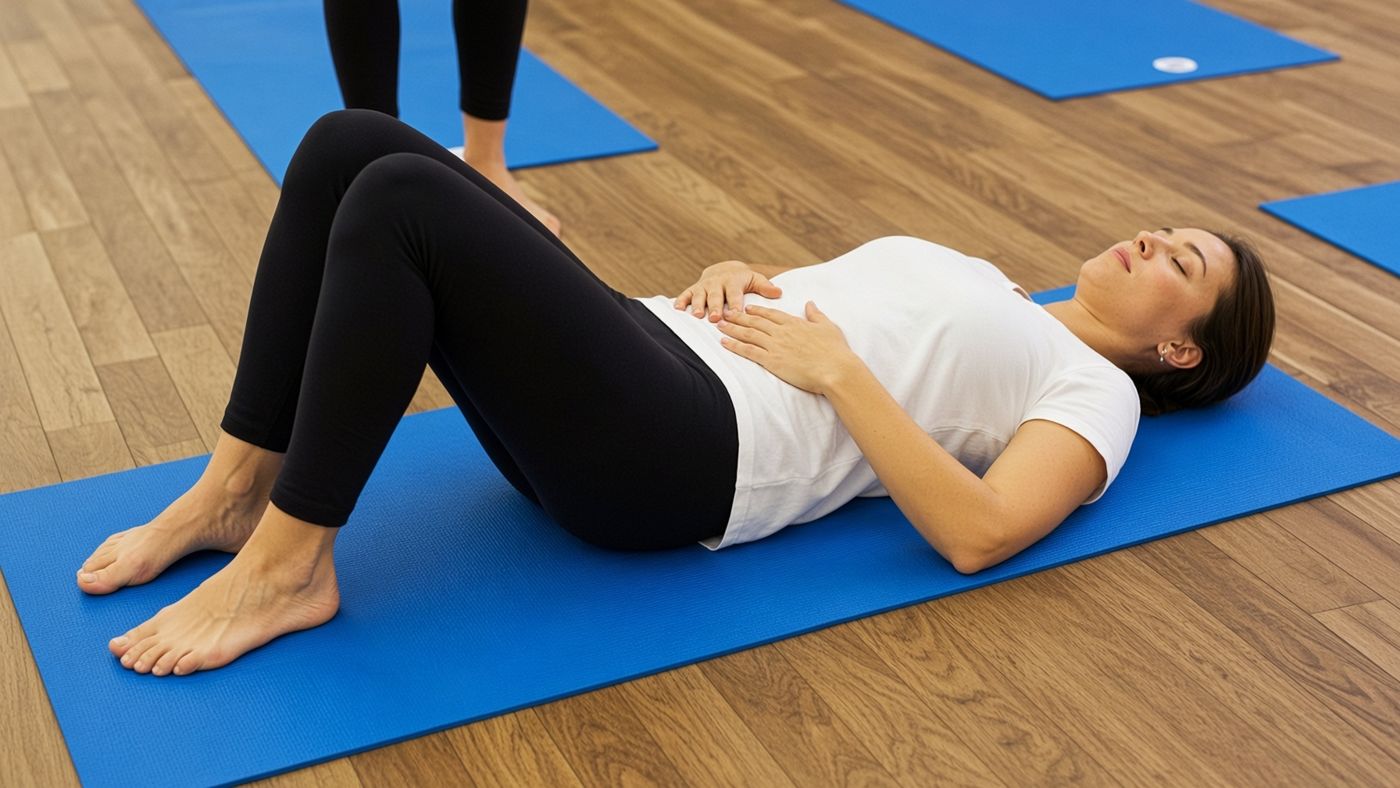
- Breathing into the base. Lying on your side or back with knees bent, inhale and imagine the breath reaching down, so the lower belly and pelvic floor soften and widen. On the exhale, let the pelvic floor lift gently, as if drawing up, then let it go completely. This is the course's way into apana and a light mula bandha.
- Free circles. Standing with knees soft, or on all fours, draw slow circles with the pelvis in each direction, like the hip movements of dance. Notice where it moves easily and where it hesitates, without forcing.
Take care
The pelvic floor lift should stay light and should always be followed by full release; constant gripping is not the goal. If you have pelvic girdle pain, keep movements small and symmetrical and avoid wide stances or standing on one leg. After birth, start gently and check with your caregiver. Pain, leaking, a feeling of heaviness in the pelvis or pain at the pubic bone are reasons to see a pelvic health physiotherapist or your doctor.
The ligaments that hold the uterus
Inside the basin, the uterus is held in place by ligaments as well as muscle. The broad ligament is a double fold of the abdominal lining that runs from each side of the uterus to the side walls of the pelvis. Along its upper edge runs the round ligament, a rope-like band about 10 to 12 cm long that travels from the top of the uterus down through the groin and ends in the tissue of the outer lips of the vulva.6
As the bump grows, these ligaments stretch to support it. The NHS calls the resulting ache "growing pains": often a sharp cramp on one side of the lower tummy, which is usually nothing to worry about if it eases when you change position or rest.7 Tummy pain with bleeding, regular tightening, pain when you pee, or pain that is severe or does not ease after 30 to 60 minutes of rest needs a call to your maternity unit.7
The bottom line
The pelvis is a sturdy ring that moves only a little, yet that little movement matters: in walking, in posture, and above all in pregnancy and birth. The course asked women to know it twice, as anatomy and as experience. Learning where the bones are, moving them gently and breathing into the base of the body is a calm way to do both.
Sources and further reading
- Anatomy, Bony Pelvis and Lower Limb: Pelvis Bones. StatPearls, NCBI Bookshelf. Link
- Anatomy, Abdomen and Pelvis: Pelvic Floor. StatPearls, NCBI Bookshelf. Link
- Becker I, Woodley SJ, Stringer MD. The adult human pubic symphysis: a systematic review. Journal of Anatomy. 2010;217(5):475–487. Link
- Vleeming A, et al. European guidelines for the diagnosis and treatment of pelvic girdle pain. European Spine Journal. 2008;17(6):794–819. Link
- Reitter A, et al. Does pregnancy and/or shifting positions create more room in a woman's pelvis? American Journal of Obstetrics and Gynecology. 2014. Link
- Chaudhry SR, Chaudhry K. Anatomy, Abdomen and Pelvis: Uterus Round Ligament. StatPearls. NCBI Bookshelf, 2023. Link
- NHS. Stomach pain in pregnancy. Last reviewed 18 November 2024. Link
Based on works from the 2011 women's yoga teacher course, reviewed and updated. General information, not medical advice. Medical review: pending.