- As pregnancy goes on, the body's centre of mass moves forward and many women widen their stance and steps to stay steady, most clearly in the third trimester.
- Falls are fairly common: in one large study, about one in four women fell at some point during pregnancy, often while hurrying, carrying something or on a slippery floor.
- Balance practice is welcome in a healthy pregnancy, as long as it is done near a wall or chair, slowly, and without any real risk of falling. On tired days, gentle chair exercise keeps you moving with the seat as your support.
What changes, and why
A growing baby, placenta and uterus add weight to the front of the body. Studies of pregnant women's movement show that the body's centre of mass moves forward, while it hardly shifts to the sides.1 To cope, many women stand with their feet a little wider and take wider steps, a change that peaks in the third trimester and settles again after birth.1
You may have heard that the lower back always arches more in pregnancy. The research is less tidy: some studies found a deeper curve, others found no change, and others found more rounding in the upper back instead.1 Bodies find their own solutions.
The joints also become somewhat looser. In one study, more than half of the women had measurably looser wrists by the third trimester. Interestingly, that looseness did not match their levels of relaxin, the hormone usually blamed for it, so the full explanation is still open.4
Does balance actually get worse?
Not in the same way for everyone. A 2024 systematic review of 22 studies found mixed results: as pregnancy advanced, balance got worse in some studies, stayed the same in others, and even improved in a few. The studies measured balance in very different ways, which makes them hard to compare.2 Standing still with the eyes closed tends to be harder in late pregnancy, which shows how much the body relies on sight to stay upright.1
What is clearer is that falls happen. In a study of almost 2,850 working women, 26.6% fell at least once during pregnancy. At work, most falls involved a slippery floor, hurrying, or carrying an object or a child.3 These are ordinary moments, which is why everyday awareness matters as much as any pose.
The review authors suggest that antenatal exercise can include balance training, with good supervision and support.2 The NHS also lists yoga among the activities that suit pregnancy, while advising against activities where there is a risk of falling.5
The course's approach
The 2020 course treated balance as more than standing on one leg. In its view, physical steadiness and inner steadiness grow together. Each practice moved from stillness on the floor, to all fours, to standing, so that the body could gather confidence step by step. Every transition was made on an exhale, with a gentle lift of the pelvic floor, which the course called mula bandha. This is a yogic idea, not a proven safety technique, but a slow, attentive exhale is a sensible way to move when your body feels different from week to week.
A balance practice for pregnancy
Keep a wall or a sturdy chair within reach for every standing step. Practise on a non-slip mat, barefoot, and stop anything that feels unsteady or uncomfortable.
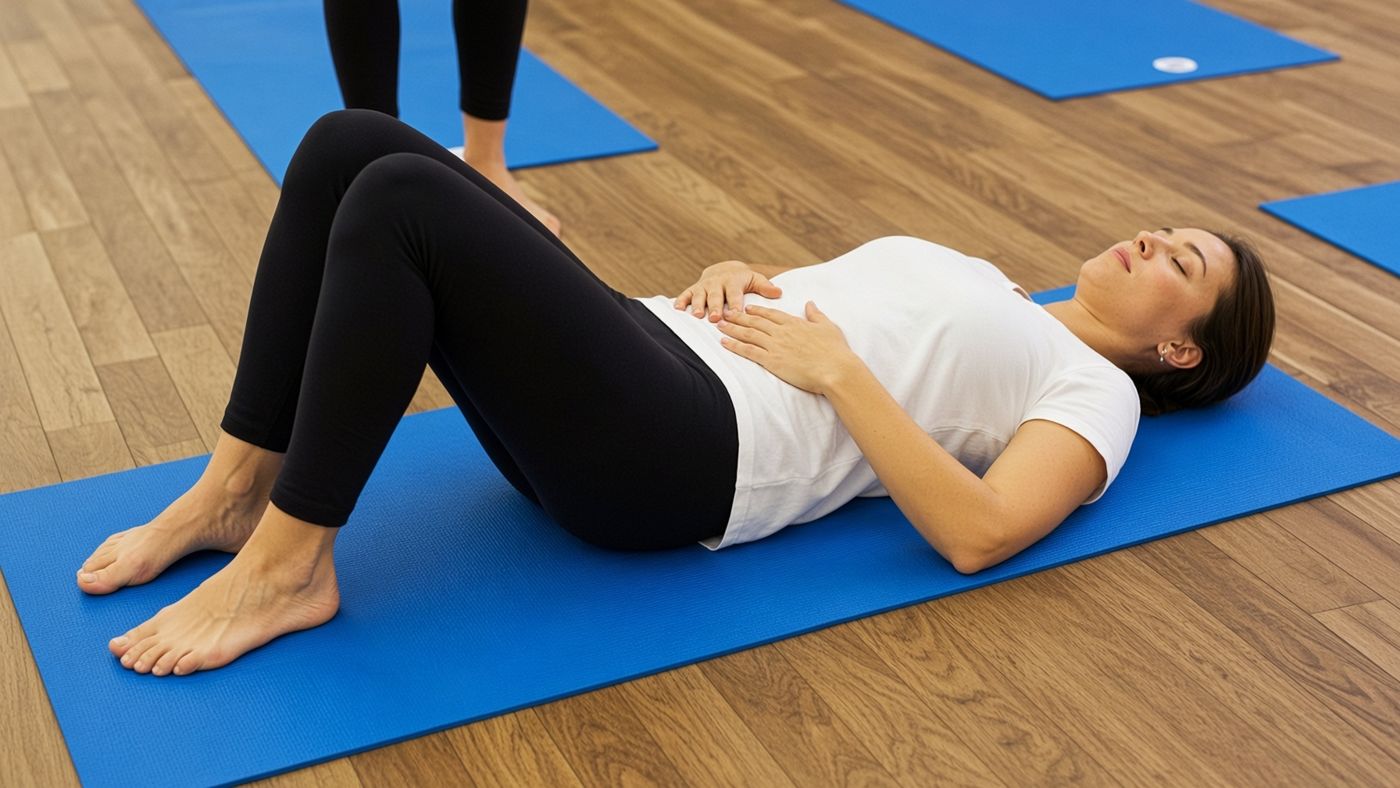
- Arrive. Lie on your side with a pillow between your knees, or sit propped up on cushions. Notice the sensations in the pelvis without trying to change them, then follow the breath through the nose for a few minutes. Safety: later in pregnancy, avoid lying flat on your back for more than a few minutes.5
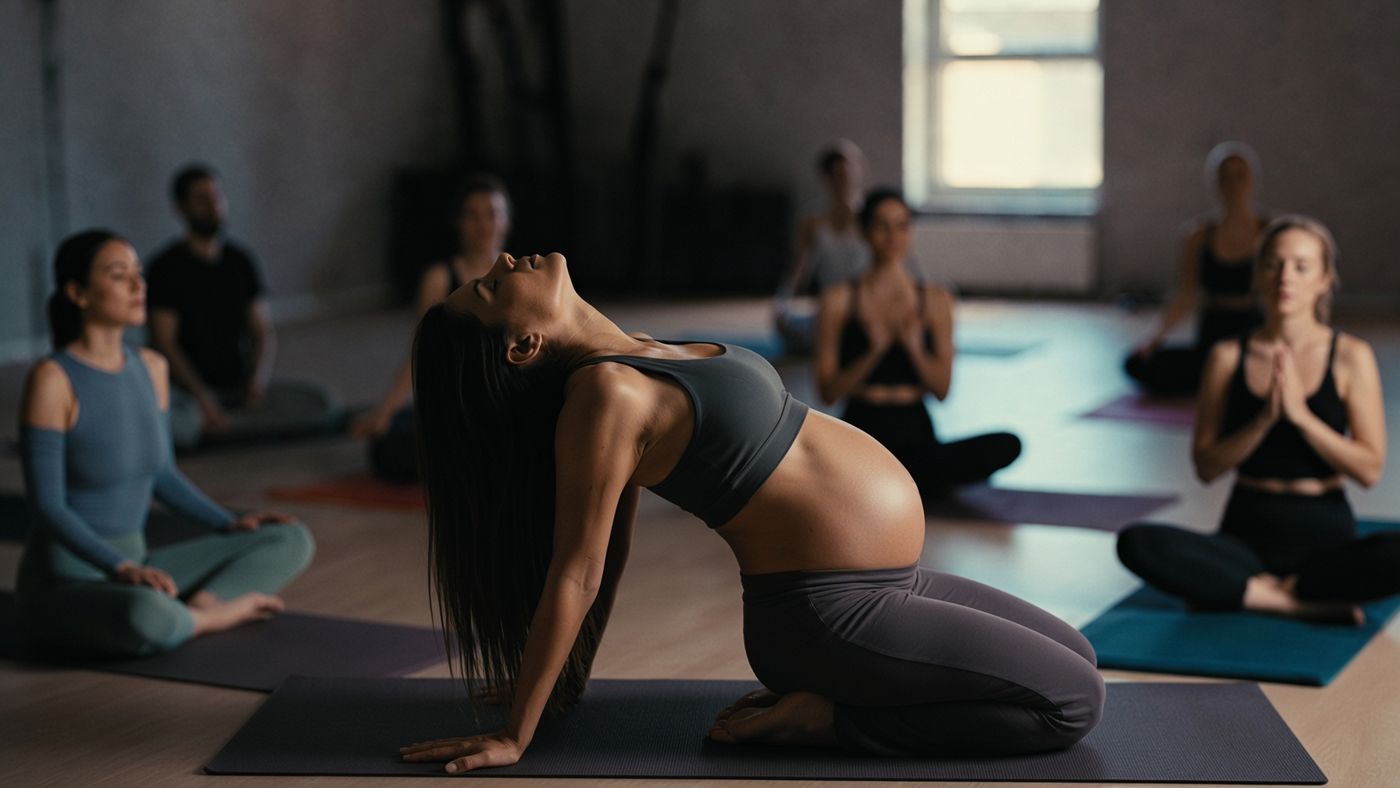
- Kneel and settle. Kneel and sit back on your heels, with a cushion or block between the heels if your knees or ankles complain. If your shoulders welcome it, cross one arm over the other in front of your face, bring the palms towards each other, and breathe into the back of the shoulders. Change arms. Kneeling is a low, stable base: a good place to feel the weight drop down before you stand.
- Find all fours. Come onto hands and knees, hands under shoulders, knees under hips. Round and gently arch the back a few times with the breath, then rest in a wide-knee forward fold with the belly between the thighs.
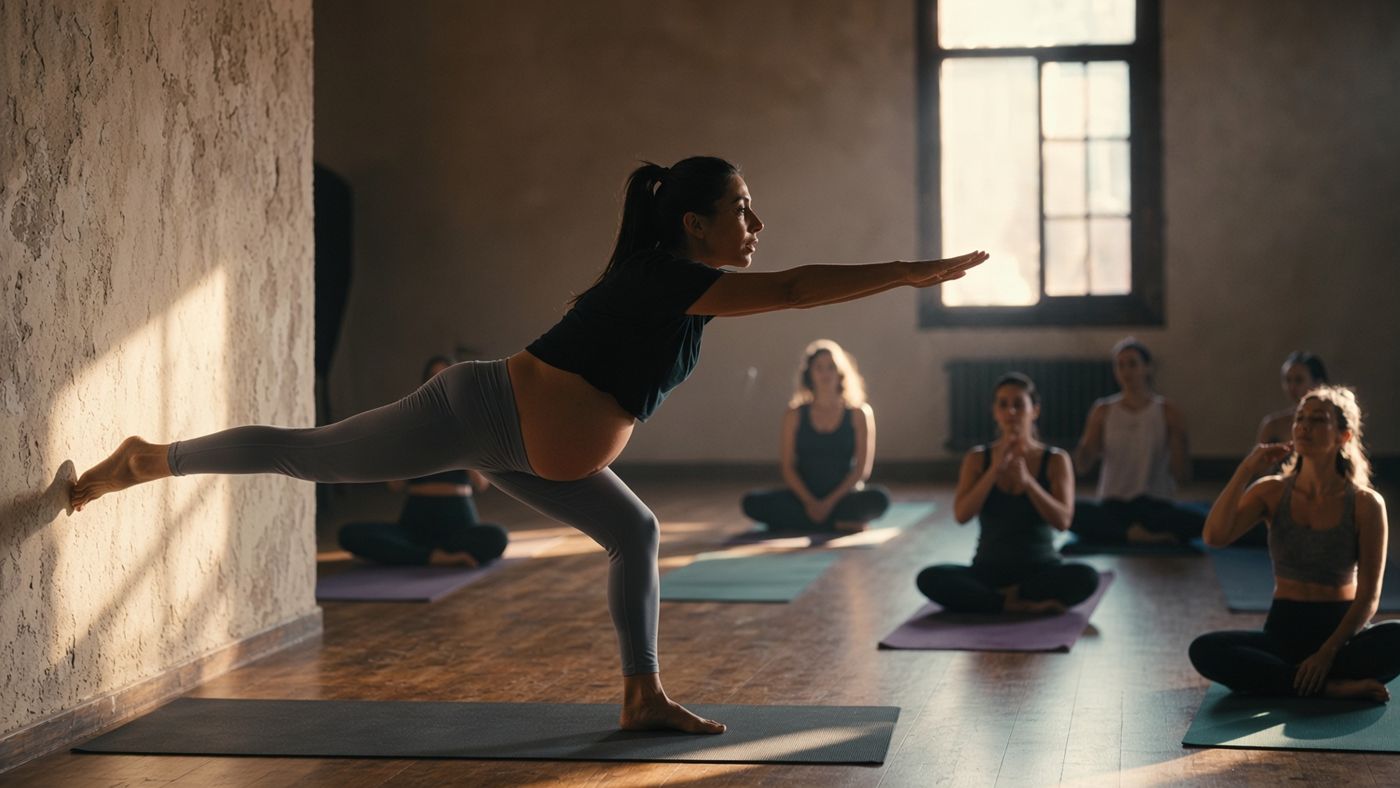
- Reach on all fours. From hands and knees, slide one leg back along the floor, then lift it only to hip height. If you feel steady, add the opposite arm. Hold for a few breaths and change sides. Safety: keep the lift small; the aim is a steady body, not a high leg.
- Standing warriors. With a chair or wall nearby, step into Warrior II with the feet wide and the front knee over the ankle, then into a short, supported Triangle with the hand on the thigh or a block. Safety: keep the stance a little shorter than usual and the feet wider apart sideways, to match the wider base the body is already choosing.
- Shift the weight. Stand with feet hip-width apart, one hand on the wall. Slowly move your weight from one foot to the other. Then rise lightly onto the toes of the back foot, and, only if it feels steady, lift it a little.
- Tree, supported. Keeping a hand on the wall, rest one foot against the ankle or calf of the standing leg (not on the knee), with the standing knee soft. Breathe here, then change sides. Safety: keep the eyes open and the gaze on a fixed point. If you feel dizzy, lower the foot at once.
- Come down slowly. Return to the floor through kneeling, rest in the forward fold, then lie on your side to rest. When you get up, rise slowly in stages: light-headedness is common in pregnancy.
Off the mat, the same lessons apply: slow down on stairs and wet floors, keep one hand free when you carry things, and choose shoes with good grip.3
When to see your midwife or doctor
Contact your midwife or maternity unit straight away if you fall or bump your tummy, even if you feel fine. Seek help too if you have bleeding, fluid leaking, tummy pain or contractions, if your baby is moving less than usual, or if you feel faint, dizzy or short of breath during or after exercise. Ask your midwife or doctor before balance work if you have a condition that limits exercise in pregnancy.
The bottom line
The body's weight moves forward in pregnancy, and many women adapt by widening their base. Whether balance clearly gets worse is still debated, but falls are common enough to take seriously. Gentle balance practice with a wall or chair nearby, slow transitions and attention in everyday moments are a reasonable way to stay steady through the months ahead.
Sources
- Conder R, Zamani R, Akrami M. The biomechanics of pregnancy: a systematic review. Journal of Functional Morphology and Kinesiology. 2019;4(4):72. Link
- Forczek-Karkosz W, Masłoń A. Postural control patterns in gravid women: a systematic review. PLoS ONE. 2024;19(12):e0312868. Link
- Dunning K, LeMasters G, Levin L, Bhattacharya A, Alterman T, Lordo K. Falls in workers during pregnancy: risk factors, job hazards, and high risk occupations. American Journal of Industrial Medicine. 2003;44(6):664–672. Link
- Marnach ML, Ramin KD, Ramsey PS, Song SW, Stensland JJ, An KN. Characterization of the relationship between joint laxity and maternal hormones in pregnancy. Obstetrics & Gynecology. 2003;101(2):331–335. Link
- NHS. Exercise in pregnancy. Link
Based on works from a 2020 pregnancy yoga teacher course, reviewed and updated. General information, not medical advice. Medical review: pending.