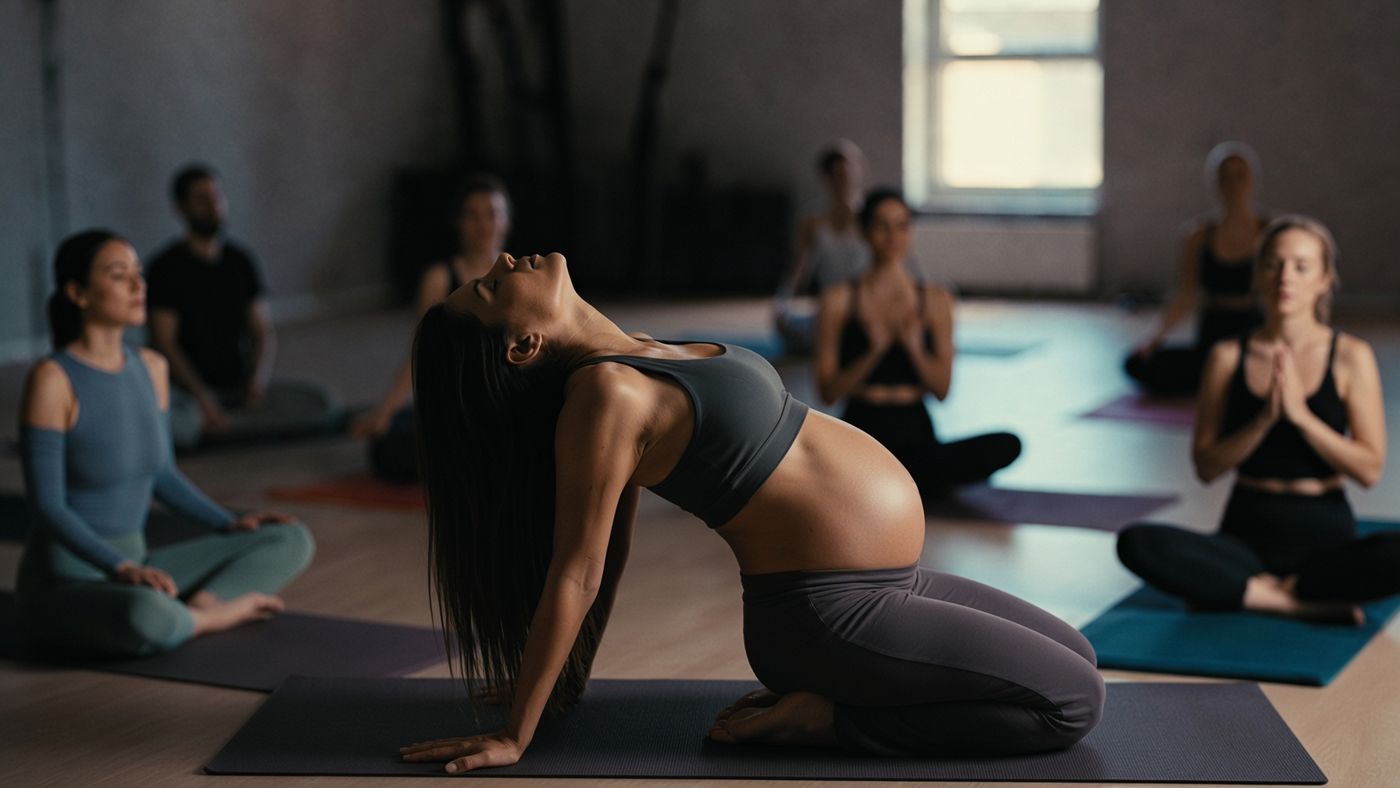
- Major guidelines encourage regular physical activity throughout pregnancy for women without a medical reason to avoid it, including in the first weeks. Yoga and gentle stretching are named as options.
- The largest review so far found no link between exercise and miscarriage. The studies behind it are weak, but they point in the same direction.
- The changes that matter most: avoid overheating (including hot yoga), avoid poses with a real risk of falling, and listen to your body on tired and nauseous days.
What the guidelines say
The World Health Organization's 2020 guidelines include, for the first time, recommendations specifically for pregnant and postpartum women. They recommend that all pregnant women without a contraindication do regular physical activity throughout pregnancy, aiming for at least 150 minutes of moderate-intensity aerobic activity across the week, with a mix of aerobic and muscle-strengthening activity. They add that gentle stretching may also be beneficial, and that women who were already active, even vigorously, before pregnancy can continue.1
The American College of Obstetricians and Gynecologists (ACOG) reached a similar conclusion in its 2020 Committee Opinion. It describes physical activity in pregnancy as "safe and desirable," asks obstetric care providers to encourage patients to start or continue exercising, and notes that routines may need to change as the body changes.2
Neither guideline asks women to wait until the second trimester. "Without a contraindication" is the important part: some pregnancies come with medical reasons to limit exercise, and only your caregiver can tell you whether yours is one of them.
Can exercise cause a miscarriage? Evidence: very low, but consistent
This is the fear behind most first-trimester questions, so it deserves a direct answer. A 2019 systematic review and meta-analysis brought together 46 studies to look at whether exercise in pregnancy is linked to losing the baby.3
Women who exercised did not have higher odds of miscarriage than women who did not. The same was true for loss around the time of birth. The amount, intensity and frequency of exercise made no difference either.3
Two honest caveats. First, the authors rated the quality of this evidence as very low. Second, most of the studies looked at moderate exercise of up to 60 minutes, so they cannot speak to much longer sessions.3 Still, no study pattern suggested harm, and the authors concluded that prenatal exercise appears safe with respect to miscarriage.
What to change, and why
Heat: the clearest rule
The WHO advises pregnant women to avoid physical activity in excessive heat, especially with high humidity, and to stay hydrated before, during and after exercise.1 A 2022 review by pregnancy exercise researchers names hot yoga specifically as an example, because of the risk of dehydration and overheating, while noting that the evidence on exercising in heat is limited.4 In practice: choose a cool, ventilated room and skip heated classes.
Falls and contact
The WHO also advises avoiding activities with physical contact or a high risk of falling.1 In yoga, that means taking care with one-legged balances, arm balances and inversions. Use a wall or a chair for balance poses, and leave out anything you would not feel steady in on a tired day.
Lying on your back
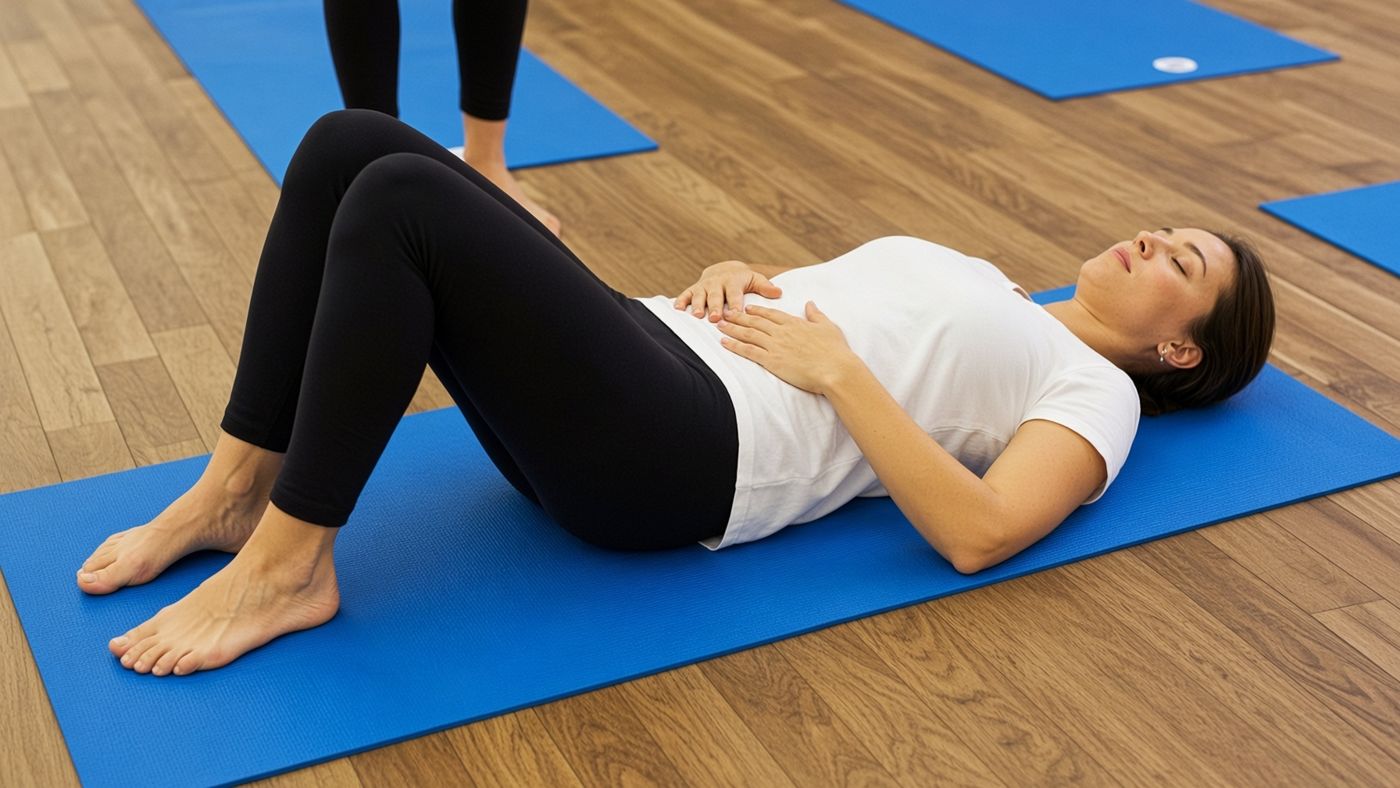
The WHO recommends avoiding exercise lying on the back after the first trimester.1 So in the first trimester itself, this is not yet a concern. Later on, the evidence is less certain than the rule suggests: a 2019 systematic review found too little evidence to say whether exercising on the back is safe or should be avoided.5 If you feel dizzy, sick or unwell on your back at any stage, simply turn onto your side.
Poses many classes forbid
A small study at 35 to 37 weeks monitored 25 healthy women through 26 yoga poses, including some often listed as forbidden, such as Downward Dog and Happy Baby. Mothers' vital signs and babies' heart rates stayed normal, and there were no falls or injuries across 650 poses.6 It was a small, short study, late in pregnancy, so it cannot clear every pose. But it is a reminder that many pose bans were never tested.
Where advice is tradition, not evidence
You may hear that you must avoid deep twists, stretching far, or working the belly in early pregnancy. We could not find studies that tested these rules. They may be reasonable caution, and a closed, gentle twist is a sensible choice over a deep one, but they are tradition and common sense, not research findings. Comfort is a fair guide: if a pose presses on the belly or feels strained, ease off.
A gentle practice for nausea and fatigue days
Not a treatment for nausea. A way to keep moving when your body asks for less. Ten to fifteen minutes is plenty.
- Seated breathing. Sit on a cushion or a chair near an open window. Breathe in through the nose, and let the exhale be a little longer than the inhale. Two or three minutes.
- Neck and shoulder rolls. Slow circles of the shoulders, then let the head tip gently from side to side. Keep the movements small if you feel queasy.
- Cat and cow. On hands and knees, round the back on the exhale and gently lengthen it on the inhale. Move slowly; skip it if being on all fours makes nausea worse.
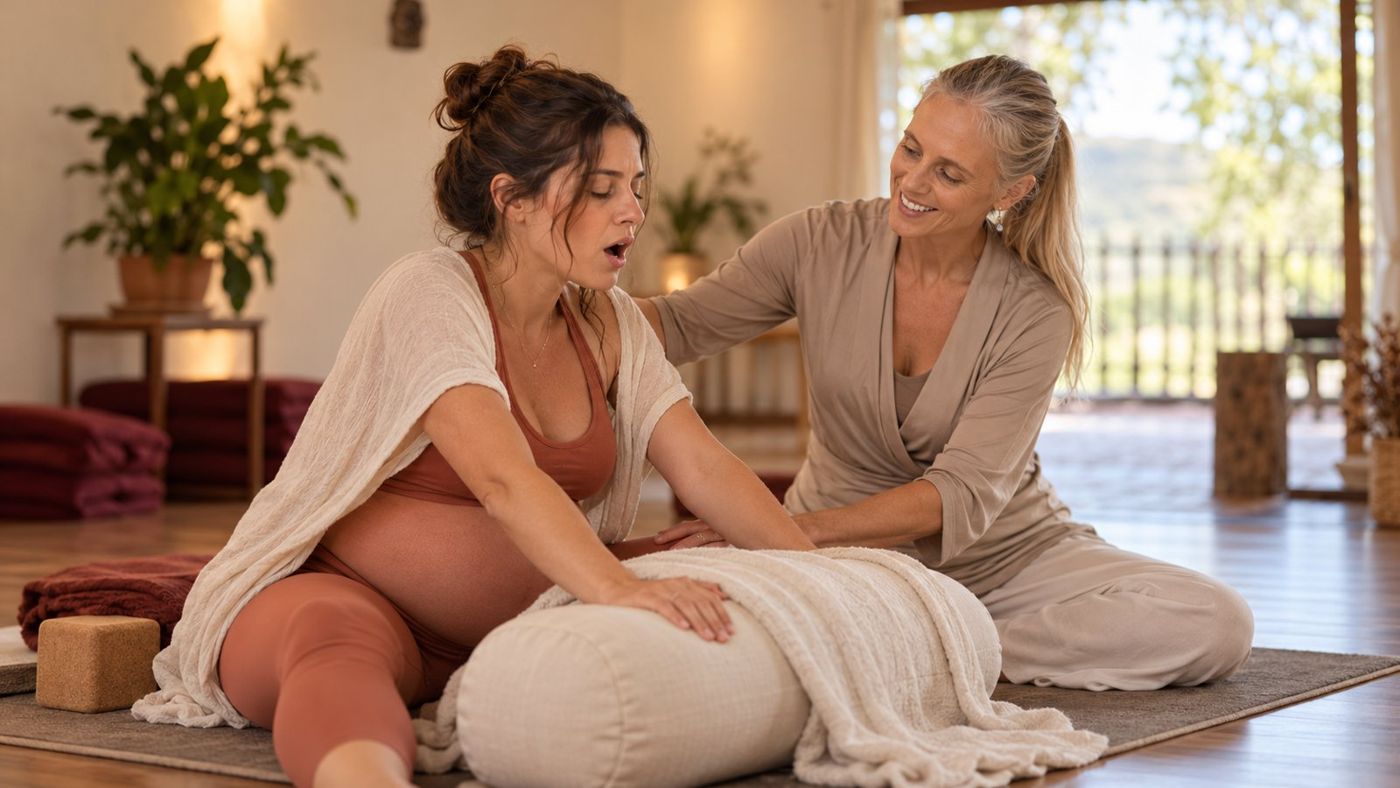
- Supported child's pose. Knees wide, a cushion or bolster under the chest and head. Stay for a few breaths, rising slowly.
- Side-lying rest. Lie on your side with a pillow between the knees. Rest for five minutes. Get up by pushing yourself up with your arms, slowly.
Keep water and a small snack nearby, and stop whenever you have had enough. On days with more energy, a walk or a regular gentle class counts toward the weekly minutes.1
When to stop and call your caregiver
Stop exercising right away and seek medical advice if you have vaginal bleeding, a persistent loss of fluid from the vagina, regular and painful contractions, severe chest pain, shortness of breath that is persistent and excessive, or dizziness or faintness that does not go away with rest.4 Also check with your caregiver before starting if you have any condition you have been told may affect exercise.
The bottom line
For most women, yoga in the first trimester is not only allowed but encouraged by the major guidelines. The research on miscarriage is reassuring, though not strong. Keep cool, keep steady, rest on hard days, and treat many of the stricter pose rules as caution rather than proven fact. When something does not feel right, stop and ask.
Sources
- Bull FC, Al-Ansari SS, Biddle S, et al. World Health Organization 2020 guidelines on physical activity and sedentary behaviour. British Journal of Sports Medicine. 2020;54(24):1451–1462. Link
- American College of Obstetricians and Gynecologists. Physical activity and exercise during pregnancy and the postpartum period: ACOG Committee Opinion No. 804. Obstetrics & Gynecology. 2020. Link
- Davenport MH, Kathol AJ, Mottola MF, et al. Prenatal exercise is not associated with fetal mortality: a systematic review and meta-analysis. British Journal of Sports Medicine. 2019;53(2):108–115. Link
- Davenport MH, Hayman M. Physical activity during pregnancy: essential steps for maternal and fetal health. Obstetric Medicine. 2022;15(3):149–150. Link
- Mottola MF, Nagpal TS, Bgeginski R, et al. Is supine exercise associated with adverse maternal and fetal outcomes? A systematic review. British Journal of Sports Medicine. 2019;53(2):82–89. Link
- Polis RL, Gussman D, Kuo YH. Yoga in pregnancy: an examination of maternal and fetal responses to 26 yoga postures. Obstetrics & Gynecology. 2015;126(6):1237–1241. Link
This article is general information, not medical advice. Medical review: pending.