- Numbness and tingling in the thumb and first fingers, often worse at night, is common in pregnancy. The usual cause is swelling that presses on a nerve at the wrist.
- A wrist splint worn at night, raising the hands, cooling them and easing off repeated wrist bending are the usual first steps.
- For many women it settles after birth, but not always quickly. Weakness, or sudden swelling with headache or blurred vision, needs a call the same day.
What is happening in the wrist
On the palm side of the wrist there is a narrow passage called the carpal tunnel. The tendons that bend the fingers run through it, together with the median nerve, which brings feeling to the thumb, index, middle and part of the ring finger. When the tissues in that tight space swell, the nerve is squeezed. That is carpal tunnel syndrome.1
In pregnancy the body holds more fluid, and some of it gathers in the hands and wrists. NHS physiotherapists note that mild swelling often appears from around five months, and that is when the tingling tends to start.2 Typical signs are pins and needles, numbness or an ache in the fingers, a clumsy or weak grip, and symptoms that are worst at night or on waking.1
How common is it?
More common than most people expect. A systematic review found that, depending on how it was measured, between about a third and almost two thirds of pregnant women reported typical symptoms, and between 7% and 43% had changes that showed up on nerve tests.3
The NHS notes that carpal tunnel syndrome caused by pregnancy often gets better by itself within a few months.1 It does not always vanish at birth, though. In the same review, more than half of the women still had some symptoms a year later, and about 30% did after three years.3 Those numbers come from a small number of studies, but they are a good reason to take the symptoms seriously rather than simply wait.
What helps day to day
- A wrist splint at night. It keeps the wrist straight while you sleep, when most of us curl our hands. A Cochrane review found limited evidence that a night splint helps more than no treatment in the short term.4 Splints are sold in pharmacies, and a physiotherapist can help you choose one.
- Hands up. When you rest, prop your hands on a cushion or along the back of the sofa. Gentle stroking from the wrist towards the elbow may also help.2
- Cool, not cold. A cold pack on the wrist, or a minute with the hands in cool water, repeated a few times, may ease the swelling.2
- Fewer repeats. Cut down on repeated wrist bending, hard gripping and heavy carrying, and break up long tasks. Try not to sleep lying on your hands.12
- Gentle movement. Light hand and wrist exercises may ease symptoms, although the evidence is limited.1 Choose what feels better. If a movement brings the tingling on, leave it out.
The course's approach: move the hand from further up
The yoga course this article draws on did not try to stretch the wrist itself. The idea was to rest the wrist while keeping the rest of the body moving: let the movement of the hand start in the forearm, the elbow and the shoulder, and work with the chest and upper back. The course favoured positions where the hands are above the heart and the chest is open, diagonal and turning movements, and opening the fingers wide as a counter to the clenched, curled hand.
The course also paid attention to posture. As the belly grows, the whole spine adjusts, and the teaching was to bring movement and space to the upper back and neck as well as the hands. This is the course's way of working, not a proven treatment for carpal tunnel syndrome. Numbness in the hands can have other causes too, which is one more reason to have it checked.
A gentle practice
About 20 minutes. Use cushions freely, keep the breath easy, and stop anything that makes the tingling worse.
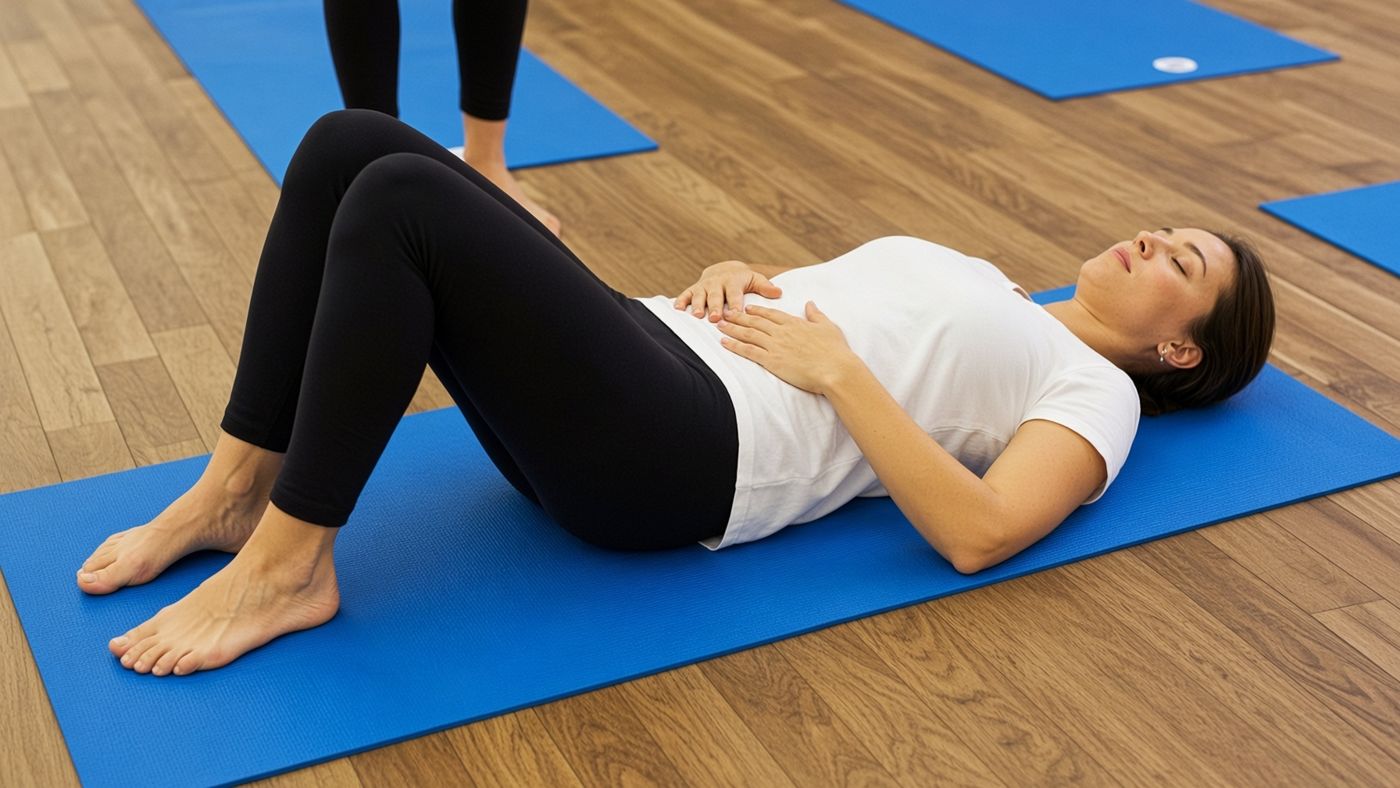
- Arrive. Lie on your back with your head and shoulders raised on cushions, knees bent and feet on the floor. Notice where your back meets the floor. If lying on your back makes you dizzy, breathless or uncomfortable, which is more likely later in pregnancy, do this on your side instead.
- Breathe down. A few slow breaths, letting the exhale travel down towards the pelvis. Notice how each breath changes the contact of your back with the floor.
- Write with the chest. Imagine a pen in the middle of your chest pointing up. Slowly write a word on the ceiling, perhaps your baby's name. Small, round movements of the ribs and upper back, with the arms soft.
- The mermaid. Lie on your side with a cushion under your head and one between your knees. Write the word again, this time leading from the belly button, then the hip, then the nose. Let the rest of the body follow like a tail.
- Spine waves on all fours. Come to hands and knees and let the spine move slowly in waves. Protect the wrists: rest on your fists, keeping the wrists straight, or bring your forearms down onto blocks or the seat of a chair. Keep the belly gently supported, without deep sagging.
- Open the chest. Still on all fours, or sitting, slide one arm under towards the opposite armpit, then sweep it open and up towards the ceiling, turning from the upper back and following the hand with your eyes. Keep the twist in the chest, not the belly. Three to five times each side.
- Hands above the heart. Sit or stand. Reach the arms up on a diagonal, moving from the shoulder and elbow while the wrists stay long and soft. At the top, spread the fingers wide, then let them relax. Lower slowly and repeat.
- Stand tall. Feet firmly on the floor, pelvis and ribs stacked, crown lifting. Notice how the upper back has adjusted to the weight of the belly, and let it rest there for a few breaths.
Avoid long holds with weight on bent-back wrists, and avoid pressing the palms hard together. Both bend the wrist far and may bring symptoms on.
When to see your midwife or doctor
Mention tingling hands at your next appointment, so it can be checked and other causes ruled out. See your doctor sooner if the numbness is constant, if your hand feels weak, you drop things, or the muscle at the base of the thumb looks thinner, or if splints and rest have not helped. A steroid injection is sometimes offered.1 Call your maternity unit straight away if swelling of the face, hands or feet comes on suddenly, or comes with a severe headache, blurred vision or flashing lights. These can be signs of pre-eclampsia.5
The bottom line
Tingling hands in pregnancy are common and usually come from swelling around a nerve at the wrist. Keep the wrists straight at night, raise and cool the hands, and spread out the tasks that make them worse. Gentle movement from the shoulders and upper back is a kind way to keep the body moving while the wrists rest. If it does not settle, or if anything feels sudden or severe, get it checked.
Sources
- NHS. Carpal tunnel syndrome. Link
- NHS Tayside Physiotherapy. Carpal tunnel during pregnancy. Link
- Padua L, Di Pasquale A, Pazzaglia C, Liotta GA, Librante A, Mondelli M. Systematic review of pregnancy-related carpal tunnel syndrome. Muscle & Nerve. 2010;42(5):697–702. Link
- Page MJ, Massy-Westropp N, O'Connor D, Pitt V. Splinting for carpal tunnel syndrome. Cochrane Database of Systematic Reviews. 2012;(7):CD010003. Link
- NHS. Pre-eclampsia. Link
Based on works from a 2020 pregnancy yoga teacher course, reviewed and updated. General information, not medical advice. Medical review: pending.