- Leg cramps are common in pregnancy, mostly in the last trimester and mostly at night. They usually pass after the baby is born.
- Nobody knows exactly why they happen, and no supplement has been clearly shown to prevent them.
- Gentle stretching and moving the legs during the day may help. A painful, swollen, red or warm leg is not a cramp and needs checking the same day.
What a cramp is
A cramp is a muscle that suddenly tightens and will not let go. In pregnancy it is usually the calf, sometimes the foot. It can last a few seconds or up to about ten minutes, and the muscle may feel sore for a while afterwards.2 It tends to come at night or when you are resting, which is why so many women meet it half asleep.
About a third of pregnant women have leg cramps, usually from around week 27 until the birth.3 The good news is in the same sentence: cramps that come with pregnancy should pass after the baby is born.3
Why does it happen?
Honestly, we don't know. Ideas often mentioned include the extra weight the legs carry, changes in circulation, and changes in minerals in the blood. None of them has been proven as the cause. It is fine to say "nobody is sure" and focus on what helps.
Magnesium, calcium and vitamins Evidence: low to very low
This is where older advice needs updating. Many pregnancy books, including the materials this article is based on, describe magnesium and calcium as very effective against cramps. The research does not back that up.
A Cochrane review updated in 2020 gathered eight small trials with 576 pregnant women, testing magnesium, calcium, vitamin B, vitamin C and vitamin D.1 What it found:
- Magnesium: the results were inconsistent. Some measures improved in one trial, others showed little or no difference.
- Calcium: very uncertain. One small trial suggested a slight drop in how often cramps came.
- Vitamin D, or calcium with vitamin D: little or no difference.
- Vitamin B: one small trial with a hopeful result, too small to rely on.
The authors concluded that it is unclear whether any of these treatments work, and that safety was barely reported.1 So eating a varied diet is always worth doing, but don't expect a particular food or tablet to fix cramps. Before taking any supplement in pregnancy, ask your midwife or doctor.
When a cramp strikes
Most cramps pass on their own. These may make it easier:2
- Stretch the calf. Straighten the leg and gently draw your toes back toward your shin, heel pushing away. If you can't reach your foot, loop a towel or scarf around it.
- Stand on it. Getting up and putting weight through the cramping leg can help the muscle release. Hold on to the bed or a wall, because a cramp can make you unsteady.
- Rub it gently. Slow, firm strokes along the calf once the worst has eased.
- Breathe out slowly. In the course's approach, a long exhale helps you stop bracing against the pain while the muscle lets go.
A daytime practice for the legs
Regular calf stretching may reduce cramps, though it may not stop them completely,2 and moving your legs during the day can help too.3 The 2020 course built its practice around the same idea: keep the legs working, and stretch the calves and the front and back of the leg. Do it once or twice a day, and a few minutes before bed. Move slowly, never bounce, and stop if anything hurts.
- Ankle circles and pumps. Sitting, lift one foot and draw slow circles with the ankle, then flex and point ten times. Change feet. A simple way to start the circulation in the lower legs.
- Wall calf stretch. Stand facing a wall, hands on it. Step one foot back, heel down, back knee straight, and lean forward until you feel the calf. Hold a few breaths, then bend the back knee slightly to reach lower down. Change sides.2
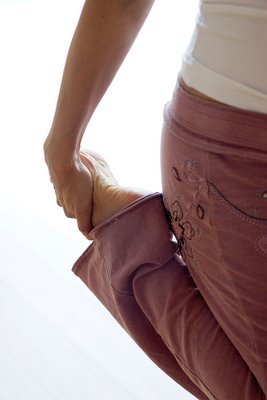
- Standing thigh stretch. The stretch in the photo above. One hand on a wall or chair, bend one knee and hold the foot behind you, knees side by side. Keep the belly soft and don't arch the lower back. If you can't reach, loop a strap around the ankle.
- Kneeling on tucked toes. Kneel with the toes tucked under and sit back gently, hands on the thighs, to stretch the soles of the feet. A few breaths is enough. Put a cushion between heels and buttocks if the knees complain.
- Warrior II. Feet wide, front knee bent over the ankle, arms long. A strong standing pose that works the legs. Use a shorter stance and a chair nearby as balance changes.
- Supported downward dog. Hands on a wall or the seat of a chair, walk back until the body makes an "L", feet hip-width apart. Bend the knees a little and press the heels toward the floor to lengthen the calves and the backs of the legs.
- Strap stretch for the back of the leg. Sit propped up against cushions, or lie on your back only if it feels fine. Loop a strap around one foot and lift the leg slowly, toes drawing toward you. Later in pregnancy, avoid long spells lying flat on your back. If you feel dizzy, sick or short of breath, roll onto your side.5
- Legs resting up. Finish by resting your legs on a sofa or a stack of cushions while you lie on your side or sit propped up, rather than lying flat with your legs up a wall.
Small habits from the course help too: get up and walk a little if you have been sitting or lying still for a long time, and take a short walk most days.
When to see your midwife or doctor
Mention it if cramps keep waking you, last longer than ten minutes, or come with numbness or swelling.2 A blood clot in the leg (deep vein thrombosis) can feel like a cramp but doesn't ease: throbbing pain in one calf or thigh, swelling in one leg, or red, warm or darkened skin. Pregnancy and the first six weeks after birth raise the risk, so contact your maternity unit or doctor the same day. If you also feel short of breath or have chest pain, call for emergency help.4
The bottom line
Night cramps are common, harmless in themselves, and usually gone once the baby arrives. No supplement has been shown to stop them, but stretching the calves, keeping the legs moving during the day and knowing how to release a cramp can make the nights a little easier.
Sources
- Luo L, Zhou K, Zhang J, Xu L, Yin W. Interventions for leg cramps in pregnancy. Cochrane Database of Systematic Reviews. 2020;(12):CD010655. Link
- NHS. Leg cramps. Link
- nidirect (Northern Ireland government health information). Leg cramps. Link
- NHS. Deep vein thrombosis (DVT). Link
- American College of Obstetricians and Gynecologists. Physical activity and exercise during pregnancy and the postpartum period. Committee Opinion No. 804. Obstetrics & Gynecology. 2020;135(4):e178–e188. Link
Based on works from a 2020 pregnancy yoga teacher course, reviewed and updated. General information, not medical advice. Medical review: pending.