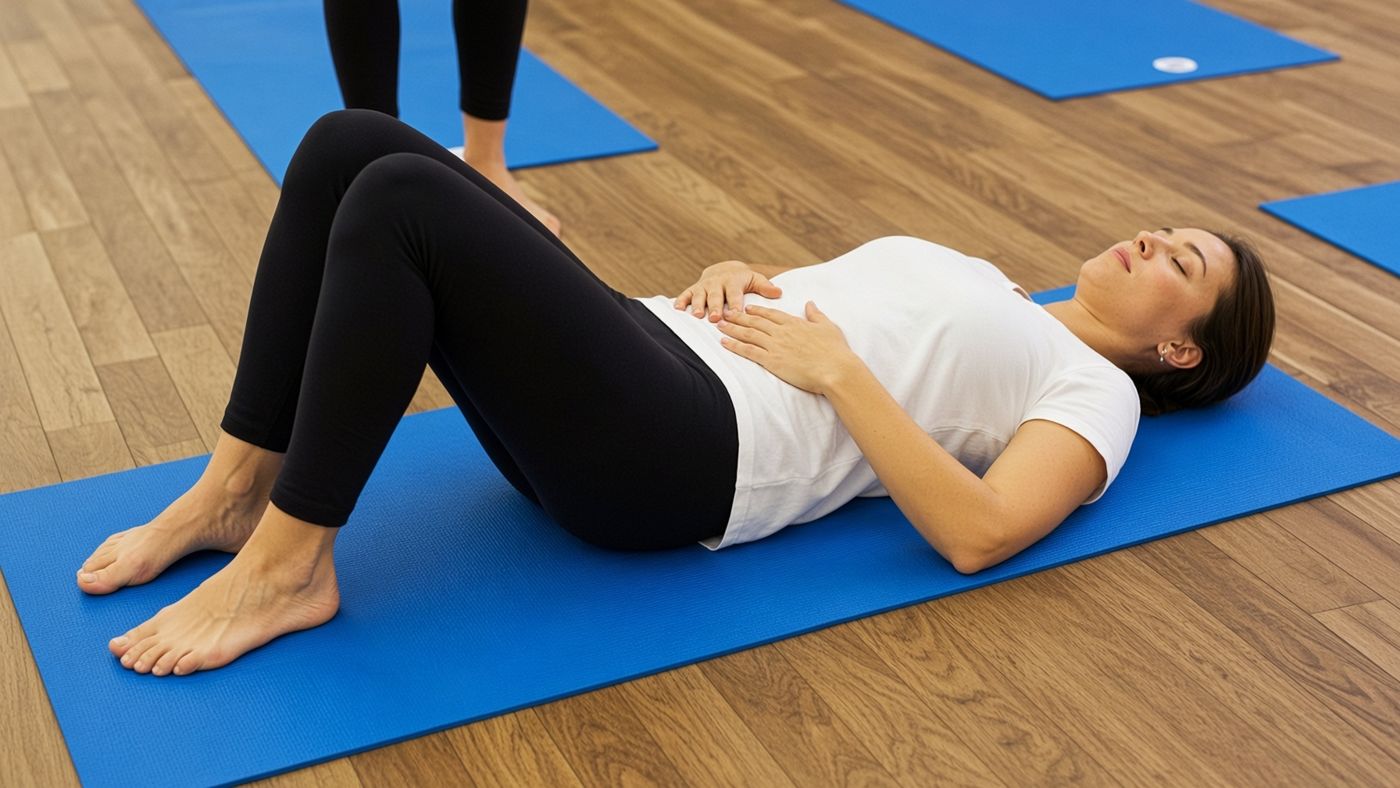
- High blood pressure in pregnancy is a medical condition, not a lifestyle problem. Your midwife or doctor leads the care: checks, tests and, when needed, medicine.
- Pre-eclampsia can become serious quickly. A severe headache, blurred vision or flashing lights, pain below the ribs or sudden swelling all need urgent help.
- Gentle movement, slow breathing and resting on your side may help you feel calmer. They do not treat high blood pressure, and the research on them in pregnancy is still thin.
Three different conditions
Blood pressure is written as two numbers: the pressure in the arteries when the heart beats, and the pressure between beats. In pregnancy, a reading of 140/90 or higher, confirmed on more than one check, counts as high. Doctors then sort it into three groups:1
- Chronic hypertension was there before pregnancy, or is found before week 20.
- Gestational hypertension appears for the first time after week 20, in someone whose blood pressure was normal before, without signs that other organs are affected.
- Pre-eclampsia is high blood pressure after week 20 together with signs that other parts of the body are under strain, most often protein in the urine, but also changes in the liver, kidneys, blood or brain. Readings of 160/110 or higher are in the severe range.
Hypertensive disorders affect roughly 2 to 8 in every 100 pregnancies worldwide.1 Pre-eclampsia is more likely in a first pregnancy, at age 40 or over, with twins or more, after pre-eclampsia in an earlier pregnancy, with a close relative who had it, with a BMI of 35 or more, and with diabetes, kidney disease, an autoimmune condition or high blood pressure before pregnancy.2 If you are at higher risk, your midwife or doctor may prescribe a low daily dose of aspirin from week 12. Do not start it on your own.2
The cause of pre-eclampsia is still not fully understood. The placenta plays a central part, which is why the condition usually settles after the baby is born. It can, though, also start in the days or weeks after birth, so the warning signs below still matter then.2 Women who have had pre-eclampsia carry a higher risk of heart disease and high blood pressure later in life,1 so ask for a blood pressure check in the months after birth and keep it up over the years.
What helps, and what has changed
The care itself belongs to your maternity team: regular blood pressure and urine checks, blood tests, scans of the baby's growth, medicine when the numbers call for it, and sometimes an earlier birth. Some older ideas have not held up.
Strict bed rest. For a long time, women with high blood pressure were told to rest as much as possible. A Cochrane review found too little evidence that bed rest improves outcomes, and concluded it should not be recommended routinely. Most women in the trials preferred to stay active.3 Rest when you are tired, and follow your own team's advice, which may be different if you have pre-eclampsia.
Mind and body practices. A 2020 systematic review looked at relaxation, yoga, guided imagery and music for women with high blood pressure or pre-eclampsia. Relaxation lowered blood pressure readings in two small trials, and yoga reduced stress, but overall these practices did not change whether pre-eclampsia developed, the need for medicine, or the baby's outcomes. The authors called the evidence weak and the safety picture unclear.4 So the honest promise of the practice below is comfort and calm, not lower numbers.
Herbs, supplements and diets. Please do not use herbal remedies, supplements or special diets to manage blood pressure in pregnancy unless your doctor or midwife has agreed. Some are untested in pregnancy, and none replaces medical treatment.
A calming practice
In the course's approach, a practice for raised blood pressure is slow and unhurried: long, easy breaths, no fast sequences, no strain, and plenty of rest. The aim is to settle the nervous system. Only practice if your midwife or doctor is happy for you to stay active. If you have been diagnosed with pre-eclampsia, ask before doing any exercise beyond everyday walking and light stretching.
Throughout: no inversions, no breath holding, no forceful breathing such as kapalabhati, and keep your head level with or above your heart. Avoid lying flat on your back for long, especially later in pregnancy. Stop if you feel dizzy, breathless or unwell.
- Arrive. Sit comfortably on a cushion or a chair, back long and supported. Close your eyes. Let the jaw soften and the tongue rest heavy in the mouth. Breathe through the nose and let the breath find its own rhythm.
- Soft ocean breath. Narrow the back of the throat very slightly, so the breath makes a quiet whispering sound, like a sleeping baby. Only you need to hear it. Keep it effortless. If it makes you light-headed or tense, go back to plain, easy breathing.
- Lengthen the exhale. Without forcing, let each out-breath become a little longer than the in-breath. Stay here for five to ten minutes, following the sound.
- Arms and breath. Still seated, inhale and float the arms up as far as is comfortable. Exhale and lower them slowly. Five to eight rounds, at the pace of your breath.
- Cat and cow. Come onto hands and knees. Exhale and round the back gently, inhale and let the chest open forward. Small, slow movements with the breath. Avoid letting the belly sag deeply.
- Supported child's pose. Knees wide for the belly, forearms and forehead resting on a cushion or bolster so the head stays at least level with the hips. A few slow breaths.
- Grounding at the wall. Stand with the feet hip-width apart, forearms on a wall. Feel the weight spread through both feet, then draw slow circles with the pelvis. Step one foot back, heel towards the floor, for a soft calf stretch. Both sides.
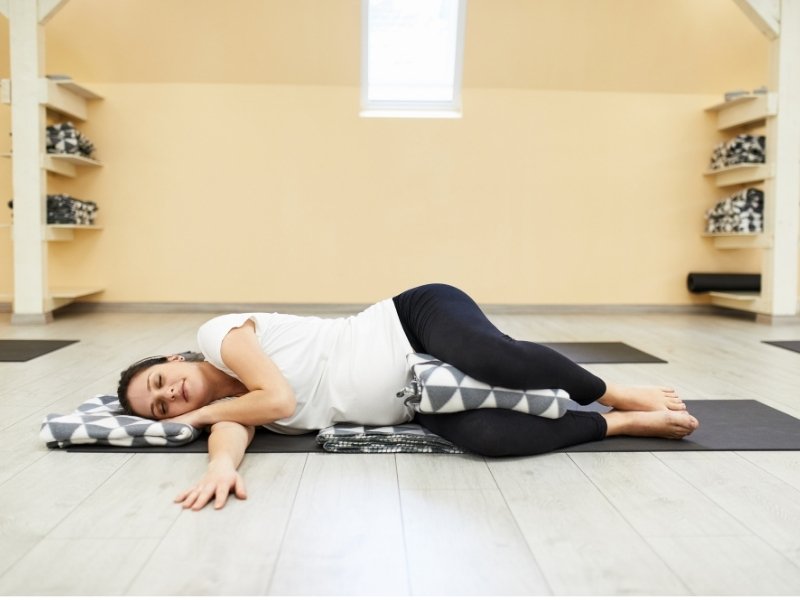
- Rest on your side. Lie down on your side, as in the photo above: a folded blanket under the head, a cushion between the knees, the lower arm resting in front. Either side is fine. Stay for five to ten minutes, letting the out-breath stay long and slow. To come up, roll a little forward and push yourself up with your arms.
Side-lying is also the safest way to fall asleep in the third trimester. After 28 weeks, going to sleep on your back has been linked to a higher risk of stillbirth, and research found no difference between the left and right side.5 If you wake on your back, simply turn onto your side.
When to see your midwife or doctor
Call your maternity unit straight away, or get emergency help, if you are pregnant or have recently given birth and have any of these:2
- a severe headache that does not ease with simple painkillers
- blurred vision, flashing lights or spots in front of the eyes
- pain just below the ribs, especially on the right
- sudden swelling of the face, hands or feet
- vomiting, heartburn that does not go away, or feeling very unwell
Also call if a home reading is 160/110 or higher, if you have a fit, chest pain or trouble breathing, or if your baby is moving less than usual. Do not wait for your next appointment.
The bottom line
High blood pressure in pregnancy needs medical care, and pre-eclampsia can change fast. Keep your appointments, know the warning signs, and act on them without delay. Around that care, a slow and gentle practice, long easy breaths and rest on your side can offer what they honestly can: a calmer body and mind while the medical team does its part.
Sources
- Newman C, Petruzzi V, Ramirez PT, Hobday C. Hypertensive disorders of pregnancy. Methodist DeBakey Cardiovascular Journal. 2024;20(2):4–12. Link
- NHS. Pre-eclampsia. Link
- Meher S, Abalos E, Carroli G. Bed rest with or without hospitalisation for hypertension during pregnancy. Cochrane Database of Systematic Reviews. 2005;(4):CD003514. Link
- Smith CA, Tuson A, Thornton C, Dahlen HG. The safety and effectiveness of mind body interventions for women with pregnancy induced hypertension and or preeclampsia: a systematic review and meta-analysis. Complementary Therapies in Medicine. 2020;52:102469. Link
- NHS. Reducing the risk of stillbirth. Link
Based on works from a 2022 pregnancy yoga teacher course, reviewed and updated. General information, not medical advice. Medical review: pending.