- Nausea and vomiting are very common in early pregnancy, can come at any time of day, and usually settle by weeks 16 to 20. They do not harm the baby.
- Small, frequent, plain meals, regular sips of fluid and rest help many women. Ginger, wrist acupressure and vitamin B6 have some limited evidence behind them.
- If you cannot keep fluids down, feel faint, or see very dark urine, call your midwife or doctor. Severe sickness is a medical condition and has effective treatment.
What is going on
Pregnancy sickness affects most pregnant women. It usually begins between weeks 4 and 7, and for about nine in ten women it has settled by week 20.2 Despite the name "morning sickness", it can arrive at any hour, day or night.1
The exact cause is not fully understood. The hormonal changes of the first weeks are thought to play a large part.1 Tiredness, strong smells, an empty stomach and stress can all make it worse, which is why so much of what helps is about rhythm and rest rather than any single remedy.
For a small number of women, about 3 in 100, the sickness becomes severe and persistent. This is called hyperemesis gravidarum. It can lead to dehydration and weight loss, and it needs medical treatment, sometimes in hospital.12 It is not a sign of weakness, and it is not something to push through alone.
Everyday things that help
- Eat little and often. Small, plain, starchy, low-fat foods such as bread, rice, pasta, potatoes or crackers are often easiest.12 An empty stomach tends to make nausea worse, so many women keep a few plain biscuits by the bed and eat one before getting up.
- Sip, don't gulp. Small, regular sips of water or other drinks through the day may help prevent vomiting.1
- Notice your triggers. Strong smells, cooking odours, stuffy rooms and heat set off nausea for many women. Cold food smells less than hot food, and fresh air often helps.12
- Rest. Tiredness makes nausea worse.1 Lying down or sitting propped up, rather than flat, is often more comfortable.
Ginger, acupressure and vitamin B6 Evidence: limited
A Cochrane review of 41 trials found no high-quality evidence for any single remedy, while noting that this is not the same as showing they do not work.3 Within that uncertainty:
- Ginger may ease symptoms for some women.14 Ginger in food or tea is a gentle place to start. Check with a pharmacist or doctor before taking ginger supplements.1
- Wrist acupressure, with a band or your own fingers on the inner wrist, may help, though the trials are small and mixed.14
- Vitamin B6 may reduce nausea more than a placebo.4 Ask your doctor or midwife about the right dose rather than choosing one yourself.
If these are not enough, a doctor can prescribe anti-sickness medicine that is considered safe in pregnancy.1 Asking for it early is sensible, not a failure.
A gentle practice for queasy days
The course this article comes from saw nausea as a whole-body experience, and used slow movement, breath and rest to give the body more room and the mind a little more calm. This is the course's approach rather than a proven treatment, but it is gentle enough for most women with an uncomplicated pregnancy, and many find it a comfort. Have something small to eat beforehand, open a window, and keep it short. Stop at once if you feel dizzy or worse.
- Seated arch and round. Sit with your feet wide and flat on the floor, on a cushion or the front of a chair. Hands on your thighs. Inhale and gently open the chest, lifting the breastbone. Exhale and round the upper back. A few slow rounds. Keep the movement in the chest, not the belly.
- Side opening. Sit with both legs folded to the left. Place your right hand on the floor beside you and, as you inhale, sweep your left arm up and over towards the right. Exhale to lower it. Switch sides. Space along the ribs often makes the breath easier.
- Tall sitting and easy breath. Sit supported, on a cushion or a chair with a pillow behind your back. Let the shoulders drop and the chest widen. One hand on the chest, one on the belly. Breathe out slowly and let the next breath arrive on its own. Keep it soft: if you feel light-headed or dizzy, the breath is too deep, so return to normal breathing.
- Cooling breath. Curl your tongue like a straw and breathe in slowly through it, then close your mouth and breathe out through the nose. If you cannot curl your tongue, breathe in gently through lightly closed teeth. Three rounds, then normal breathing. Many women find the cool air pleasant when they feel hot and queasy.
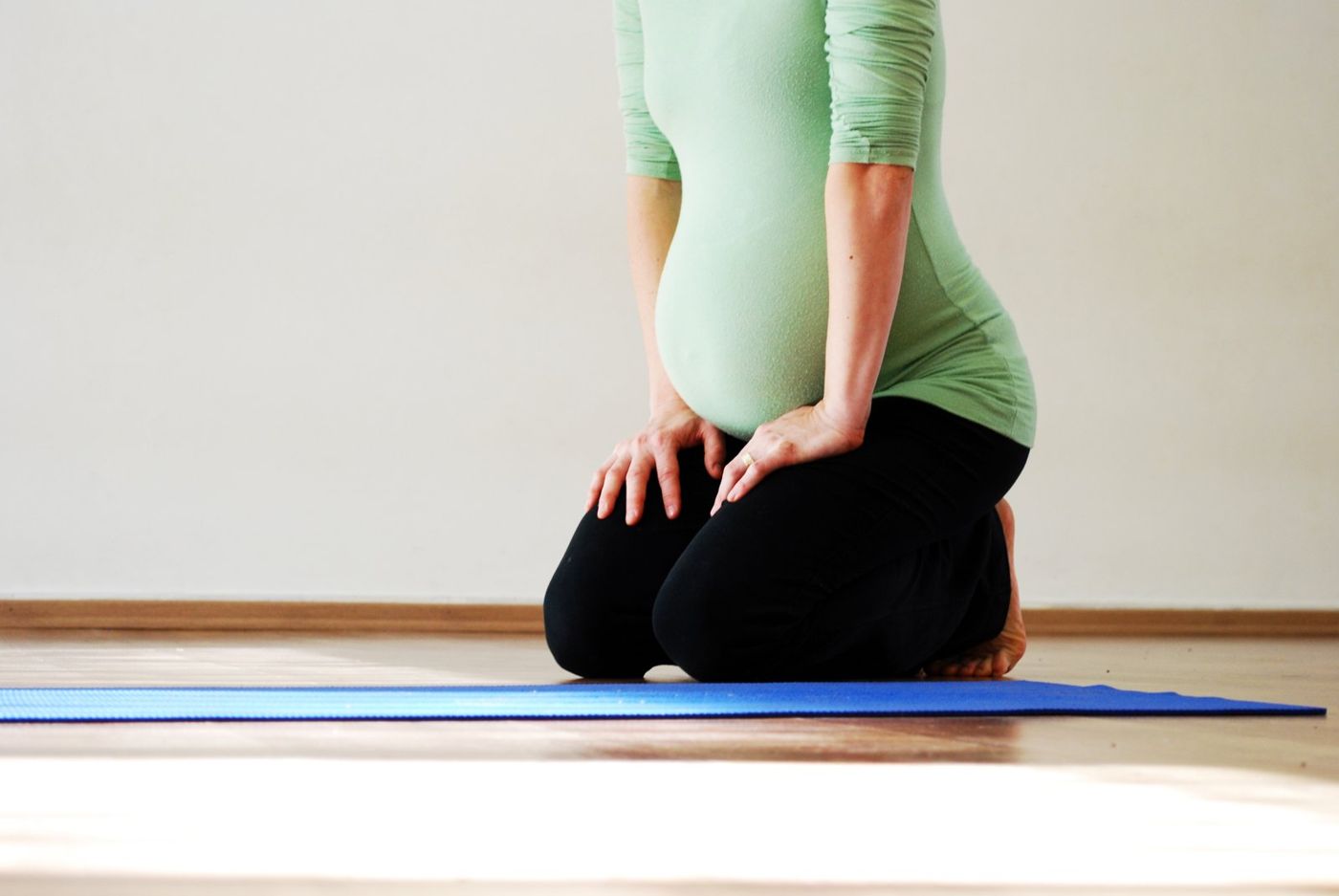
- Kneeling with a gentle twist. Kneel and sit back on your heels, with your hands resting on your thighs, as in the photo above. Put a cushion between your heels or under your knees if that is more comfortable, and widen the knees to give the belly space. Inhale to sit tall. Exhale and turn gently to the left, right hand on the left knee, left hand behind you. Turn from the upper back and chest, never by squeezing the belly. Three breaths, back to centre, then the other side.
- Propped rest. Lie back over a firm cushion or bolster so your head and chest are raised, never flat. Knees bent, feet on the floor, arms wide or resting on the body. Gentle pelvic tilts with the breath are fine here. Stay a few minutes, or simply rest. Later in pregnancy, rest on your side instead.
- Coming up. Move fingers and toes, hug your knees gently, roll onto your side and push up slowly with your arms. Sit for a moment before you stand. Getting up too fast can bring on a new wave of nausea.
The course ended this sequence with a moment of gratitude for a body that can move and breathe for two. If that feels right, take a breath for it before you get up.
When to see your midwife or doctor
Contact your midwife or doctor the same day if you are being sick and you have very dark urine or have not passed urine for more than 8 hours, cannot keep food or fluids down for 24 hours, feel very weak, dizzy or faint when standing up, have tummy pain, have a high temperature, vomit blood, or are losing weight.1 Also seek advice if sickness stops you getting through the day, if you have pain when passing urine, or if vomiting starts for the first time after week 16, as these can point to another cause.2
The bottom line
Pregnancy sickness is common, usually passes by mid-pregnancy, and is not a danger to your baby in itself. Food, fluids and rest come first, and medical help is there when they are not enough. Gentle movement and a softer breath will not cure it, but on many days they can make the hours easier to live with.
Sources
- NHS. Vomiting and morning sickness in pregnancy. Link
- Royal College of Obstetricians and Gynaecologists (RCOG). Pregnancy sickness (nausea and vomiting of pregnancy and hyperemesis gravidarum): patient information. Link
- Matthews A, Haas DM, O'Mathúna DP, Dowswell T. Interventions for nausea and vomiting in early pregnancy. Cochrane Database of Systematic Reviews. 2015;(9):CD007575. Link
- Festin M. Nausea and vomiting in early pregnancy. American Family Physician. 2015;92(6):516–517. Link
Based on works from a 2022 pregnancy yoga teacher course, reviewed and updated. General information, not medical advice. Medical review: pending.