- Feeling low, teary or anxious in the first days after birth is very common and usually passes within two weeks. Feelings that last longer, or get worse, may be postnatal depression, which is common and treatable.
- Regular, gentle-to-moderate exercise has been shown to ease mild-to-moderate postnatal depressive symptoms. Research on postnatal yoga is promising, but small.
- Movement can support recovery. It is not a replacement for treatment. Thoughts of harming yourself or your baby need urgent help.
Baby blues, depression and anxiety
The baby blues are short-lived mood changes in the first days after birth: feeling down, anxious or irritable. According to the NHS, they usually go away within two weeks of the birth.1 They don't need medical treatment, but they do deserve rest, kindness and help.
Postnatal depression is different. It can start during pregnancy, soon after birth, or up to a year later. Signs include feeling hopeless or unable to cope, feeling guilty or worthless, and difficult feelings about, or difficulty bonding with, your baby.1 Unlike the blues, it generally does not get better without treatment.6 The NHS says it usually improves in three to six months, sometimes longer, and that it is important to get help even if you have only some of the signs.1
Anxiety often travels with it: worrying all the time, feeling fearful or restless.1 Many people with perinatal depression also have an anxiety disorder.3 And it is not only mothers: fathers and partners can become depressed after a baby arrives, too.1
Rarely, a mother develops postpartum psychosis, with confusion, very high or rapidly changing moods, or seeing and believing things that are not real. It is a medical emergency.3,6
How common is it?
More common than most people expect. If this is you, you are far from alone.
The World Health Organization notes that the figure is higher in lower-income countries.2
Exercise and postnatal depression Evidence: moderate
A 2017 meta-analysis in Obstetrics & Gynecology pooled 16 randomized trials with 1,327 women, comparing exercise after birth with usual care.4 What it found:
- Across all women, exercise reduced depressive symptoms by a small amount.
- In women who already had depressive symptoms, the effect was moderate, and depression was more likely to resolve.
- The authors concluded that light-to-moderate aerobic exercise helps.
The authors are clear about the limits: the trials were small, and some had weaknesses in how they were run. Their conclusion applies to mild-to-moderate symptoms. It does not show that exercise can replace treatment for more severe depression.
What about yoga? Evidence: low
A 2024 systematic review looked for every study of yoga after birth and its effect on mental health. It found only six, with 377 women in total, and just three of them were randomized trials.5 Together they suggest fewer depressive symptoms and better well-being and quality of life after postnatal yoga.
The authors call yoga "promising", and also say more high-quality research is needed. The studies were small, the programs very different from one another, and none had complete follow-up. So yoga is a reasonable, gentle way to move, with encouraging early signs, rather than a proven treatment.
Breath and relaxation: honest about the evidence
Slow breathing and rest practices are part of most yoga classes, and many women find them calming. But in the 2024 review, only one of the six studies even described breathing as part of its program.5 We could not find good trials that test breathing on its own for postnatal depression. Use it because it feels settling, not because it has been proven to treat low mood.
Sleep and support
Sleep and help with practical things are not luxuries. The NHS suggests getting as much sleep and rest as you can, asking for help with everyday tasks, getting regular exercise, even if it's just a short daily walk, and talking about your feelings with someone you trust.1 If someone offers to hold the baby so you can nap, say yes.
A gentle 5-minute practice, baby nearby
For a quiet moment, with your baby safely on a mat or in a cot beside you. Only if your caregiver has said gentle movement is fine, and stop anything that hurts.
- Arrive (1 minute). Sit on the floor or a chair, feet grounded. Rest a hand on your chest or belly. Notice three things you can see and three you can hear, including your baby.
- Longer out-breath (1 minute). Breathe in through the nose. Breathe out slowly, a little longer than the in-breath, as if fogging a window. No counting needed.
- Shoulder and neck release (1 minute). Roll the shoulders slowly back a few times. Let one ear drop toward a shoulder, then the other. Feeding and carrying gather tension here.
- Gentle cat and cow (1 minute). On hands and knees beside your baby, round the back softly on the out-breath, let it lengthen on the in-breath. Keep it small and comfortable.
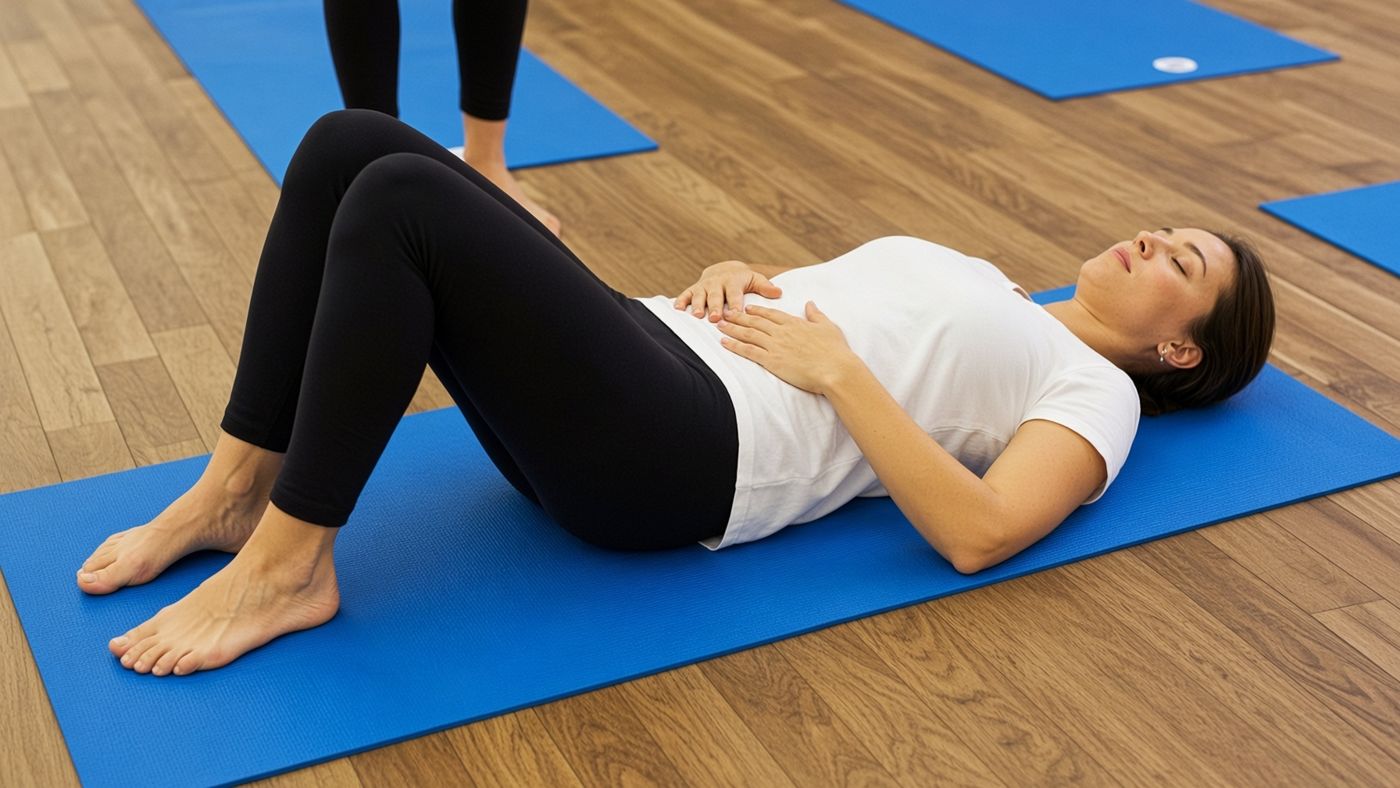
- Rest (1 minute). Lie on your side or back, one hand where you can feel your breath. If thoughts come, that's fine. Before you get up, roll onto your side first.
On harder days, a five-minute walk outside with the pram counts just as much.
When to get help
Movement is not a replacement for treatment. Postnatal depression is treated with talking therapies such as CBT, medicine, or both.6 Talk to your doctor, midwife or health visitor if low mood, worry or numbness lasts beyond the first two weeks, if you feel you can't cope, or if you are struggling to bond with your baby, even if you only have some of the signs.1
Get urgent help now, by calling your local emergency number or going to the nearest emergency department, if you have thoughts of harming yourself or your baby, thoughts of suicide, or if you or someone close to you notices signs of psychosis, such as confusion, hearing or seeing things that are not there, or very sudden changes in mood.1,6 Asking for help is not a failure. It is how recovery starts.
The bottom line
Low days after birth are common, and so is postnatal depression. Neither says anything about how good a mother you are. Regular, gentle movement has real evidence behind it for easing mild-to-moderate symptoms, and postnatal yoga looks promising. Treat them as part of the support around you, alongside rest, people who help, and professional care when you need it.
Sources
- NHS. Postnatal depression. NHS website (nhs.uk). Accessed November 2026. Link
- World Health Organization. Maternal mental health. WHO, Mental Health and Substance Use. Accessed November 2026. Link
- American Psychiatric Association. What is postpartum depression? psychiatry.org. Accessed November 2026. Link
- McCurdy AP, Boulé NG, Sivak A, Davenport MH. Effects of exercise on mild-to-moderate depressive symptoms in the postpartum period: a meta-analysis. Obstetrics & Gynecology. 2017;129(6):1087–1097. Link
- Munns L, Spark N, Crossland A, Preston C. The effects of yoga-based interventions on postnatal mental health and well-being: a systematic review. Heliyon. 2024;10(3):e25455. Link
- National Institute of Mental Health. Perinatal depression. nimh.nih.gov. Accessed November 2026. Link
This article is general information, not medical advice. Medical review: pending.