- Prolapse means one or more pelvic organs have moved down and bulge into the vagina. It is not life threatening, and mild prolapse often causes no symptoms at all.
- Signs of prolapse on examination are far more common than symptoms. Many women with a mild prolapse never notice it.
- Pelvic floor muscle training, guided by a physiotherapist, has the best evidence for easing symptoms. Pessaries and surgery are options when more help is needed.
What it is
The bladder, womb and bowel are held in place by the pelvic floor, a sling of muscles and ligaments at the base of the pelvis. When that support weakens, one or more organs can sag and bulge into the vagina.1 This is called pelvic organ prolapse. Doctors grade it from 1 to 4, from mild to most severe.2
The Royal College of Obstetricians and Gynaecologists describes the main types in plain terms:2
- Front wall: the bladder bulges into the front of the vagina.
- Back wall: the rectum, or sometimes the small bowel, bulges into the back of the vagina.
- Womb: the uterus drops down into the vagina.
- Vault: after a hysterectomy, the top of the vagina drops down.
More than one type can happen at the same time. Prolapse is something many women live with, not an emergency.
How common is it?
It depends very much on how you look for it. A review of the research found that when prolapse is defined by symptoms, it affects about 3 to 6% of women. When it is defined by a vaginal examination, it is found in up to half.3
The last figure comes from the RCOG.2 The gap between these numbers matters. Some descent of the pelvic organs on examination is common and often causes no trouble. Treatment is about how you feel, not only about what an examination shows.
Why it happens
Usually there is no single cause, but a combination.2 The NHS and RCOG list these risk factors:1,2
- Pregnancy and childbirth.
- Getting older, especially after menopause.
- Being overweight.
- Long-term constipation and straining, a long-lasting cough, or heavy lifting.
- Some conditions that affect connective tissue, such as joint hypermobility.
Vaginal birth stands out. A Swedish study of more than 5,000 women who had given birth once found symptoms of prolapse 20 years later in 14.6% of those who had a vaginal birth, compared with 6.3% of those who had a caesarean.4 A larger baby and a higher body weight today also added to the risk. This is not a reason for guilt: it is simply useful to know where the strain came from.
What it can feel like
Some women feel nothing at all. Others notice:1,2
- A feeling of heaviness or dragging in the vagina or lower belly, often worse after standing for a long time.
- A bulge you can feel or see in or at the opening of the vagina.
- Bladder changes: needing to go often, not emptying fully, or small leaks when you cough or lift.
- Bowel changes, such as constipation or a feeling of not emptying.
- Discomfort or less sensation during sex.
Pelvic floor training Evidence: low to moderate
This is the best-studied option, and it is usually the first step. If you are new to the pelvic floor itself, our guide to pelvic floor training explains how the muscles work.
A Cochrane review pooled six trials. In the trials that measured symptoms, women who did pelvic floor training improved more than those who did not, and in two pooled trials they had a 17% greater chance of their prolapse improving by a stage. The authors called this "some evidence" of benefit and noted that several trials were small.5
The largest trial since then, POPPY, included 447 women with newly diagnosed prolapse in the UK, New Zealand and Australia. Women who had one-to-one training with a physiotherapist reported fewer prolapse symptoms after a year than women who received a lifestyle advice leaflet.6 The difference was real but modest, and only two thirds of women returned the 12-month questionnaire.
The RCOG notes that a course usually takes 3 to 6 months, and that exercises may ease symptoms but are unlikely to make the prolapse disappear.2
Pessaries and surgery
A pessary is a soft silicone or plastic device placed in the vagina to support the organs. Ring pessaries are the most common, and they are cleaned and changed every few months.2 After menopause, a vaginal estrogen cream, tablet or ring may ease discomfort.1
Surgery to lift and support the organs is an option for more severe prolapse.1 It does not always last: the RCOG says about 25 to 30 in 100 women who have prolapse surgery will develop another prolapse later.2 Vaginal mesh surgery is generally no longer offered on the NHS unless there is no alternative.1
Everyday habits Evidence: limited
The NHS and RCOG recommend keeping a healthy weight, preventing constipation, treating a long-standing cough, stopping smoking, and avoiding heavy lifting and high-impact activities such as running or trampolining.1,2 This advice is sensible, but be aware that the Cochrane review found no trials testing lifestyle changes as a treatment for prolapse.5
What it means for yoga
There are no trials of yoga for prolapse, so what follows is careful reasoning rather than proven rules.
- Keep breathing. Straining puts pressure on the pelvic floor, which is why the guidance focuses on constipation, coughing and heavy lifting. Holding your breath and bearing down during a hard pose works the same way. Breathe out on the effort.
- Notice heaviness. If a pose, long standing or a deep squat brings on a dragging feeling, make it shorter, lighter or supported.
- Inversions. We found no reliable research on inversions and prolapse, either for or against. If you enjoy a gentle supported pose with the hips raised, and it feels comfortable, there is no evidence that it harms or helps. Read more in our article on gravity and the pelvis.
A gentle practice
Not a treatment. A calm way to connect with the pelvic floor, alongside any plan from your physiotherapist.
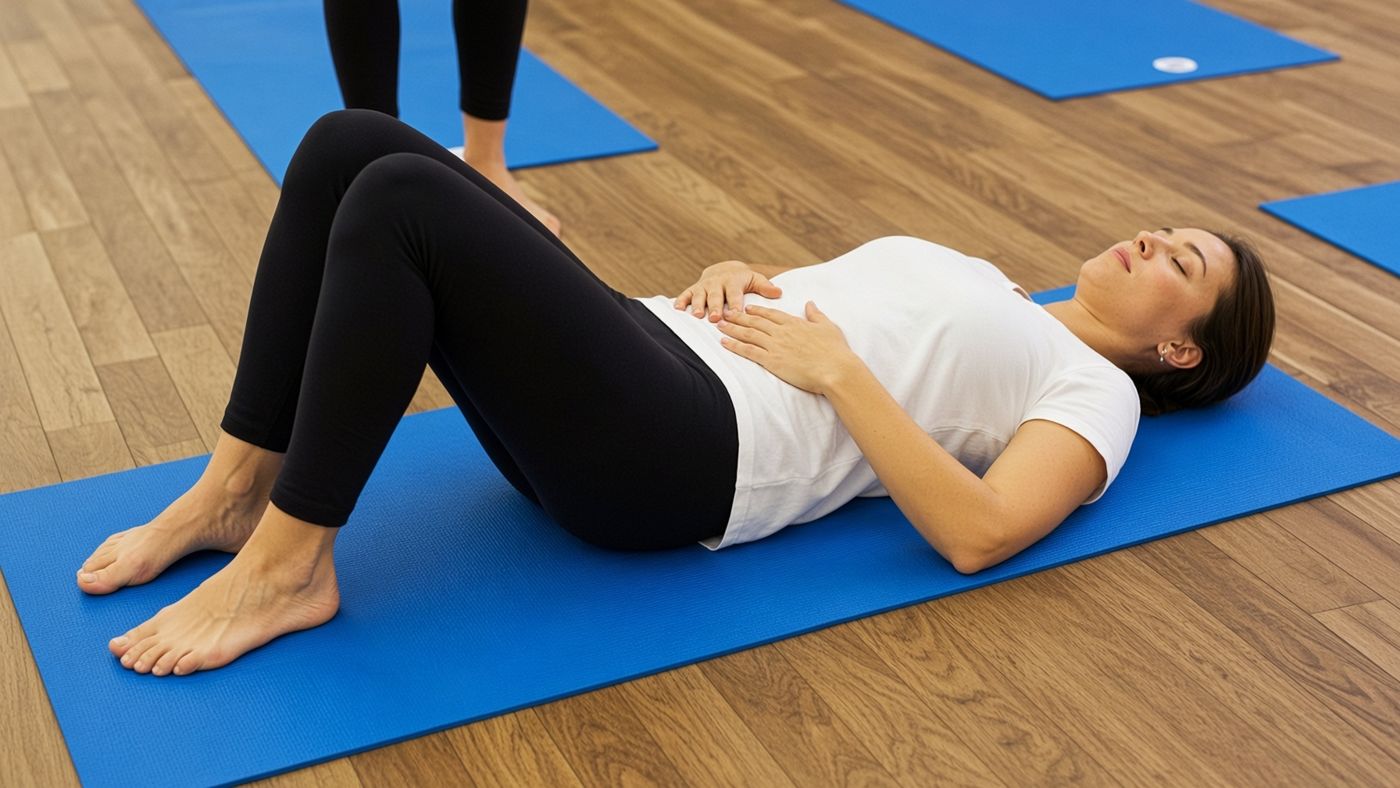
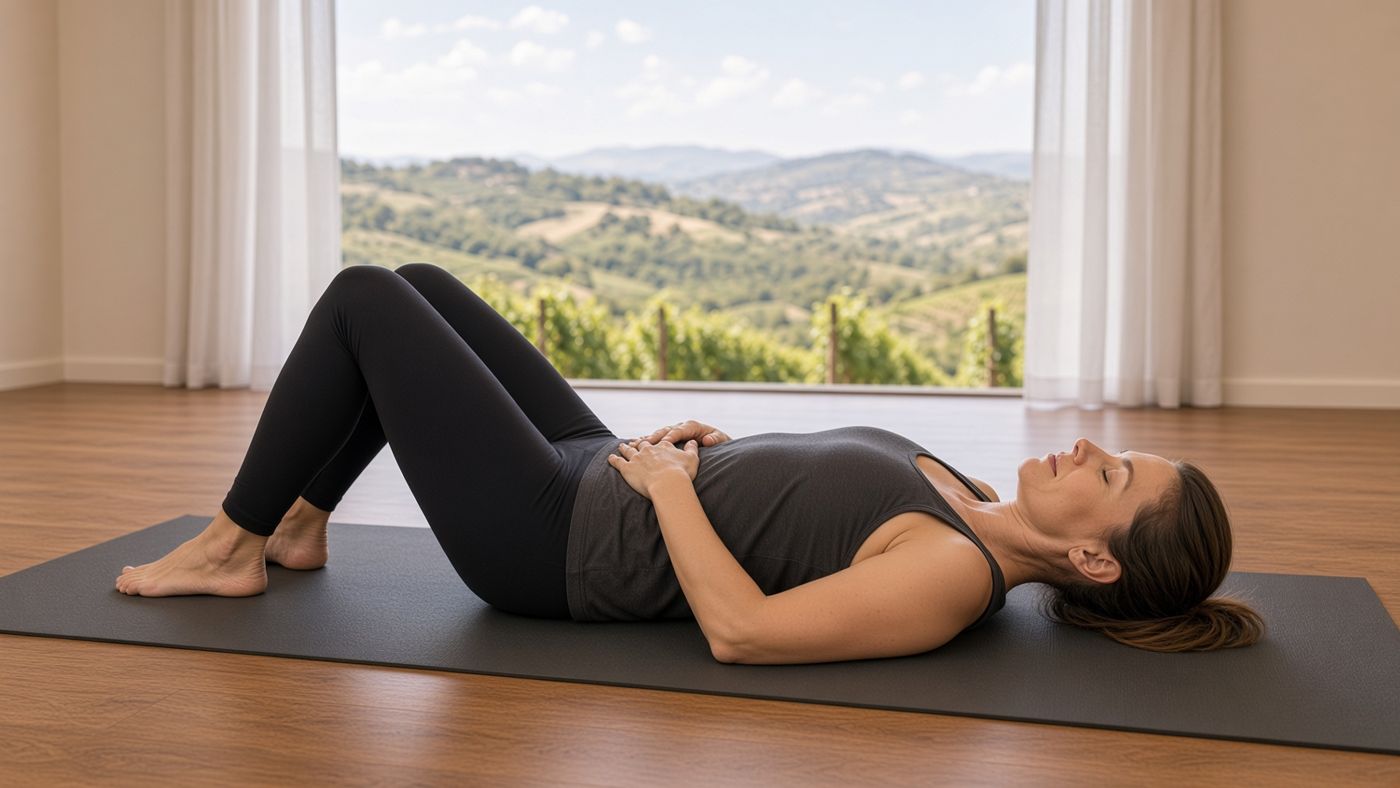
- Settle lying down. Lie on your back with knees bent and feet on the floor, or with your legs resting on a chair. Let the belly soften.
- Breathe wide. Inhale into the sides of the ribs and let the pelvic floor relax. On a long exhale, gently lift the pelvic floor, as if stopping wind. Rest fully between breaths.
- Lift on the effort. Practise lifting the pelvic floor just before you cough, sneeze, stand up or pick something up. Never hold the breath.
- Supported bridge. On an exhale, lift the pelvic floor and raise the hips a little. Inhale to lower. Five slow times, only if comfortable.
- Rest. End lying down for a few breaths. If you felt heaviness, notice when it came and use that as a guide next time.
When to see a professional
See your doctor if you feel or see a lump in or around the vagina, or have any of the symptoms above. It is not urgent, but it is worth checking.1 Ask for a referral to a pelvic health physiotherapist, who can check your pelvic floor and tailor exercises to you.
The bottom line
Prolapse is common, especially after vaginal birth and with age, and mild prolapse often causes no symptoms. When it does, guided pelvic floor training is the best-supported first step, with pessaries and surgery available if needed. A calm practice that avoids breath-holding and straining fits well alongside professional care.
Sources
- NHS. Pelvic organ prolapse. NHS website. Link
- Royal College of Obstetricians and Gynaecologists. Pelvic organ prolapse: patient information. Updated May 2022. Link
- Barber MD, Maher C. Epidemiology and outcome assessment of pelvic organ prolapse. International Urogynecology Journal. 2013;24(11):1783–1790. Link
- Gyhagen M, Bullarbo M, Nielsen TF, Milsom I. Prevalence and risk factors for pelvic organ prolapse 20 years after childbirth: a national cohort study in singleton primiparae after vaginal or caesarean delivery. BJOG. 2013;120(2):152–160. Link
- Hagen S, Stark D. Conservative prevention and management of pelvic organ prolapse in women. Cochrane Database of Systematic Reviews. 2011;(12):CD003882. Link
- Hagen S, Stark D, Glazener C, et al. Individualised pelvic floor muscle training in women with pelvic organ prolapse (POPPY): a multicentre randomised controlled trial. The Lancet. 2014;383(9919):796–806. Link
This article is general information, not medical advice. Medical review: pending.